
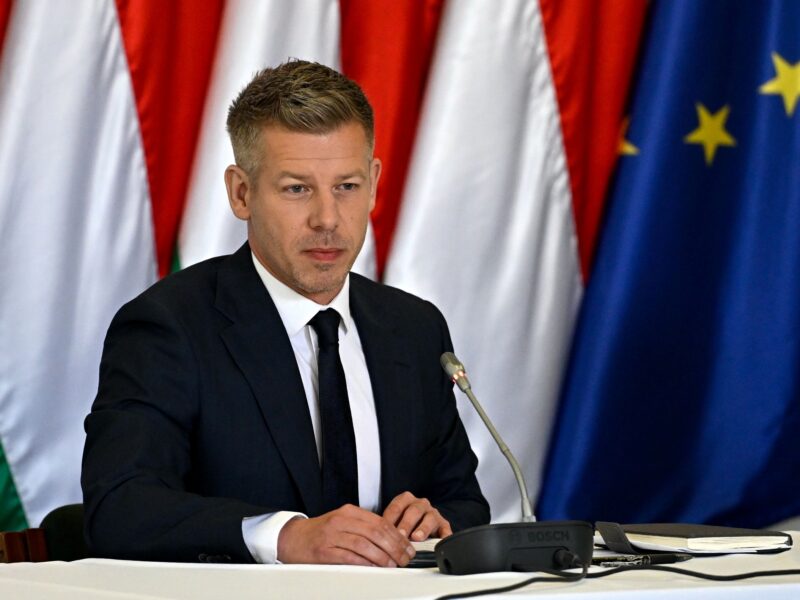
(CN) — The blue European Union flag flies once again in front of the Hungarian parliament. Public confidence is soaring. And Péter Magyar, Hungary’s brash new 45-year-old prime minister, is reveling in his role as the slayer of the Viktor Orbán regime.
It’s been five days since Magyar was sworn in as the new boss in Budapest and since then Hungary has witnessed political drama unfold as Magyar’s Tisza party takes the reins of power and, in their view, flushes out the corruption of the Orbán regime.
On April 12, Magyar, a former Orbán ally turned whistleblower, rocked European politics when his upstart Tisza party routed Orbán’s Fidesz party in national elections, ending a strongman’s 16-year reign as Europe’s far-right champion.
With a supermajority in parliament, Tisza has the power to carry out sweeping constitutional changes and undo years’ worth of controversial policies and laws passed by Orbán. Opinion polls, meanwhile, show the mood is buoyant in Hungary with a key survey of consumer confidence jumping by 16 points since Magyar’s win, the biggest increase ever recorded.
Thursday marked a symbolic day as Magyar’s cabinet took possession of their respective ministry buildings and Magyar entered his future prime minister’s office, a building that served as the transportation ministry under Orbán.
In a sign of Tisza’s pro-EU stance, EU flags have been restored on the National Assembly. Orbán, an ultranationalist who loathed the Brussels bureaucracy, removed the EU flag in 2012.
Orbán and his team, meanwhile, have stayed mostly out of sight. Hungarian media reported seeing Orbán ministers enter ministry buildings through back doors shortly before the government handover Thursday.
On Monday, Magyar posted a video where he took camera crews for a tour of Orbán’s official Buda Castle residence and through an adjacent newly constructed government building to depict the Orbán government as living lavishly on public money.
In the video, Magyar said Orbán had adorned his opulent residence with almost 100 valuable paintings from the Hungarian National Gallery. He likened what he saw to the decadence and corruption of Romania’s communist-era dictator Nicolae Ceaușescu — though the comparison seemed a bit far-fetched given that Ceaușescu built himself a palace with about 1,100 rooms.
“Let’s check out the cigar room,” Magyar told the cameras sarcastically, walking into a room arranged with armchairs next to a luxury restaurant inside the new government building. “Everyone needs a good cigar room, especially if it’s [paid for] with public money.”
Sitting down in an armchair, Magyar told his audience to imagine he was one of Orbán’s top cronies, sipping whisky or rum. His video captured about eight million views in a single day.
To differentiate himself from Orbán and appear modest, Magyar said he would not move into a government residence but remain at his family home in Buda. He also said he would forgo the armored BMW limousine Orbán used and instead use a more modest Škoda Superb, a large executive car.
Magyar’s takeover and his fierce statements about going after Orbán-era corruption, shutting down Fidesz-run government media and kicking Orbán allies out of official positions is sending shockwaves through the Fidesz camp.
In late April, Magyar accused Orbán allies of moving vast sums of ill-gotten money out of the EU to shield it from prosecution.
“Orbán-linked oligarchs are transferring tens of billions of forints to the United Arab Emirates, the United States, Uruguay and other distant countries,” Magyar said.
He later said tax authorities had stopped the transfer of millions of dollars out of Hungary linked to Antal Rogán, a Fidesz deputy parliamentary leader before Magyar’s election win.
Magyar also warned that Orbán regime insiders might try to flee the country to avoid prosecution.
There’s been a lot of speculation about this, but so far no major figures have left Hungary. The Guardian newspaper, citing anonymous sources, reported Orbán is considering a move to the United States. His eldest daughter moved to New York last year.
At least one influential person, though, has fled Magyar’s reach: Zbigniew Ziobro, a former Polish justice minister given shelter in Hungary by Orbán after his far-right party lost power in Poland.
Ziobro recently left Hungary for the United States after U.S. President Donald Trump reportedly granted him a visa. Magyar had threatened to extradite Ziobro to Poland, where he faces charges of misusing public funds and deploying spyware against political opponents. Ziobro accuses Polish Prime Minister Donald Tusk of being behind the charges, which he says are political.
Magyar’s anti-corruption campaign is starting to heat up.
Since April 12, Fidesz-linked individuals have come under greater police scrutiny, Hungarian media report. In one case, prosecutors arrested two individuals tied to Orbán’s younger brother, Áron Orbán.
Separately, police arrested the Fidesz-affiliated mayor of Halásztelek, a town outside Budapest, on suspicion he obtained a bogus parliamentary job for his 70-year-old mother. Policeaccuse the mayor, Barnabás Nagy, and a former Fidesz parliamentarian, Zoltán Bóna, of receiving a portion of her salary.
Also, a Fidesz regional politician, Rádi Feríz, was recently arrested on charges of budget fraud, Hungarian media reported.
Unease is growing among Orbán’s closest — and most powerful — allies too.
In a tearful interview with the independent news site Kontroll, media mogul Gyula Balásy declared that he had signed a notarized document turning his media empire over to the state. Balásy won lucrative contracts under Orbán.
After his announcement, Hungarian police launched criminal investigations into his companies for suspected misappropriation of funds and money laundering.
In his interview, Balásy claimed he “had nothing to hide” and that he wanted to ensure the future of his companies and their roughly 500 employees under the new government.
Courthouse News reporter Cain Burdeau is based in the European Union.

Our weekly newsletter Closing Arguments offers the latest about ongoing
trials, major litigation and rulings in courthouses around the U.S. and the world,
while the monthly Under the Lights dishes the legal dirt from Hollywood,
sports, Big Tech and the arts.