
University of Tokyo develops device that increases computer processing speed by 1000 times, operating without generating heat.
https://www.nikkei.com/article/DGXZQOSG132XK0T10C26A5000000/

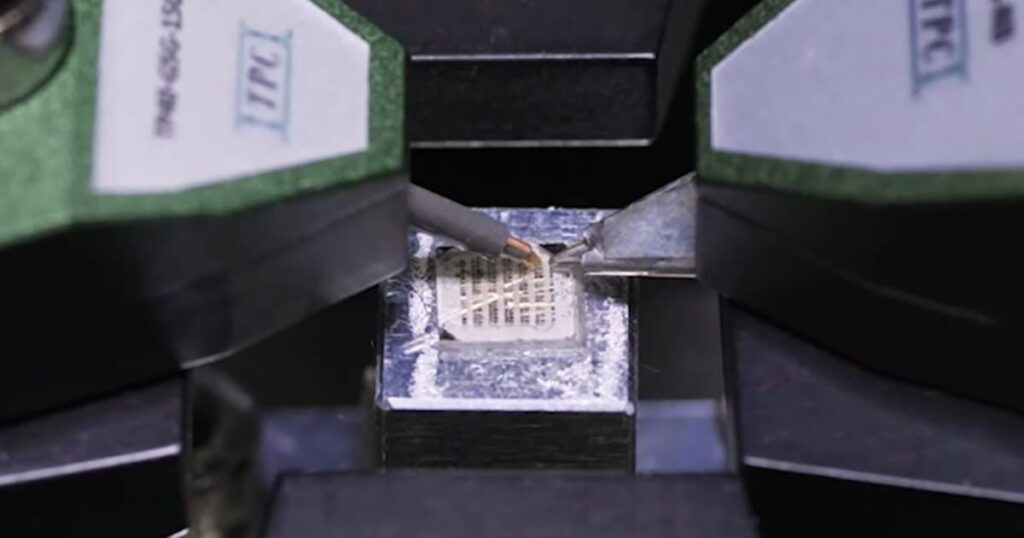
University of Tokyo develops device that increases computer processing speed by 1000 times, operating without generating heat.
https://www.nikkei.com/article/DGXZQOSG132XK0T10C26A5000000/
25 Comments
That’s not possible!
Turbo botton is back!!
What an incredibly well-written explanation of how it works!!!
A research team from the University of Tokyo and other institutions has developed a device that can increase the information processing speed of semiconductor chips used in computers and other devices by 1,000 times. This device generates less heat, leading to reduced power consumption. The team aims to develop a practical prototype chip by 2030.
Applying this technology could potentially allow data that previously took an hour to download to be processed in just one second, according to Professor Tomoaki Nakatsuji of the University of Tokyo. The research findings were published in the American scientific journal “Science.”
Computers perform calculations using bits, which represent the presence or absence of electrical current as “0” or “1”. This electrical current is controlled by tiny components called transistors. While high-speed bit control is crucial for high-speed calculations, exceeding a certain processing speed posed a challenge: the required power increases dramatically, generating heat. Existing processing technologies had reached their limits in the 2000s.
The newly developed “non-volatile quantum switching element” represents bits using the magnetic properties (spin) of electrons, rather than the flow of electricity. In experiments, it was possible to process one bit of information in 40 picoseconds (pico is one trillionth of a second), which is 1/1000th of the time of conventional methods. With existing technology, even at its fastest, it took about 1 nanosecond (nano is one billionth of a second) to record one bit of information.
The element is composed of two types of materials: tantalum and mangansin. The electrical signal passed through the tantalum is ultimately recorded in the mangansin as information about the direction of a minute magnetic force. This direction represents a bit.
The element generates little heat, and in experiments, it operated stably even after processing information more than 100 billion times. Attempting to achieve the same processing speed with existing technology would result in failure due to heat after approximately 10 million to 1 million cycles.
Because the new technology stores information magnetically, it can also be applied to non-volatile memory. Professor Nakatsuji explains, “Information can be recorded with almost no energy consumption.”
The proliferation of artificial intelligence (AI) and other technologies is increasing the amount of information processed, leading to higher electricity demand. According to the International Energy Agency (IEA), the spread of AI is expected to expand the electricity demand of data centers worldwide to 945 terawatts (a terawatt is 1 trillion watts) by 2030. This is more than double the level in 2024 and will exceed Japan’s total electricity consumption.
The research has also found that the performance of the elements tends to improve as they become smaller. If this can be put into practical use, it could potentially reduce the power consumption required for information processing to one-hundredth of what it is now, and the researchers plan to develop a prototype chip by 2030. Collaboration with companies is crucial for prototyping and manufacturing the chip, and Professor Nakatsuji is enthusiastic, saying, “We want to collaborate globally to aim for social implementation.”
The newly developed “non-volatile quantum switching element” represents bits using the magnetic properties (spin) of electrons, rather than the flow of electricity. In experiments, it was possible to process one bit of information in 40 picoseconds (pico is one trillionth of a second), which is 1/1000th of the time of conventional methods. With existing technology, even at its fastest, it took about 1 nanosecond (nano is one billionth of a second) to record one bit of information.
The element is composed of two types of materials: tantalum and mangansin. The electrical signal passed through the tantalum is ultimately recorded in the mangansin as information about the direction of a minute magnetic force. This direction represents a bit.
The element generates little heat, and in experiments, it operated stably even after processing information more than 100 billion times. Attempting to achieve the same processing speed with existing technology would result in failure due to heat after approximately 10 million to 1 million cycles.
Because the new technology stores information magnetically, it can also be applied to non-volatile memory. Professor Nakatsuji explains, “Information can be recorded with almost no energy consumption.”
Researchers from the University of Tokyo have developed a groundbreaking, heat-free optical computing technology that uses light instead of electricity to process data, potentially increasing computing speeds by up to 1,000 times. This technology employs “diffraction casting,” utilizing photons and silicon waveguides for rapid, efficient calculations, resulting in less than 1% of the energy consumption of traditional electric chips.
Because the system uses photonics rather than electrical currents, it avoids resistance, operating with virtually no heat generation.
This is the kind of advances in tech I love to see (please don’t sell to data centers only)
As with all of these breakthroughs, the 1000x increase without heat is just for the actual computation, not the massive machinery needed to make quantum computing work. And the speed up is theoretical on paper only, they have not made a product that could be scaled anywhere close to production.
Someday, this may be a thing. But we’re easily 30 years from having one at any sort of scale, if it ever happens. When it is truly ready, it will be popping up everywhere and you won’t need articles to let you know how cool it is.
It generates MUCH LESS heat, not no heat.
They’re measuring the spin of electrons on an atom via magnetism to be the bits and can detect it in 40 picoseconds. They can also read this data 100s of billions of times without overheating.
Far less heat and far less electricity to read things a couple powers faster than we currently can. This stuff is way the fuck out of my league but this reads like “remember when we switched from vacuum tubes to transistors? Yeah kind of like that level of change”.
Did they turn it upside down??
Can it run GTA 6?
Wow, can’t wait to see the benefits on the consumer sides and i can finally play Crysis worry free!
RIP Intel stock
It’s using individual electrons as the bits is the new and fancy part? But not as a “ quantum computer”
Nice! Looks like we solved the future boys!
Playstation 6??? hell yeah
Someone wrote the article in gibberish
what, a usb stick with Windows debloating software on it?
/s, i wonder if this could evolve into something (that we could use) that replaces transistors like how transistors replaced vacuum tubes
Wonder if they’ll start going missing like those US scientists
What kind of speed? Article mentions several things:
Network speed: possibility that data that took an hour to download could be processed in one second
Processing speed: process a bit of information in forty picos (one-trunths of a trillionths of a second) and a thousandth of a second in a short time
Storage speed: “We can record information without consuming almost any energy.”
Can it really be all three?
Excellent news for the Great Salt Puddle.
VTEC engaged
Finally someone is using the infinite liver of tantalium!
Nice. But it won’t scale. It is the equivalent if building a chip with a tunneling microscope by hand.
Yeah… Cool… The singularity is inevitable and it’s going to kill us all.