
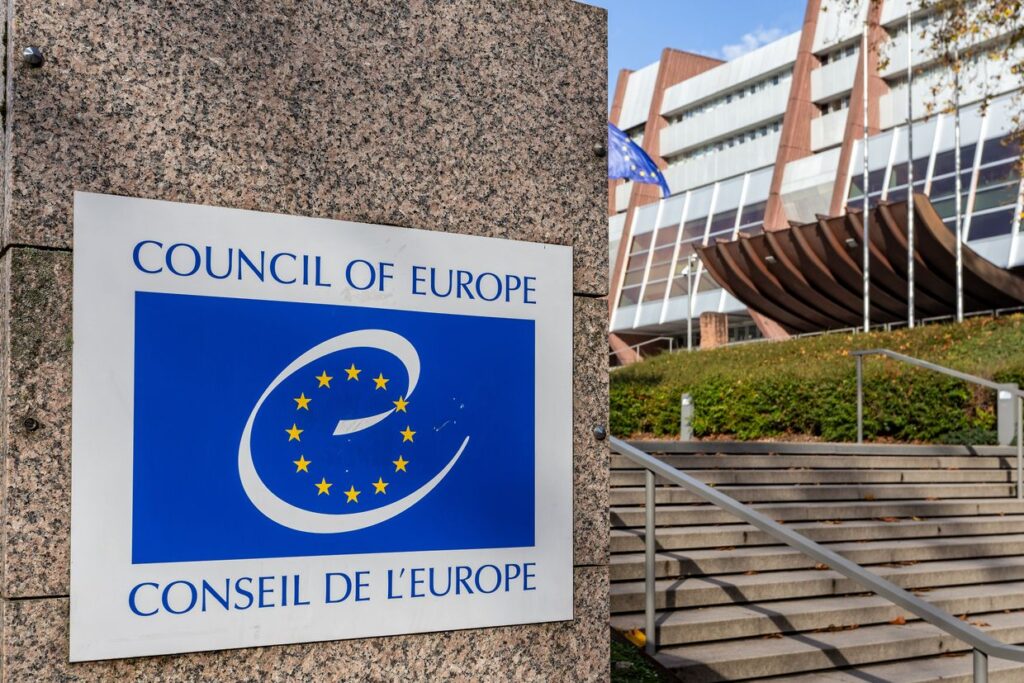
The Council of Europe’s Secretary-General gave the green light to move from collecting signatures to taking action to set up a Nuremberg-style court to try Russia’s leadership for its war of aggression against Ukraine during a summit of 46 European foreign ministers in Moldova on May 15.
36 countries and the European Union have committed to supporting the Special Tribunal, and the Netherlands has carried out preparatory work to host the court in The Hague.
“Today is a historic day … The Hague will restore justice from the ruins of war,” said Foreign Minister Andrii Sybiha.
The tribunal is needed because no court exists with the remit to try the crime of aggression, i.e., the decision to start and carry out an illegal war.
In the tribunal’s cross-hairs is Russian President Vladimir Putin, members of his inner circle, and potentially other countries. Sybiha mentioned Belarus’ leader, Alexander Lukashenko. North Korean leaders could also feature, given that they have also sent soldiers to attack Ukraine.
“Action now needs to be taken to follow up on this political commitment by securing the Tribunal’s functioning and funding,” said Alain Berset, Secretary-General of the Council of Europe.
The EU donated 10 million euros ($12 million) in January to already fund investigations and the collection of evidence, but now it will be for the signatories to decide how much each will fund the court, its composition, and when it will begin work.
The Ukrainian government expects that the special tribunal will be fully operational in 2027.
Foreign ministers also noted progress on establishing a second Council of Europe body, the International Claims Commission.
That body will award financial compensation to victims of Russia’s war against Ukraine. A so-called Register of Damage, which will guide the claims commission’s work, has already received over 150,000 claims.
However, more countries need to back the claims commission before it can begin work. So far, five countries (Estonia, Iceland, Ireland, Latvia, and Ukraine) plus the European Union have voted to ratify the convention underpinning the claims commission – 25 are required.
And once ratified, the thorny and expensive question of who will pay out compensation claims would still have to be answered.
One European diplomat suggested that Russia’s frozen assets worldwide could be used for this purpose, but even they might not be sufficient. Roughly $305 billion of Russian assets have been immobilized worldwide, just over half the $588 billion cost of reconstruction and recovery in Ukraine, estimates the World Bank.
Not to mention that Russia’s frozen assets have been proposed as a way to pay back the EU’s 90 billion euro loan ($106 billion) to Ukraine.