
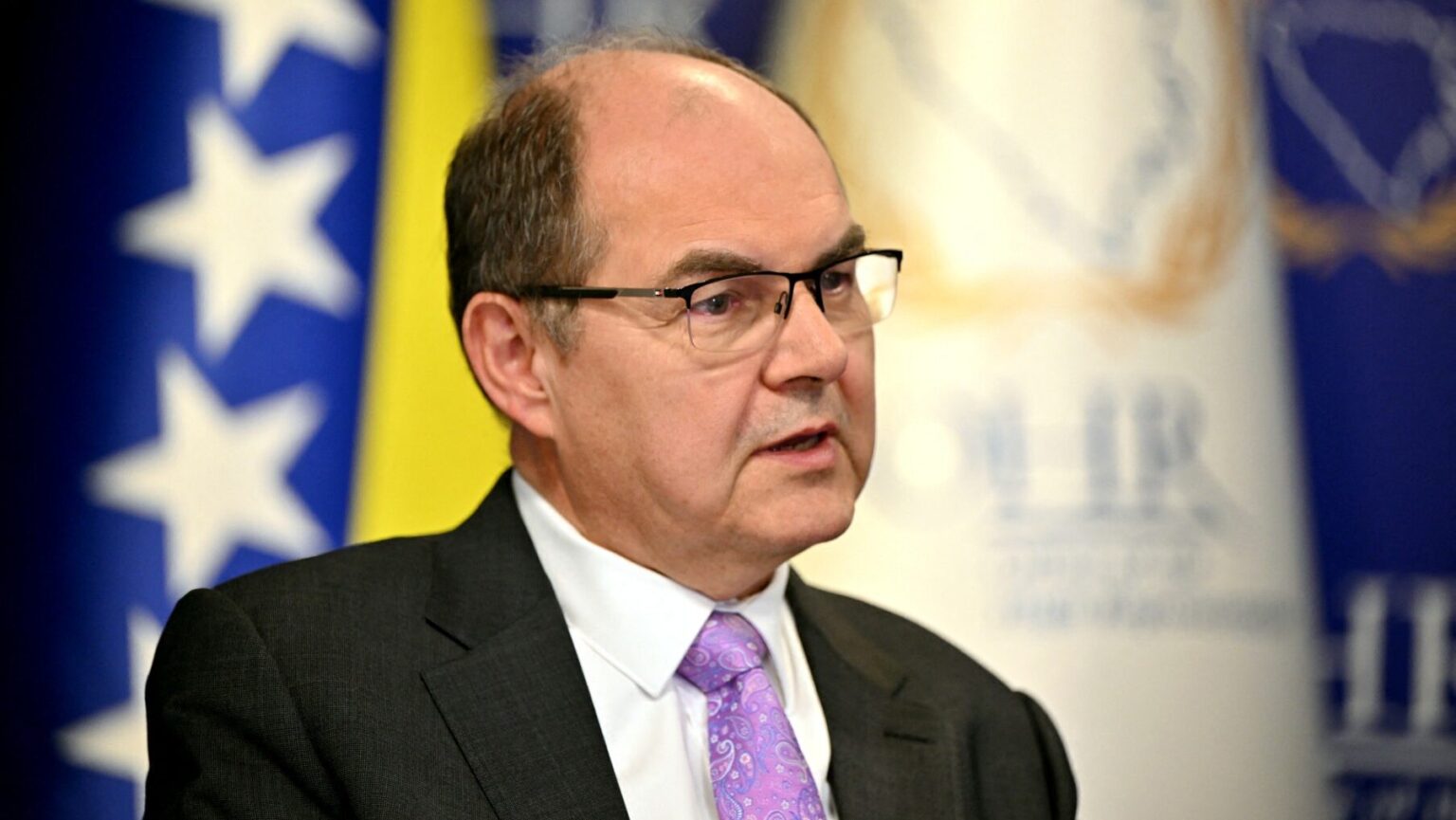
Few people in Germany will have heard of Christian Schmidt, yet everyone in Bosnia and Herzegovina knows the man who has played such a powerful role in defining their affairs. It took press reports of Schmidt’s resignation as High Representative to bring him to wider attention. But what is this man—who, as a democratically elected minister in Germany, met with only very moderate success—doing in this country? The question ought to concern us, for it touches upon fundamental issues such as democracy and national sovereignty.
The mainstream press has portrayed Schmidt’s withdrawal largely as a setback in a global power struggle. The villains are named: “Milorad Dodik, the powerful Bosnian Serb politician and Putin’s most loyal ally in Europe,” as Michael Martens in the FAZ calls him, and—how could it be otherwise?—Donald Trump. America has become a rival, taking an axe to Bosnia in the expectation that the Europeans are too weak to defend themselves, writes Martens.
That Schmidt yielded to pressure from Washington seems plausible—providing yet more proof that the post-Cold War order established over 30 years ago is swiftly falling apart. With the German establishment clinging to the post-Cold War status quo, the push for change comes from America.
For those of us who care about democracy and self-determination, however, Schmidt’s resignation has a broader meaning and should be seen—independently of global tensions—as a good thing. As Filip Gašpar of the Berliner Zeitung writes, it marks the end of a political model of domination: Bosnia and Herzegovina remains to this day the only state in Europe where a foreign official can enact laws, dismiss elected politicians, and directly intervene in domestic politics.
Schmidt, as High Representative, was tasked with enforcing the 1995 Dayton Peace Agreement. He became known for massive interventions in the country’s courts and politics from the moment he assumed office in August 2021. Like his predecessors, he was appointed by the Steering Board of the Peace Implementation Council (PIC)—an institution which includes representatives from Canada, France, Germany, Italy, Japan, Russia, the UK, the US, the EU Presidency, the European Commission, and the Organisation of the Islamic Conference (though Russia and China famously withheld their support for Schmidt). His ability to change things like the constitution falls under the so-called Bonn Powers—granted to the High Representative by the PIC.
To give an idea of the breadth of his interventions, here are two of the most prominent examples.
In 2024, he submitted, on his own initiative, an assessment in an ongoing appeals case before the European Court of Human Rights (ECHR). The case (Kovačević v. BiH) was, broadly speaking, about the extent to which elections in Bosnia are tied to ethnic affiliations. Schmidt intervened in favour of the status quo.
As one commentator explained, this system upholds a de facto ethno-national cartel of power enshrined in the country’s constitution. The constitution established strict ethnic quotas in the composition of Parliament. Those refusing any ethnic self-declaration—perhaps wishing to exercise their rights simply as constitutionally recognised “citizens”—were effectively excluded from public office.
In another case, in 2022, Schmidt imposed changes to the constitution and electoral law just hours after an election, as the votes were still being counted. Through these amendments, he increased the number of delegates in the House of People of the Federation of Bosnia and Herzegovina and altered the process for nominating its president and vice presidents. The effect, apart from being imposed autocratically from above, was again to lock ethnicity into the voting procedure—favouring, as one legal critic notes, ethnic parties over free citizenship.
It is telling that in an era in which decolonisation looms so large, very few on the progressive Left seem to worry about such interventionism. And yet this is precisely what technocratic governance produces: unelected officials imposing policies on populations with no democratic mandate. Indeed, though commentators acknowledge that Schmidt was a hugely controversial figure, most have tended to deplore not the breadth of his authority, but its limits: “The High Representatives are paper tigers. On paper, they possess the power to enact or annul laws and to dismiss elected politicians. Yet they lack the power to enforce their decrees,” laments Martens in the FAZ.
Rather than a colony, it is more apt to describe Bosnia-Herzegovina as a vast experiment in technocracy, born out of a globalist mindset. In such a system, there are unelected ’experts,’ bureaucrats, and officials with the right to impose policies on the public. Lacking democratic legitimacy, they act under the guise of superior knowledge. Schmidt, trained as a lawyer but active as a politician before being dispatched to Bosnia, became a textbook example of such a technocrat.
His limits as a politician became clear during his stint as agricultural minister in Germany (2014–2018). It is ironic that his appointment owed less to his abilities than to his ethnic affiliation. In Bavaria, his home region, strict attention is paid to parity between Franconians and other groups; since Schmidt was a Franconian, the position was his by right. He was therefore already familiar with the ethnic model of politics he would later favour in the Balkans.
Though not everything he did was wrong, his ineptness stood out even then. In 2017, he caused outrage when he voted “Yes” to a further EU authorisation for glyphosate—a decision arguably correct on its own terms, but one he entirely failed to communicate. His poor communication skills were equally evident during the Fipronil scandal of the same year, when millions of contaminated eggs made their way from the Netherlands into Germany. Schmidt rejected all criticism of his crisis management, accusing others of procedural failures—earning him the tabloid Bild’s label the “Scandal Minister.”
Few Germans will have regretted his departure—democracy’s virtue being that politicians, unlike technocrats, can eventually be removed. Sadly, few will have paid much attention to what he was up to in Bosnia and Herzegovina in the first place. Most associate the country with the devastating war of the 1990s, and the pundit consensus has long held that the Balkans are inherently tribal—that people there are prone to violence once international control eases. It is a message still promoted by NGOs and foundations. The German Green Party’s Heinrich Böll Foundation, playing the anti-Trump card, views Schmidt’s departure as near-catastrophic, warning that American profit interests will destabilise the entire Balkan region.
It is good that such commentaries are now met with growing scepticism. Nor should the debate be reduced to Trump versus Europe. Bosnia and Herzegovina, in its current structure, is a product of post-Cold War globalisation—one in which, by a sleight of hand, principles like democracy, political autonomy, and accountability were quietly set aside in 1995 with the Dayton Accords. In his book Bosnia, published in 1999 (Pluto Press), political scientist David Chandler described how this system, far from strengthening conflict resolution mechanisms, was perpetuating dependencies:
Three years of intensive involvement by the world’s most powerful states … and leading international institutions … has done little to create viable institutions of self-government in the state. This growing imbalance of power between international institutions and Bosnian representatives raises questions over the extensive external regulation of the state and the lack of local involvement and responsibility in the process of peace-building and conflict-resolution.
It is an indictment of this system that nearly 30 years later, the country is still deemed unable to truly govern itself. More importantly, Bosnia and Herzegovina should serve as a warning to all of us about the dangers of technocratic rule—and about what happens when democratic principles can be so easily overturned.
In 2023, Bosnian Serb leader Milorad Dodik was summoned before a Bosnian court for repeatedly refusing to recognise rulings by Christian Schmidt. He was charged—under a law Schmidt himself had enacted—convicted, and banned from public office. The case exposed the central contradiction of the system with stark clarity: a foreign official enacts laws, while elected politicians face criminal prosecution for refusing to accept them.
It may have been easier for technocrats to impose their rule on a small, troubled country like Bosnia and Herzegovina—but the ideology of technocracy is not confined to it. Few who observed the Dayton Agreement would have believed that 30 years on, the notion that electorates must be reined in when they vote against the established order would become so entrenched across the wider democratic world. In recent years, with the rise of populism, we have seen presidential elections cancelled, candidates banned, majority parties excluded, and much more. As an experiment in globalist technocracy, Bosnia and Herzegovina has had a far wider influence than many care to acknowledge.
Whatever the motives of the American administration in withdrawing support for Christian Schmidt, it is a step to be welcomed. May his removal usher in a period in which democracy and freedom are given a chance.