
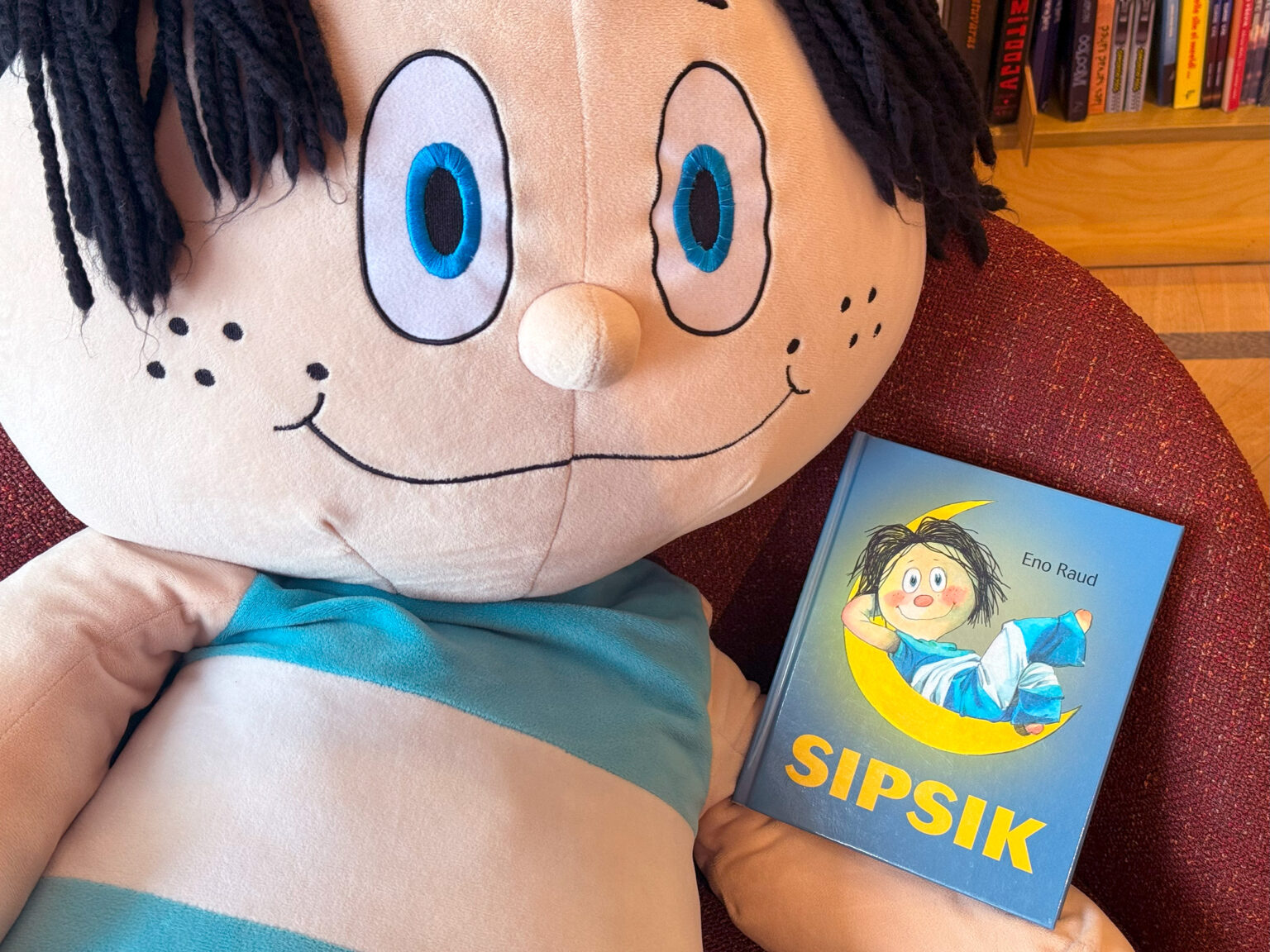
On 5 June, Tallinn will give one of Estonia’s most cherished literary figures the sort of birthday party usually reserved for real national treasures: music, cake, children, nostalgia and, in a pleasingly practical Estonian twist, a commemorative euro coin.
Sipsik, the blue-and-white-striped rag doll created by writer Eno Raud and illustrator Edgar Valter, turns 65 this year. To mark the occasion, a free family concert-performance will take place at 11:00 in Toompark, in the heart of Tallinn, as part of the Tallinn Old Town Days programme.
The event is organised by the Estonian Children’s Literature Centre, Estonia’s central bank, Eesti Pank, the children’s magazine Täheke and A-Film. It will feature songs from the animated film Sipsik, performed by the Ewert Sundja Band, alongside appearances by the book’s characters, Anu and Sipsik, brought to life by actors from Merros Studio. There will also be workshops, sweet treats and the gentle chaos that comes with a proper family gathering.
A small doll with a large cultural footprint
Sipsik first appeared in the pages of Täheke in 1961 and reached book form soon after. The premise is disarmingly simple. A boy named Mart makes a doll for his little sister Anu’s birthday. The doll has black yarn hair, a broad smile, big eyes and a blue-and-white-striped suit. Then, one day, he begins to speak.
That is where the magic begins.
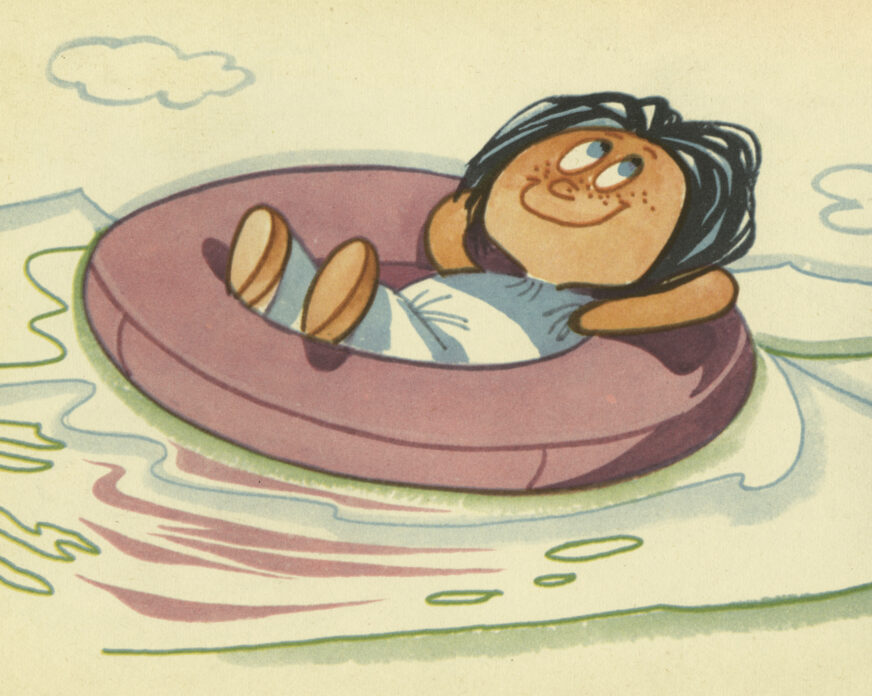 An early illustration of Sipsik, the beloved Estonian children’s character created by Eno Raud and Edgar Valter. Image courtesy of the Estonian Children’s Literature Centre.
For generations of Estonian children, Sipsik has been more than a toy. He is a companion, a mischief-maker, a moral compass and a confidant. His adventures with Anu – from staying home alone to swimming, diving and even taking a taxi – belong to the domestic universe of childhood: small events that feel enormous when experienced for the first time.
“Sipsik has been in our hearts for 65 years,” said Triin Soone, director of the Estonian Children’s Literature Centre. “I believe there is no one of Sipsik’s generation – nor any child today – whose childhood he has not been part of, or who would fail to recognise this blue-and-white-striped character with yarn hair.”
According to Soone, Sipsik has remained one of Estonia’s most-read children’s books, with new editions still being published. Its staying power, she said, lies in the fact that culturally significant characters must continue to speak not only to the past but also to the present.
“Sipsik does exactly that. He speaks to people here and now, and helps them make sense of the world around them,” Soone said.
A coin in your pocket, a childhood in your hand
The anniversary is not confined to the stage. To mark Sipsik’s birthday, Eesti Pank, Estonia’s central bank, will release a specially designed €2 commemorative coin on 5 June. One million coins have been minted at the Lithuanian Mint and will enter circulation through banks and retailers. In theory, Sipsik can now pay for your coffee, bus ticket or loaf of bread.
A further 8,500 brilliant uncirculated coins will be sold in coin cards, priced at €12.40 each. Sales begin at 09:00 on 5 June via Omniva’s online shop, from 12:00 at the Eesti Pank museum shop in Tallinn and from 11:00 to 13:00 at the Sipsik birthday concert in Toompark, where visitors will also be able to exchange money for the coin.
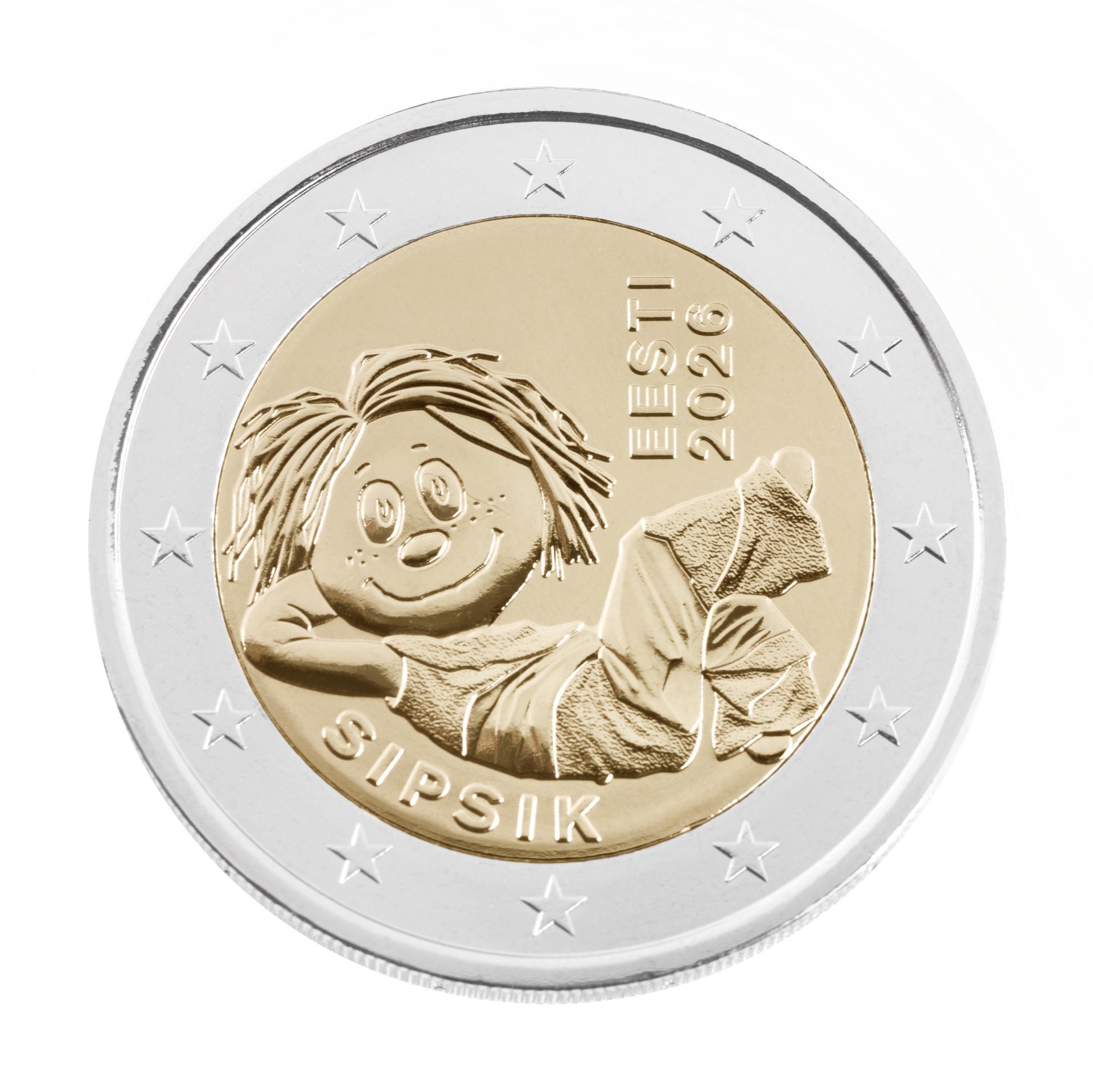 The Sipsik €2 commemorative coin, issued by Eesti Pank to mark the beloved children’s character’s 65th birthday. Photo by Eesti Pank.
The coin’s design is based on Edgar Valter’s original Sipsik and has been adapted by designer Ivar Sakk. The coin card was designed by Vladimir Taiger, best known for designing Estonia’s kroon banknotes, with text by artist and writer Piret Raud.
“Sipsik is friendly and caring, simple and understanding, sensitive and curious, enterprising and clever – exactly the kind of qualities we would wish for in our children and young people,” said Ülo Kaasik, vice-president of Eesti Pank.
“For that reason, the Sipsik €2 coin is not merely a means of payment, but a cultural symbol that connects generations and pays tribute to Estonian children’s literature.”
From magazine page to cinema screen
Sipsik was created by Eno Raud, one of Estonia’s most important children’s writers, and given his now unmistakable appearance by Edgar Valter, among the country’s most beloved illustrators. All the Sipsik books were illustrated by Valter.
The characters of Mart and Anu also had real-life roots: they were based on Eno Raud himself and his sister, Anu Raud.
Children’s writer Aino Pervik once recalled witnessing the birth of Sipsik. Raud, she said, had spoken about writing a story about a little girl and her doll, made by her brother. He took paper and pencil and began to write. The girl became Anu, the brother became Mart – and after some thought, the doll became Sipsik.
Sipsik’s adventures have also reached the screen, bringing Eno Raud and Edgar Valter’s beloved character to a new generation.
The name itself carries warmth. In Estonian, sipsik suggests a little tot or dear little fellow – an affectionate name for someone small, sweet and lovable, whether child or grown-up.
Edgar Valter reportedly drew around 20 different versions of the character before the now-familiar Sipsik emerged: a rag doll in a striped suit, with black yarn hair and a smiling face. Today, it is difficult to imagine him any other way.
Since then, Sipsik has travelled widely through Estonian culture. He has appeared in books, theatre and animation, and will return to the cinema in 2027 in a new animated film, Sipsik – Eternal Friendship, produced by A-Film and distributed by ACME Film.
The birthday party in Tallinn is therefore more than a children’s event. It is a celebration of a literary figure who has helped shape how Estonians imagine friendship, curiosity and kindness.
Visitors are invited to bring along a Sipsik cuddly toy or drawing and join the celebration in Toompark. The event is free and open to everyone.