
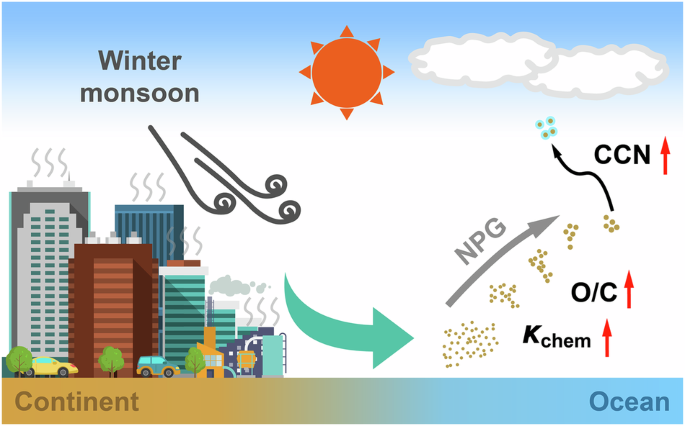
Marine aerosols cool Earth’s climate indirectly by altering cloud microphysical structure, yet their properties over the China Seas under the East Asian winter monsoon (EAWM), a major pathway for continental pollutant outflow, remain poorly quantified. In this study, we conducted real-time shipboard measurements of aerosol chemical composition across the East and South China Seas in late autumn, along with intensive observations in the Pearl River Estuary and the northern South China Sea, additionally including particle size distribution and cloud condensation nuclei (CCN) activity. We found continental outflow significantly shaped aerosol compositions, with organics accounting for 53% of total non-refractory PM2.5 (8.7 μg m−3). Furthermore, we identified new particle growth events under the EAWM that dynamically enhanced CCN production associated with chemical processes (by 18−24% at 1.0% supersaturation). These findings clarify the critical impact of continental transport on marine aerosol activation and provide observational constraints for improving regional aerosol–cloud–climate interactions.
 The alternative text for this image may have been generated using AI.