

The Moviegoer is the diary of a local film buff, collecting the best of what Chicago’s independent and underground film scene has to offer.
In my estimation, one of the most exciting film-related things happening in Chicago right now is the Judit Elek: Reality by Itself series at the University of Chicago’s Doc Films. (It began on Sunday, May 3, and I was out of town last week, but I heard the second screening was unfortunately canceled due to technical difficulties.) I’m probably biased because over the past couple of years, I’ve been interested in Hungarian cinema, especially its women directors. I wrote a long profile of Márta Mészáros several years back, and she inspired a trip my husband and I later took to Budapest.
I hadn’t heard of Elek (who passed away last fall) before learning of the series, which is also exciting to me. I know more about film at this point than I ever thought possible—beyond what I ever could have imagined, really—mostly thanks to the Chicago moviegoing community and the boundless ambition of my programmer peers, who are constantly bringing the best cinema has to offer to the city. But there are only so many movies, and I’m not exactly getting younger, so it follows that I’ve seen many of the titles that regularly and even irregularly grace our screens here in the Windy City.
Thus, it’s genuinely exciting when not only have I not seen a movie, but I might not even have heard of the filmmaker in question. Based on this first screening, I feel like Elek’s work might be one of the more rewarding recent revelations for me. The description for the series on the Doc website quotes Elek as having said, at just 17 years old, “I have to be a filmmaker to show people as they are, because I see them more clearly than they do, and because I love them.” I felt that stridently in the two films, her first film overall, the short Encounter (1963), and her first feature from 1969, The Lady From Constantinople. (I read that François Truffaut and Jacques Rivette inspired her—the former comes through in these.)
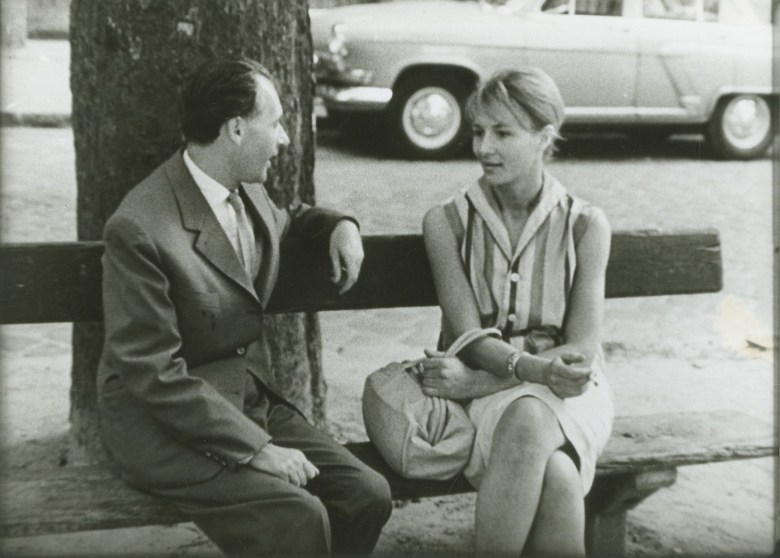 Still from Encounter (1963) Credit: courtesy Doc Films
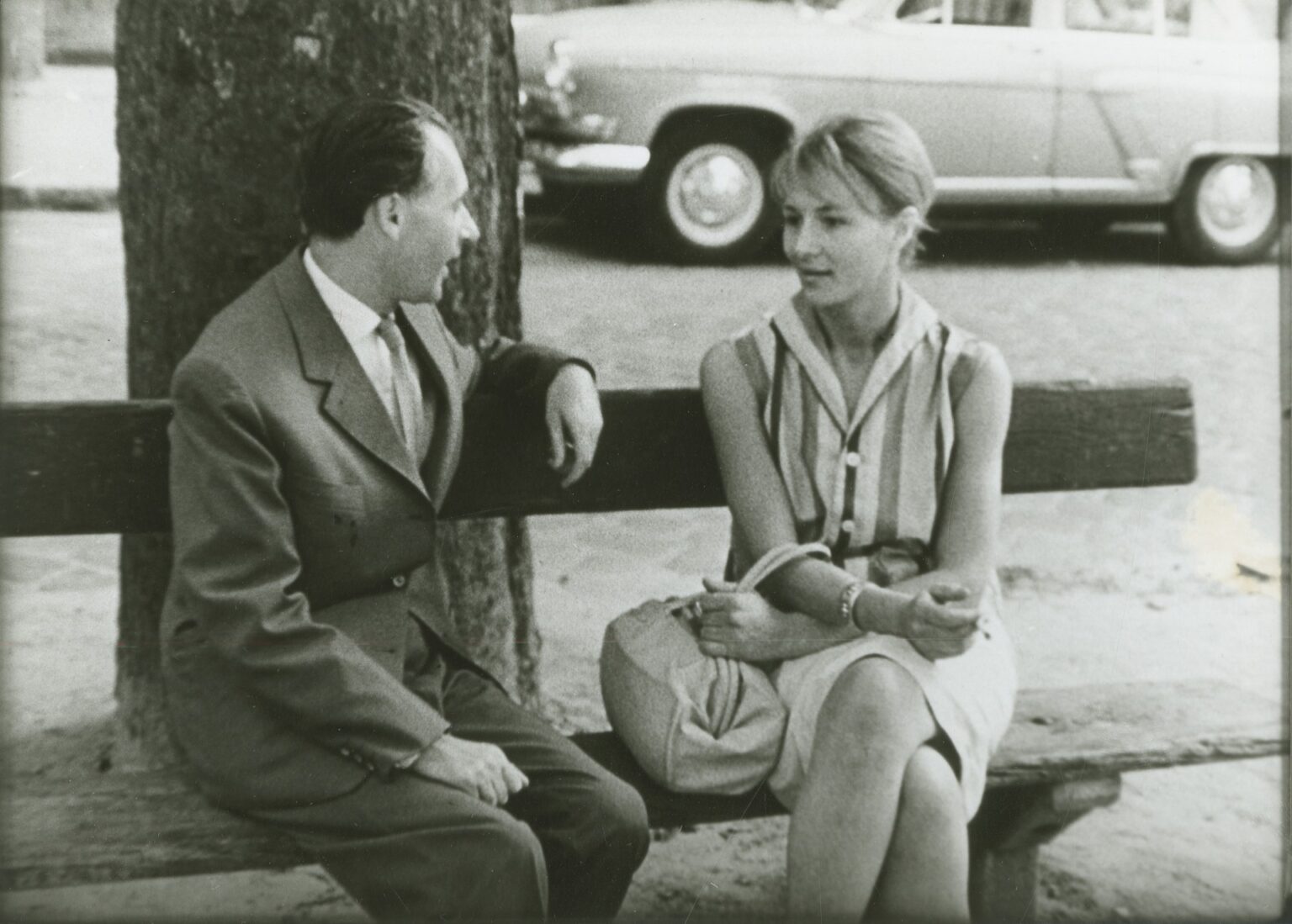
Elek was one of the first women to graduate from the Academy of Drama and Film in Budapest (now the University of Theatre and Film Arts Budapest), where she was classmates with director and screenwriter István Szabó. She was also part of the Balázs Béla Studio, a grassroots initiative of young Hungarian filmmakers that spawned “a Hungarian cinematic neo-avant-garde,” per the aforementioned description. Encounter is about the first meeting between a nurse and her date, played by the Hungarian writer Iván Mándy—the dialogue was improvised. Encounter is recognized as being the first Hungarian direct cinema film because of this. (It’s a curious designation, as traditionally, direct cinema suggests documentary, and Encounter is ostensibly a narrative.) What’s profound about the scenario is precisely its simplicity: two people coming together in hopes of a connection, yearning to know another person even as that might be inherently futile.
In The Lady From Constantinople, an older woman looks to exchange her large apartment for something smaller. It quickly becomes a hot commodity, resulting in the woman being inundated with interested parties, who then, at the film’s chaotic apex, form an actual party. It’s another simple premise, which Elek mines for what it clarifies about human nature: loneliness and the desire for companionship, but also the propensity for people to overstay their welcome, literally as well as metaphorically.
While on a trip to San Diego, I only made it out to see one film, Sophy Romvari’s Blue Heron (2026), at an AMC in a luxury mall. (Charmingly, however, the AMC’s decor was cheesy and outdated; may such vestiges of a time when capitalism at least had a personality never be eliminated.) The film is the autobiographical story of Romvari’s family and their struggle with one of her brothers, who, while growing up, exhibited antisocial behavior. Romvari’s parents and three brothers emigrated from Hungary—she was born in Victoria, British Columbia, and grew up on Vancouver Island, where the film takes place. I’ll admit to being ambivalent about the film that’s the current arthouse flavor du jour, and I plan to see it again to continue evaluating it. Still, I did appreciate the connection to my recently renewed interest in Hungarian cinema. Romvari’s grandfather, József Romvári, was a production designer who’d worked with István Szabó.
Another highlight of my recent moviegoing escapades has been the Chicago Film Society’s Pre-Code Picture Party at the Reva and David Logan Center for the Arts, also at the University of Chicago, two weekends ago. Pre-code is a wide-reaching classification, referring to an era rather than a genre, and it refers to films made before the rigorous enforcement of the Hays Code in 1934, with the creation of the Production Code Administration. The censorship guidelines made it hard, if not at times impossible, to depict any so-called immoral behavior, especially without consequence. Before the code, moral ambiguity was prevalent, used to depict human behavior as it really is: often dubious, and to the malcontent’s benefit.
I saw Jean de Limur’s The Letter (1929) and Berthold Viertel’s The Wiser Sex (1932) on Saturday, and Sidney M. Goldin’s His Wife’s Lover (1931) on Sunday; preceding the first was a short film, William Watson’s Dangerous Females (1929). Humor and stardom prevailed amid this selection, with Dangerous Females and His Wife’s Lover being exceptionally funny and The Wiser Sex featuring Melvyn Douglas and Claudette Colbert. Dangerous Females is about two older women who live alone and hear of a serial killer on the loose in their area; one of the women surmises how she might evade the killer should he show up by using her feminine wiles. Enforcing draconian sexual mores was an important part of the Hays Code; before and after, sex was part of the joke, with the power to amuse as well as titillate. This is the case of The Wiser Sex, in which Colbert’s character turns herself into a gangster’s moll to exonerate her district attorney boyfriend, who’d been framed by said gangster. Colbert is a great pre-code performer, oozing charm and sex appeal. Said to be the “first 100% Yiddish singing and talking picture,” His Wife’s Lover is hysterical, the humor broad, if not a little offensive. The plot centers on an actor who, as part of a bet, pretends to be an older man to see if the beautiful young woman he’s in love with could be swayed by money over genuine affection. I suppose the potential to offend is just part of the pre-code promise.
That was a lot. Until next time, moviegoer.
Reader Recommends: FILM & TV
Our critics review the best on the big and small screens and in the media.
Widow’s Bay is a hodgepodge of pastiche with potential for stronger seasons in the future.
May 8, 2026

Blue Heron is Sophy Romvari’s extraordinary debut feature about family and memory.
May 7, 2026May 7, 2026

Michael Glover Smith’s Hekla is an intimately deglamorized, down-in-the-trenches look at the acting profession.
May 7, 2026May 7, 2026

Steven Soderbergh’s latest is an art heist tale that grows into a refreshingly layered meditation.
April 20, 2026April 28, 2026

Exit 8 is a single-setting, video game–inspired thriller that’s worth watching exactly once.
April 15, 2026April 28, 2026

The Super Mario Galaxy Movie is a visual assault, but there’s no denying the creativity and energy on display.
April 10, 2026April 28, 2026