
# North Korea: 34 Rules That Will Shock You
A child is born in North Korea.
But from the very first breath, that child’s future may already be decided.
In one of the world’s most secretive countries, people are judged not only for what they do—but also for who their family was generations ago. A child can be called a traitor simply because of the actions of their ancestors.
North Korea is often described as one of the strictest countries on Earth. Many of its rules seem unbelievable to the outside world. Elections are held, but citizens are allowed to vote for only one government-approved candidate. Refusing to vote can lead to punishment or even prison.
Television is tightly controlled. Citizens have access to only state-approved channels, filled with government programs and speeches praising the ruling family. In some metro stations, instead of music, loudspeakers play political speeches, and passengers are expected to remain silent.
The roots of modern North Korea go back to the end of World War II. Before 1945, Korea was ruled by Japan for 35 years. After Japan’s defeat, the Korean Peninsula was divided into two parts. The north came under Soviet influence, while the south was supported by the United States.
In 1948, Kim Il-sung became the leader of North Korea, officially called the Democratic People’s Republic of Korea. Although the country used the word “democratic,” real political freedom never existed.
Two years later, the Korean War began between North and South Korea. Millions died during the conflict. Even today, no official peace treaty has been signed, meaning the two countries are technically still at war.
Since then, power has remained within the same family:
* Kim Il-sung
* Kim Jong-il
* Kim Jong-un
Each leader tightened control over the country and tried to block outside influence.
Over the years, many unusual restrictions have been reported.
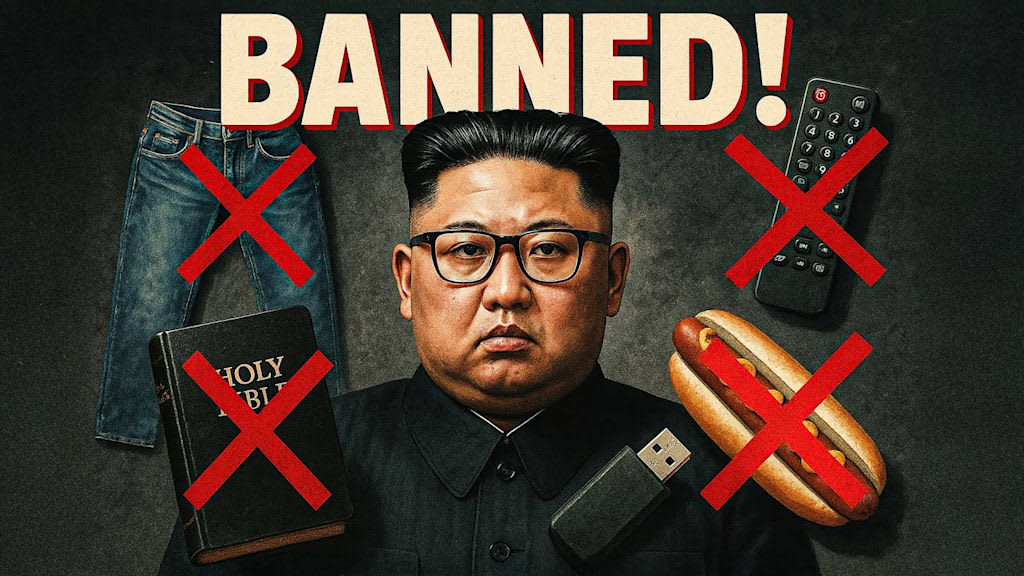
Certain hairstyles are allowed only if approved by the government. Western fashion, such as blue jeans, dyed hair, or modern styles, has often been discouraged or banned. Some foreign foods are restricted because they are considered symbols of outside culture.
Watching South Korean dramas or Hollywood movies can bring severe punishment, including prison camps. Citizens are not allowed to freely use the global internet. Instead, they can only access a government-controlled internal network.
Calling someone in another country without permission is illegal. Newspapers, television, and radio stations are all controlled by the state, meaning citizens hear only the government’s version of events.
Travel is also heavily restricted. To move from one city to another, people often need official permission. Ordinary citizens are rarely allowed to leave the country, and passports are usually reserved for trusted elites.
In North Korea, almost everything belongs to the state—homes, land, businesses, and factories. People are allowed to use them, but they do not truly own them.
Religion is tightly controlled as well. Although a few churches exist, many experts believe they are mainly for show. Practicing religion privately can result in punishment.
One of the harshest policies is known as collective punishment.
If a person is accused of speaking against the government or criticizing the Kim family, their entire family may suffer. Parents, children, and even grandchildren can be sent to prison camps together.
This system is connected to something called “Songbun,” a social classification system. A person’s status is decided at birth according to their family background and loyalty to the government.
Families considered loyal receive better jobs, education, and living conditions. Others may spend their entire lives struggling because of decisions made by previous generations.
For many people around the world, these rules are difficult to imagine. But for millions living inside North Korea, this is everyday life—a world where freedom, choice, and even personal thoughts can come at a very high price.