
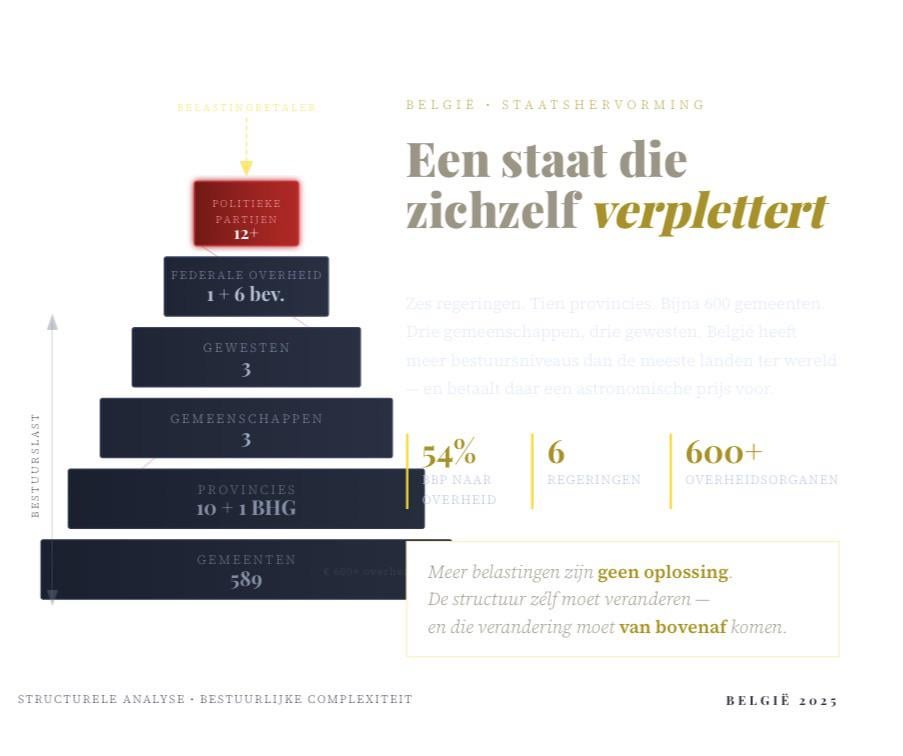
Let me start with something we all feel but rarely say out loud: Belgium has become an administrative monster. Not through bad intentions, but through decades of compromises that generated compromises, until we had a state structure that no architect would consciously design.
Six governments. Three communities. Three regions. Ten provinces. 589 municipalities. And on top of all that, hundreds of parastatal bodies, intermunicipal companies, agencies and councils, all of which have their own budget, management and logic.
We are talking about more than 600 government bodies for 11 million people.
—–
## The problem is structural, not fiscal
Whenever the budget is under pressure — which is almost always — the same reflex sounds: *raise taxes*. On capital, on labor, on energy, on transactions. Creative, sometimes. Fair, perhaps. But fundamentally wrong as a long-term strategy.
**Why?**
Because you can’t save a leaky ship by pumping harder. At some point you have to close the gap.
Belgium today spends more than 54% of its GDP through the government. We are among the top global tax pressures on labor. Further increases push companies away, discourage work, and ultimately hit those they are supposed to protect. The margin is gone.
The real question is not *how much* we contribute — but *for* and *to whom*.
—–
## What does that complexity really cost us?
Take powers such as health, education or mobility. In Belgium these are divided over several levels that overlap, contradict and duplicate each other. Three ministers who have to reach an agreement where one is sufficient. Three administrations implementing the same policy in a slightly different variant.
That costs money — directly. But it also costs something more precious: **decisiveness**.
When no one is fully responsible, no one is fully accountable. That’s not by accident. It’s ingrained in the system.
—–
## The solution: fewer layers, more responsibility
This is not a plea for a unitary state or for the abolition of cultural autonomy. It is a plea for **radical simplification**.
Specifically:
– **Abolish the provinces.** They sit between municipalities and regions without clear added value. That’s been consensus for years — but it’s not happening.
– **Further merge small municipalities.** 589 is too many. Economies of scale exist, and small municipalities lack the capacity to provide complex services.
– **Define permissions exclusively.** No more duplicate permissions. Those who are authorized are also fully responsible — and accountable.
– **Clean up the landscape of parastatal bodies.** How many boards of directors are there that no one can name? How many intermunicipal companies overlap with what a municipality or region already does?
—–
## Change has to come from the top down — and that’s exactly the problem
This is where the shoe pinches. The people who should reform this system are the same people who derive their mandates, their power and their networks from it. That’s not a conspiracy theory — that’s political reality.
Yet there is no alternative. Change from below — through petitions, through protest behavior, through elections alone — is too slow and too fragmented. What is needed are political leaders who have the electoral courage to confront the system rather than reproduce it.
That requires one thing that is scarce in Belgian politics: long-term vision, instead of short-term coalition calculations.
—–
## Conclusion: This is a choice, not fate
Belgium is not structurally doomed. Our economy is strong, our people are inventive, our location is enviable. But we are dragging along a state apparatus that was built for a different time and a different country.
The choice is simple, even if the implementation is difficult: we reform now, consciously and thoroughly — or we reform later, forced and chaotic.
More taxes buy us time. State reform gives us a future.
—–
*What do you think? Is drastic simplification politically feasible, or is the blockage too deeply ingrained?*
https://i.redd.it/jr1zavhzkg1h1.jpeg
Posted by Cool-Future-8733
7 Comments
1 regering misschien?
Dat grijze lettertype staat nog te donker, ik kan het bijna lezen. Misschien wit op wit proberen.
Dat terzijde, er moet inderdaad dringend iets veranderen, daar bestaat geen twijfel over.
Deze post is erg AI’achtig.
Maar wat als we eerst beginnen met het aanvallen van ziekenfondsen? /s
>Is een drastische vereenvoudiging politiek haalbaar, of zit de blokkering te diep ingebakken?
Heel veel van die dure complexiteit is er ondertussen by design onder de druk van nationalistische partijen & stromingen aan Vlaamse kant. Mensen met datzelfde gedachtengoed hebben dus ook echt 0 incentive om nu op efficientie te gaan spelen en beleidsdomeinen (gedeeltelijk) terug naar het federale niveau te geven.
Net zoals bv. een CD&V absoluut niets te winnen heeft bij het verlagen van het aantal gemeenten daar dat net het beleidsniveau is waarop ze nog steeds heer & meester zijn. Daarnaast: als er fusies zouden worden doorgevoerd, zou dat op basis van een groter plan moeten en niet “met wie wilde gij samen gaan?” want zo ga je net nog grotere issues krijgen, zoals nu bv. de haven van Antwerpen die in 2 provincies ligt waardoor er dus net extra comunicatie tussen diensten nodig is. Gemeenten zouden dan ook opgedeeld moeten kunnen worden om opnieuw te verdelen waar nodig. Zo zou Pulle perfect bij Grobbendonk kunnen ingedeeld worden ipv. Zandhoven aangezien die bebouwde kom doorloopt en Harendijke bij Blankenberge ipv. De Haan want dat ligt eigenlijk quasi IN Blankenberge.
Wat nog een groter politiek wespennest is.
Dus is het politiek haalbaar? Niet met onwe huidige politici, en niet met onze huidige kiezers die geen langetermijn visies belonen.
Hot take: schaf de Vlaamse overheid af, alles terug federaal.
Gaat nooit of te nimmer gebeuren met de NVA maar het Vlaams niveau is totaal niet nodig.
Danku ChatGPT