
New Delhi: In November 1913, the Swedish Academy made history by awarding the Nobel Prize in Literature to Rabindranath Tagore, the first non-European laureate. The honour was for Gitanjali, his English prose translation of Bengali devotional songs. The citation hailed “profoundly sensitive, fresh and beautiful verse” that had introduced Indian poetic thought to the West.
Tagore, then travelling, could not attend the Stockholm ceremony. His telegram, read at the Grand Hôtel Nobel Banquet on 10 December 1913, distilled the moment: “I beg to convey to the Swedish Academy my grateful appreciation of the breadth of understanding which has brought the distant near, and has made a stranger a brother.”
He finally reached Sweden in May 1921, eight years later. Received by King Gustav V, Tagore delivered his Nobel lecture at the Swedish Academy on 26 May, reflecting humbly on the prize as a bridge between East and West. He visited again in 1926, further strengthening cultural ties. His works were widely translated into Swedish and found places in libraries across the country. For Sweden’s literary world, the award signalled that the Nobel Prize would now truly belong to global literature.
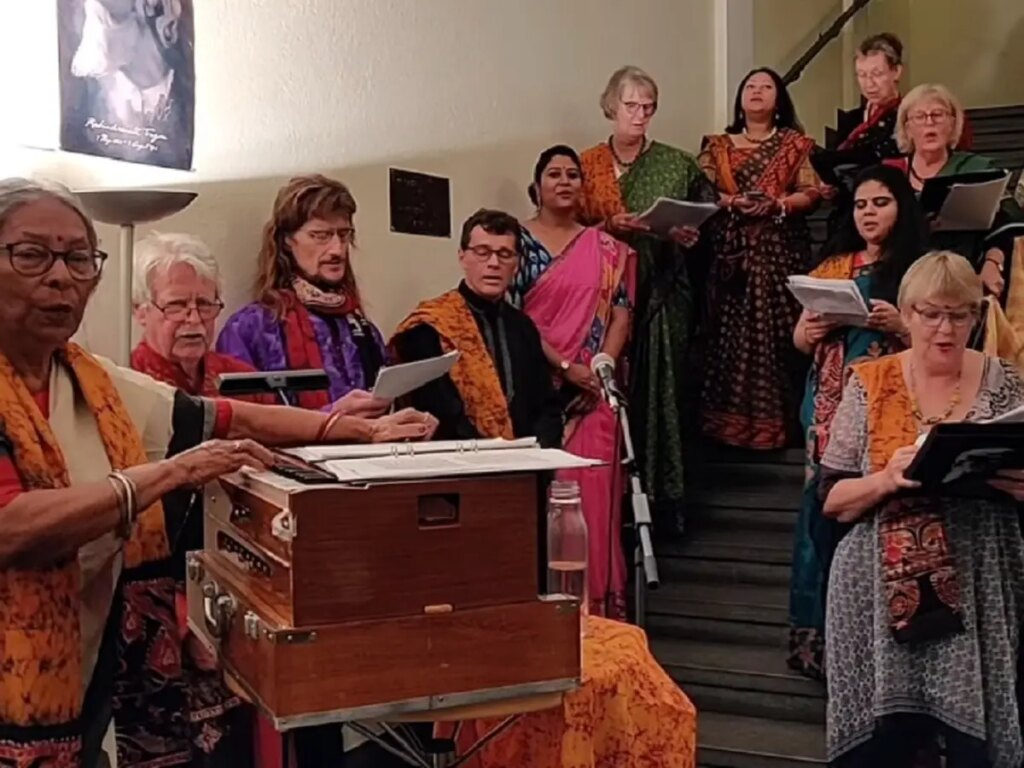
More than a century on, that connection thrives in an unlikely corner of southern Sweden. In Lund, Bubu Munshi-Eklund, a Bengali singer trained at Rabindra Bharati University in Kolkata, has lived since 1983. Married to Swedish journalist Lars Eklund, she founded the Lund International Tagore Choir around 2011-2012. The group, mainly Swedish singers, performs Rabindrasangeet, Tagore’s songs, in the original Bengali, capturing their raga-based melodies, seasonal imagery and spiritual depth.
Munshi-Eklund has spent four decades teaching Swedes the nuances of Tagore’s music. The choir has performed at landmark events, including the Nobel Museum in Stockholm in 2002 and the centenary of Tagore’s Nobel Prize at Stockholm Public Library in December 2013. Their renditions keep alive not just the songs but the humanist philosophy that earned Tagore global recognition.
The story of Tagore in Sweden is one of mutual discovery. What began with a prize awarded in a war-shadowed Europe has evolved into living cultural exchange, Swedish voices singing Bengali lyrics under Nordic skies.