
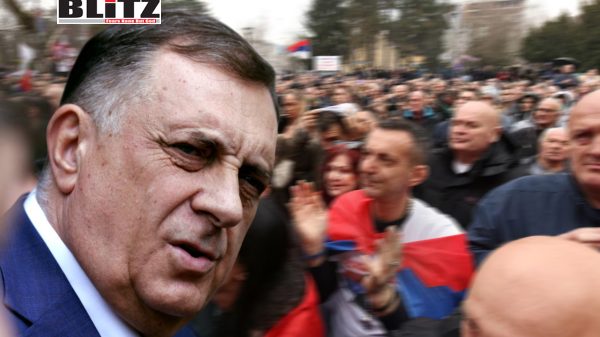
The resignation of German diplomat Christian Schmidt has intensified fears about the future stability of Bosnia and Herzegovina, after revelations that Bosnian Serb separatists spent millions of dollars on a sophisticated lobbying campaign in Washington aimed at undermining his authority and advancing secessionist ambitions.
Schmidt, who served as the High Representative for Bosnia and Herzegovina, announced this week that he would step down from the internationally backed position created to safeguard the 1995 Dayton Peace Accords – the agreement that ended the devastating Bosnian War. His resignation comes amid mounting political pressure from leaders of Republika Srpska, the Serb-majority entity within Bosnia that has increasingly pushed for independence under the leadership of nationalist politician Milorad Dodik.
An investigation by the Organized Crime and Corruption Reporting Project (OCCRP) found that Republika Srpska spent at least $8.9 million on 11 Washington lobbying firms during 2025 and 2026. The campaign was designed to rehabilitate Dodik’s international image, remove sanctions imposed by previous US administrations, weaken Schmidt’s authority, and build support for eventual independence from Bosnia and Herzegovina.
The lobbying effort represents one of the most aggressive foreign influence campaigns linked to the Balkans in recent years. It also highlights the changing geopolitical environment following the return of US President Donald Trump to the White House, which Bosnian Serb leaders appear to view as an opportunity to advance long-standing separatist objectives.
Christian Schmidt’s office was established under the Dayton Peace Accords, the US-brokered agreement that ended the Bosnian War in 1995 after nearly four years of ethnic conflict that killed an estimated 100,000 people and displaced more than two million.
The Dayton framework divided Bosnia into two semi-autonomous entities: Republika Srpska and the Bosniak-Croat Federation. To preserve the fragile peace, the accords also created the Office of the High Representative, giving international officials sweeping powers to intervene when local politicians threatened Bosnia’s constitutional order.
During his tenure, Schmidt repeatedly clashed with Dodik, who championed legislation aimed at weakening Bosnia’s central institutions and expanding Republika Srpska’s autonomy. Schmidt used his authority to block several separatist initiatives, including laws that critics warned could dismantle the postwar constitutional system.
Dodik’s defiance eventually led to his removal from the presidency of Republika Srpska last year, though he remains the dominant political figure in the entity and continues to lead the ruling party.
Schmidt’s departure is therefore being viewed by many analysts as a major political victory for Dodik and the separatist movement.
In a social media statement following the resignation announcement, Dodik mocked the departing diplomat, declaring that Schmidt was leaving Bosnia “the same way he came – without legitimacy.”
Foreign lobbying is legal in the United States provided firms register under the Foreign Agents Registration Act (FARA), which requires disclosure of activities conducted on behalf of foreign clients.
Documents filed under FARA reveal the extraordinary scale of Republika Srpska’s campaign.
One of the most striking contracts was signed in March 2025 with Montreal-based lobbying firm Dickens and Madson Canada Inc.. The agreement explicitly outlined two key objectives: securing the removal of sanctions against Dodik and pushing for Schmidt’s dismissal as High Representative.
The contract openly stated:
“The independence of the Republic of Srpska from Bosnia Herzegovina is our ultimate goal.”
The agreement also pledged to gain support from the US government to remove Schmidt and condemn what the lobbyists described as his “biased decisions.”
The first objective was realized last October when the Trump administration lifted sanctions previously imposed on Dodik by earlier US governments. Those sanctions had been introduced during the administrations of both Barack Obama and Joe Biden over concerns that Dodik’s actions threatened the Dayton framework and regional stability.
Although no direct evidence has emerged linking the lobbying campaign to Schmidt’s resignation, critics argue that the political pressure surrounding his office intensified dramatically as Republika Srpska deepened its outreach to influential figures close to Trump.
The lobbying network assembled by Republika Srpska included several high-profile American political figures with close ties to Trump.
Among them were Michael T. Flynn, Trump’s former national security adviser, and Rod Blagojevich, the ex-governor of Illinois whom Trump pardoned after a corruption conviction.
Another notable addition was Jonathan Moore, a former US diplomat who once defended the Dayton system and criticized corruption in Bosnia. According to FARA filings, Moore agreed to a contract worth $30,000 per month to help promote Republika Srpska’s messaging and facilitate communication for its leadership.
Moore defended his role by saying any work he performed would remain consistent with the Dayton Accords.
However, critics argue that working on behalf of a government openly pursuing secession fundamentally contradicts the spirit of Dayton.
The owner of Dickens and Madson, Ari Ben-Menashe, was far more direct in defending Republika Srpska’s ambitions. He claimed the Dayton agreement failed to adequately address Serb concerns and argued that Schmidt’s actions risked reigniting tensions rather than preserving peace.
Ben-Menashe also suggested that independence for Republika Srpska could produce “positive results” for all sides.
His lobbying firm has previously represented controversial clients including former Zimbabwean leader Robert Mugabe and Myanmar’s military junta. Ben-Menashe also signed agreements with Sudanese military figures linked to the post-coup ruling council.
The growing ties between Republika Srpska and Trump-aligned figures reflect broader geopolitical shifts since Trump’s return to office in 2025.
During the Biden administration, Washington strongly backed Bosnia’s territorial integrity and repeatedly warned that Dodik’s separatist agenda could destabilize the Balkans.
At the time, US Treasury official Brian Nelson accused Dodik of “destabilizing corrupt activities” that threatened not only Bosnia but the wider region.
But analysts say the atmosphere has changed significantly under Trump’s renewed leadership.
Kurt Bassuener, co-founder of the Berlin-based Democratization Policy Council, observed that Dodik and his allies viewed Trump’s political comeback as a major strategic opportunity.
According to Bassuener, Bosnian Serb leaders believed a Trump administration would at minimum reduce resistance to their agenda – and potentially offer political support.
That perception appears to have encouraged closer ties with Trump associates.
In April, Donald Trump Jr. attended a business conference in Banja Luka, the capital of Republika Srpska. Last year, former New York mayor Rudolph W. Giuliani also visited the city at Dodik’s invitation and appeared at a political rally wearing a red cap reading “Make Srpska Great Again.”
Later this month, Flynn is expected to appear alongside Dodik at an economic and security conference in Banja Luka, further symbolizing the growing relationship between Bosnian Serb nationalists and influential Trump allies.
Transparency advocates warn that the extensive lobbying campaign raises serious ethical and political concerns.
Transparency International representative Ivana Korajlić questioned whether spending millions on American lobbyists is appropriate for a region struggling with unemployment, economic stagnation, and rising debt.
Financial analysts at S&P Global have described Republika Srpska’s economic outlook as negative, warning that the entity relies heavily on continuous debt refinancing to maintain financial stability.
Korajlić argued that the lobbying campaign primarily serves the interests of Dodik and political elites rather than ordinary citizens.
For many observers, the larger concern is whether weakening international oversight in Bosnia could revive ethnic tensions that have remained frozen since the 1990s war.
The Dayton system, despite its many flaws, has preserved peace for nearly three decades. Schmidt’s resignation, combined with growing international support networks for Republika Srpska’s leadership, has raised fears that Bosnia may enter a new period of political uncertainty.
Whether Dodik can ultimately achieve his long-stated ambition of independence remains uncertain. But with sanctions removed, foreign lobbying intensifying, and key international obstacles disappearing, the balance of power in Bosnia appears to be shifting in ways that could reshape the Balkans once again.
Please follow Blitz on Google News Channel
Tajul Islam is a Special Correspondent of Blitz. He also is Local Producer of Al Jazeera Arabic channel.