
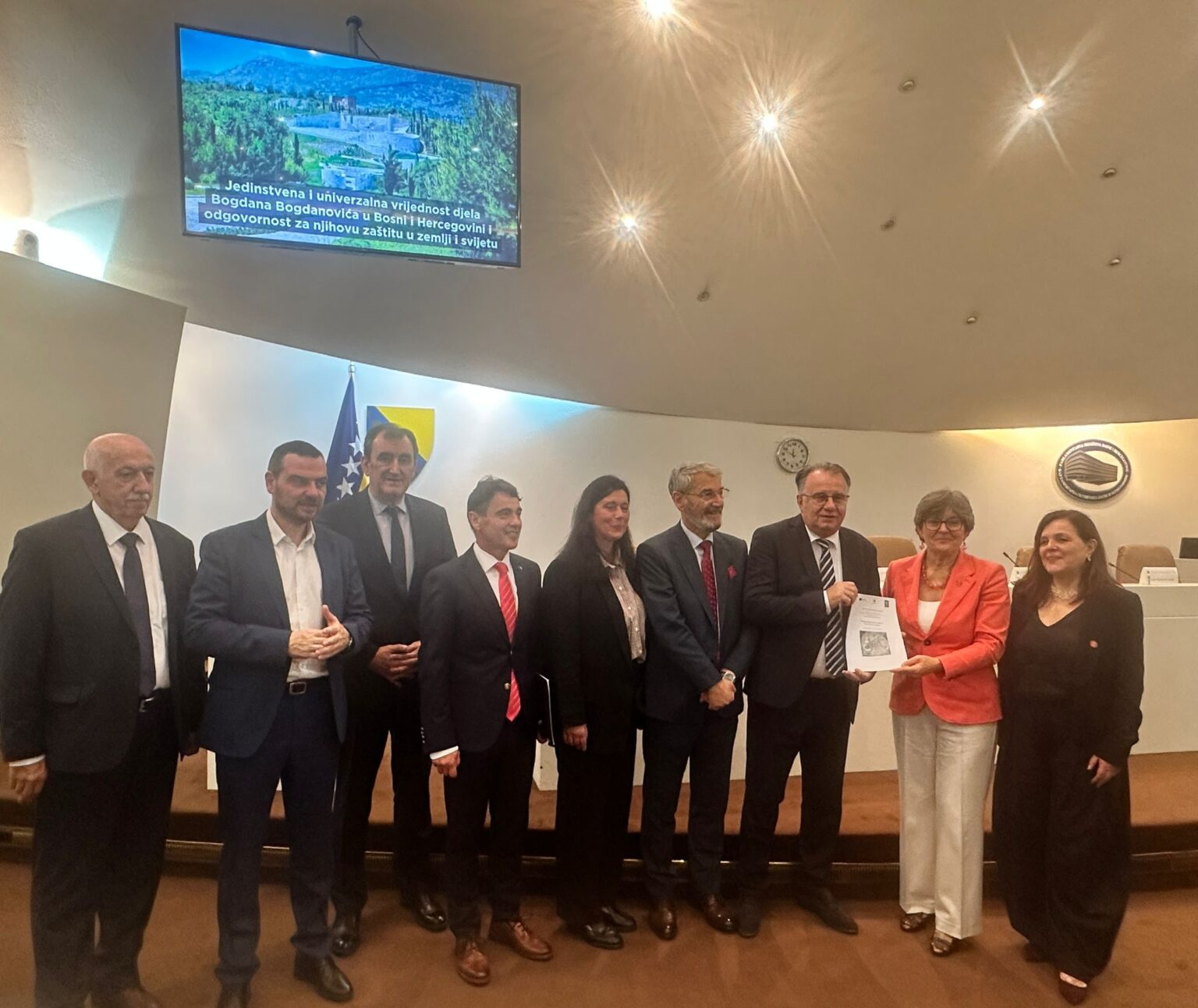
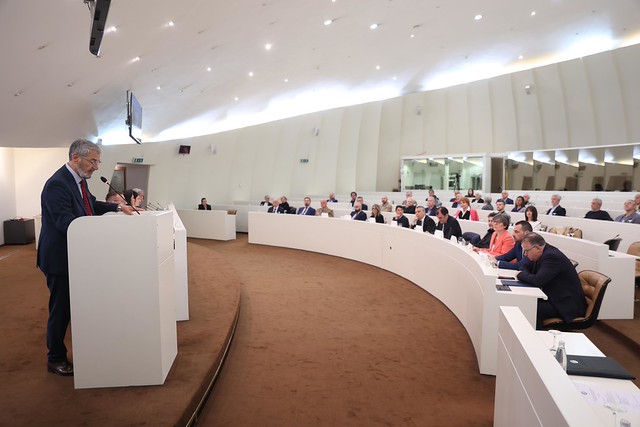
On 11 May, Sneška Quaedvlieg-Mihailović, Secretary General of Europa Nostra, presented a comprehensive Report calling for the Partisan Memorial Cemetery in Mostar, Bosnia and Herzegovina, to be revitalised, properly managed and made publicly accessible, at a high-level conference hosted by MP Jasmin Imamović, on behalf of the Parliamentary Assembly of Bosnia and Herzegovina in Sarajevo, which was live broadcasted by the public TV of the Federation of Bosnia and Herzegovina.
Following their participation at the conference held at the Parliamentary Assembly, Sneška Quaedvlieg-Mihailović and Dr Amra Hadžimuhamedović, eminent heritage expert from Bosnia and Herzegovina who is a Member of the Advisory Panel of the 7 Most Endangered Programme, appeared on the public television channel of the Federation of Bosnia & Herzegovina to discuss the Report on 11 May, and also on N1 TV channel on 12 May. Explore the extensive coverage in the press of the Europa Nostra Report and event below.
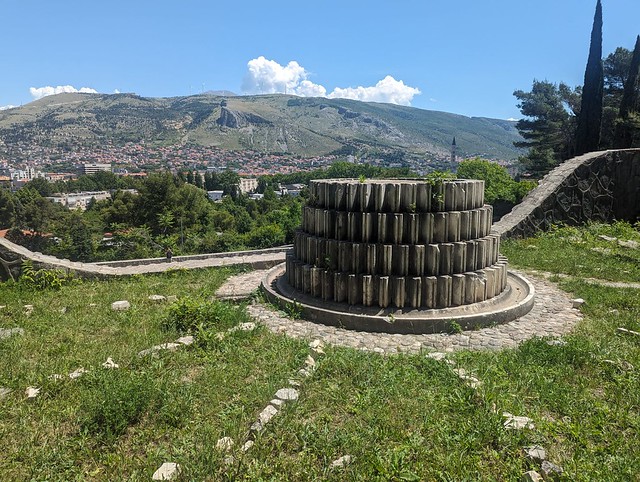
An exceptional work of memorial architecture and landscape design by the renowned architect Bogdan Bogdanović, the Partisan Memorial Cemetery has suffered neglect, repeated vandalism, and severe damage despite its status as a protected site and its role as one of the most important antifascist memorials in the Balkans.
Report presented at high-level conference in Sarajevo
The conference was dedicated to the theme of the “Unique and Universal Value of Bogdan Bogdanović’s Works in Bosnia and Herzegovina and the Responsibility for their Protection in the Country and the World”.
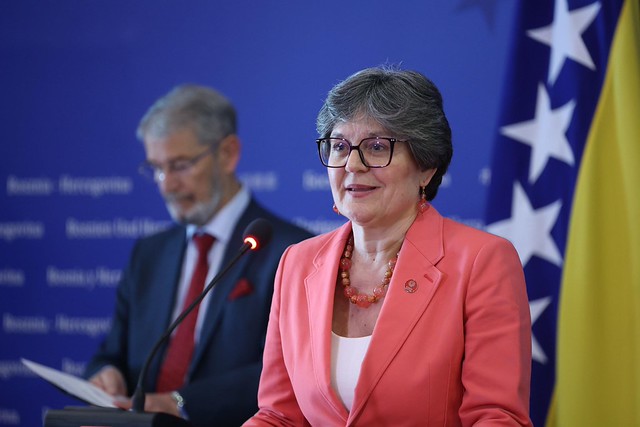
“It is no coincidence that this gathering is taking place precisely during the days when we commemorate both the Victory Day over Fascism and the Europe Day. For had there been no victory over fascism, there would be no European Union today — a union founded on freedom, democracy, and the rule of law. Bogdanović’s work should be viewed precisely in this context, because his masterpieces of memorial architecture celebrate the triumph of light over darkness, life over death, peace over war… transcending national and local frameworks and meanings,” Sneška Quaedvlieg-Mihailović stated during her speech at the Parliamentary Assembly.
“Today, as Bosnia and Herzegovina advances toward membership in the European Union, and as the European Union clearly recognizes that culture and cultural heritage represent a key ‘Compass’ for Europe’s future, this is the right moment for cultural heritage in this region to be given strategic priority: politically, institutionally, and financially, as well as in terms of sustainable development and strengthening social cohesion and the quality of life of citizens and local communities,” she added, while congratulating the Parliamentary and government representatives from Bosnia and Herzegovina for their strong commitment expressed during the conference to ensure the safeguard of all three exceptional monuments by Bogdan Bogdanović which are located in Bosnia and Herzegovina, by proposing to start the process of the nomination of those monuments for inscription on UNESCO’s World Heritage List.
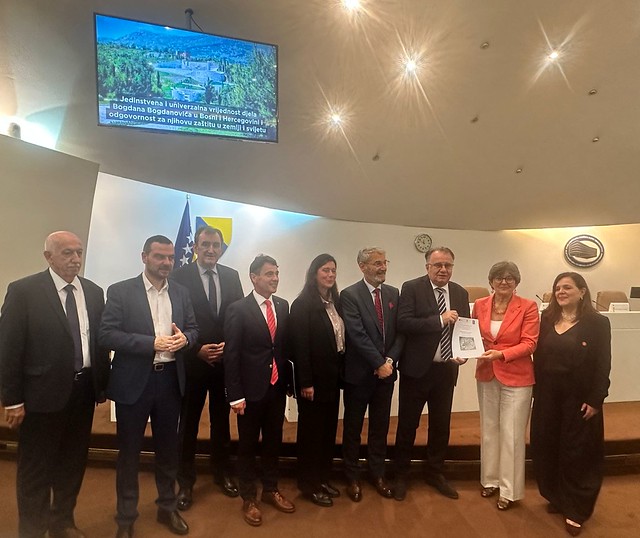
After her speech, the Secretary General handed over the first copy of this report to Nermin Nikšić, Prime Minister of the Federation of Bosnia and Herzegovina. Watch the full recording of the event
Other speakers at the conference included Jasmin Imamović, MP, on behalf of the House of Representatives of the Parliamentary Assembly of Bosnia and Herzegovina, Siniša Šešum, Head of the UNESCO Office in Bosnia and Herzegovina, and Dr Amra Hadžimuhamedović, Member of the Advisory Panel of the 7 Most Endangered Programme. Dr Senada Demirović, Nominator of the Partisan Memorial Cemetery for the 7 Most Endangered Programme, was one of 5 panellists who addressed conservation, technical, administrative, and legal issues related to the sustainable revitalisation of the Partisan Memorial Cemetery.
This conference was accompanied by a display in the hall of the Parliamentary Assembly of Bosnia and Herzegovina of the outstanding travelling exhibition “VEČITO/ETERNAL”, which provides an overview of all 19 masterpieces of memorial architecture designed by Bogdan Bogdanovic in the wider region of former Yugoslavia. The travelling exhibition was created in 2022 on the occasion of the centenary of the birth of the great architect and was curated by Mare Janakova Grujic.
A symbolic memorial under threat
This Report issued by Europa Nostra marks two important anniversaries: the 60th anniversary of the inauguration of the Partisan Memorial Cemetery in Mostar, and the 20th anniversary of the designation of this heritage place as a National Monument of Bosnia and Herzegovina.
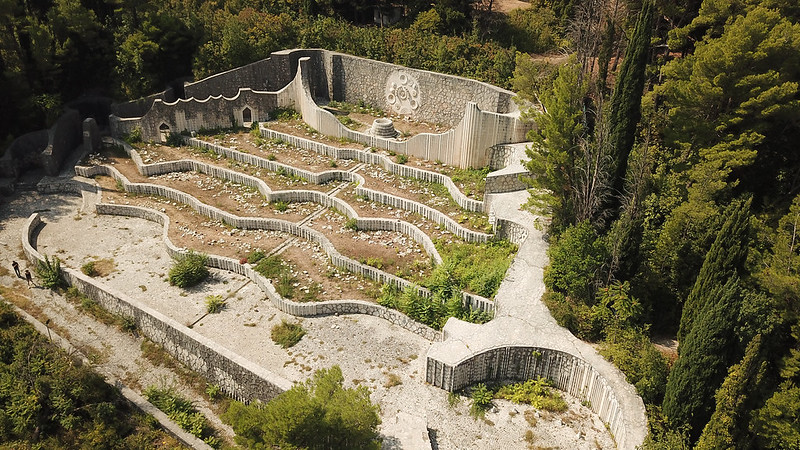
The Partisan Memorial Cemetery was built between 1960 and 1965 and designed as a public park — bringing the living and those resting in peace together. Despite being protected by law and being one of the most important antifascist memorials in the Balkans, the site has suffered neglect, repeated vandalism and severe damage, most dramatically in June 2022, when more than 700 engraved stone memorial markers were smashed in a single night. Vandalism continues to this day, without an effective institutional response, which has contributed to a deplorable climate of impunity and betrayal of the rule of law, which in practice serves as an encouragement for repeated acts of vandalism. Ongoing acts of destruction of graves and memorial elements, which includes graffiti with fascist signs, continue to endanger the physical integrity and symbolic dignity of the site, despite its highest level of statutory protection in Bosnia and Herzegovina.
Key recommendations of the report:
- The monument’s critical condition demands immediate physical protection by adequate safety measures and criminal prosecution for any acts of vandalism to uphold the rule of law.
- The report praises the local and regional experts and civil society groups for having joined forces to develop revitalisation and management plans based on European and international best practices and offers advice and support from European experts.
- All levels of government, from the state and entity to the cantonal and local levels, must jointly prioritise the site’s protection and integrate it into Mostar’s urban landscape within the relevant sustainable development frameworks. Given the Commission to Preserve National Monuments’ key responsibility for safeguarding national monuments, the Report urges the Presidency of Bosnia and Herzegovina to implement its decision on the Commission’s future functioning without delay.
- Given the site’s European significance, the EU should provide strategic and financial support, alongside desired involvement from UNESCO and the Council of Europe.
- The revitalisation project should be accompanied by adequate educational and interpretive programmes and activities that place the memorial within the wider artistic and historical context of Bogdan Bogdanović’s work.
- A comprehensive revitalisation project should also seek to unlock the site’s potential as a major tourism asset, a vital urban green space, and a tool for climate resilience as well as for the well-being of inhabitants and visitors of Mostar.
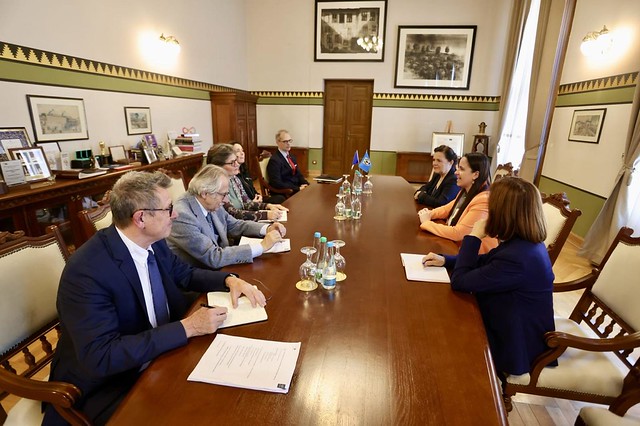
The Report is grounded, inter alia, in a mission to Mostar and Sarajevo, undertaken in October 2024, which brought together a wide range of expertise, including representatives of Europa Nostra, the European Union, UNESCO, local and national authorities and agencies, academics, as well as civil society led by the NGO IDEAA, who submitted the nomination of the Partisan Memorial Cemetery for the 7 Most Endangered Programme 2023.
The findings of the mission were further complemented and enriched by expert inputs and recommendations developed subsequently, including the conclusions of the First Regional expert conference held on 25-28 September 2025 in Mostar on the occasion of the 60th anniversary of the inauguration of the Partisan Memorial Cemetery.
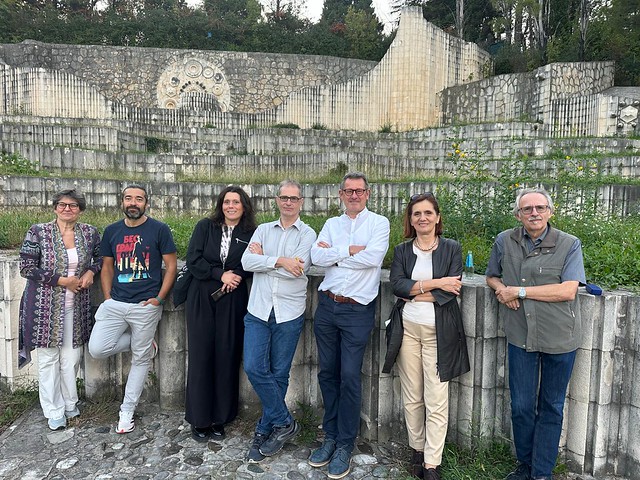
The Report was compiled by a European team of experts, namely Guy Clausse, Vice-President of Europa Nostra; Sneška Quaedvlieg-Mihailović, Secretary General of Europa Nostra; Dr Joachim Schneider, Economist and Urban Planner; and David Castrillo, Architect. The Report was produced in consultation with the following independent experts from Bosnia and Herzegovina and the wider region: Dr Senada Demirović, Head of the local NGO IDEAA, which submitted the nomination of the Partisan Memorial Cemetery for the 7 Most Endangered Programme 2023; Dr Amra Hadžimuhamedović, President of the HIDR – Centre for Peace and Heritage, and member of the Advisory Panel of the 7 Most Endangered Programme; Dr Dragan Markovina, Historian from Croatia, who was born and raised in Mostar; and Dr Slavica Vujović, President of Europa Nostra Serbia, Conservation Architect, who was born and raised in Mostar.
In the press
Explore further press coverage on the Report and the conference “Unique and Universal Value of Bogdan Bogdanović’s Works in Bosnia and Herzegovina and the Responsibility for their Protection in the Country and the World” at the Parliamentary Assembly of Bosnia and Herzegovina in Sarajevo.
- Interview of Sneška Quaedvlieg-Mihailović and Dr Amra Hadžimuhamedović on the channel N1
- Sneška Quaedvlieg-Mihailović and Dr Amra Hadžimuhamedović appearance on the public television channel of the Federation of Bosnia & Herzegovina
- News article, “Protecting the work of Bogdan Bogdanović: a question of preserving anti-fascist and EU values,” Federalna televizija (FTV), the public broadcasting service for the Federation of Bosnia and Herzegovina
- News article, “Protecting the work of Bogdan Bogdanović: a question of preserving anti-fascist and EU values,” Federal News Agency (FENA) of Bosnia and Herzegovina
- News article, “Procedure launched to inscribe the works of Bogdan Bogdanović on the UNESCO World Heritage List,” Radio Sarajevo
- News article, “Conference held in Sarajevo: Procedure launched to inscribe the works of Bogdan Bogdanović on the UNESCO list,” Slobodna Bosna
- News article, “Nikšić: We need to restore the Partisan Cemetery in Mostar,” Bljesak.Info