
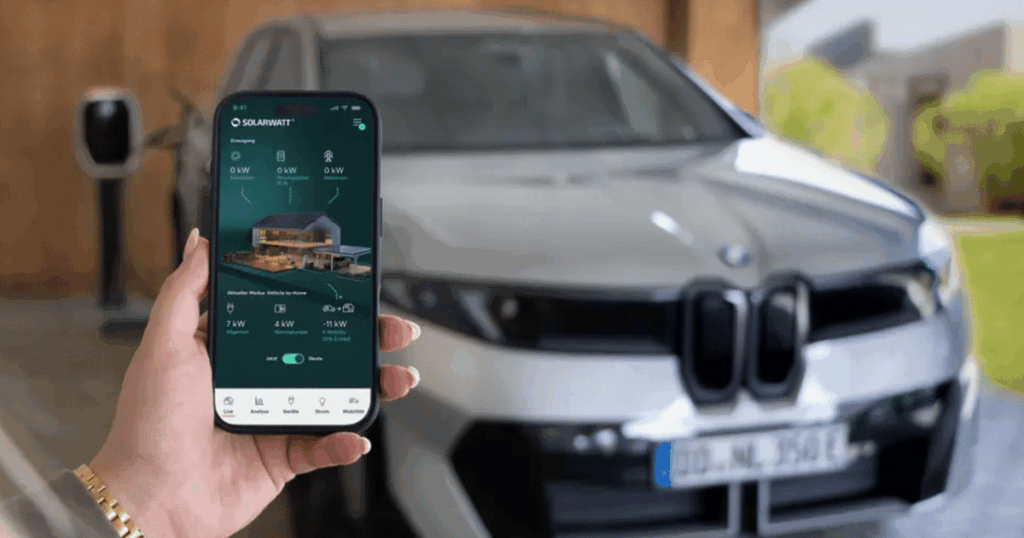
BMW has partnered with residential clean energy solutions firm Solarwatt to integrate its V2G-capable vehicles into the latter’s home EMS, enabling V2H applications, in Germany, Austria and the Netherlands.
The collaboration means that BMW’s recently launched vehicle-to-grid (V2G) capable infrastructure can be integrated into Solarwatt’s energy management system (EMS), which controls and optimises energy flows in households.
BMW’s bi-directional charging-capable EV infrastructure can be combined with home solar PV, home battery storage and consumer energy usage. Thus it enables vehicle-to-home (V2H) applications, another potential application for leveraging EV battery power.
It follows BMW launching what it claimed was Germany’s first V2G bundle for consumers in February this year, paying up to €0.40 per kWh discharged to the grid. To participate, customers need one of BMW’s Neue Klasse EVs, its 11kW, BMW Wallbox Professional bidirectional charger, and a smart meter.
The market launch for the integration of bidirectional BMW vehicles into Solarwatt’s new vehicle-to-home (V2H) EMS is planned for late 2026 in Germany, Austria and the Netherlands.
Using either the My BMW or Solarwatt apps, users will be able to use their EV battery’s capacity as additional storage for any excess solar, while the Solarwatt EMS allows for integration of dynamic electricity rates. Solarwatt’s EMS controls both its own products and other companies’.
“Bidirectional charging holds enormous potential for the energy transition, as the batteries of electric vehicles collectively form a massive storage reserve. If this flexibility is intelligently integrated into energy markets and households, it can help relieve the strain on power grids, better integrate renewable energy, and make additional storage capacity available quickly and cost-effectively,” said Marcus Krieg, VP new business at the BMW Group.
Overall, such collaborations should increase consumers’ ability to reduce exposure to the grid and also help the grid manage peak demand and congestion.
Generally speaking, the technology for V2G, V2H and other EV battery-integrating applications is proven. The big industry challenge is integrating the different parts of the EV and energy user ecosystem in a way that is financially attractive and easy to use for consumers.