
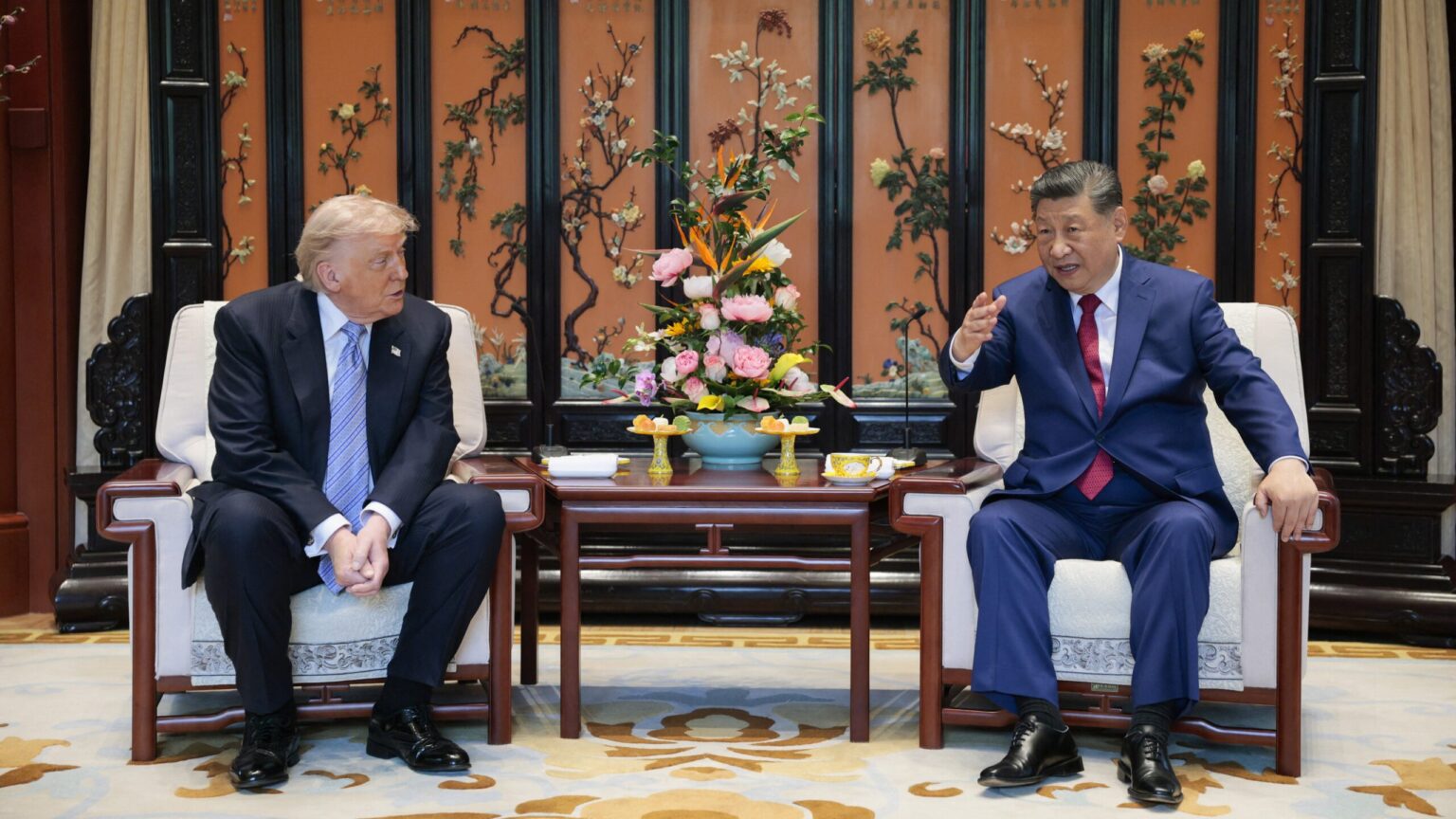
When Trump and Xi shook hands in Beijing on 15 May, they were not speaking to Europe. That omission was not accidental—it was structural. The summit’s deeper importance lies in what it revealed about the world now taking shape: one in which Europe’s security, prosperity, and values are being shaped by forces it neither chose nor can meaningfully influence.
The EU finds itself squeezed between two superpowers whose interests diverge from Europe’s in different ways—Washington’s growing indifference and Beijing’s patient strategic ambition. That double pressure has brought Europe to a reckoning it can no longer postpone.
The reckoning is this: the world being constructed around Europe is a world of empires, in the Schmittian sense—vast, self-willed blocs that control what others need and use that control to write the rules of global order on their own terms.
Carl Schmitt’s nomos—the spatial ordering of political power—is being redrawn, and Europe is not among the drawers. Europe must now choose whether to become a pole within this order or be governed by those who are.
The G2 Nightmare
For years, European foreign policy thinkers have identified the G2 scenario as their deepest strategic fear: Washington and Beijing managing their rivalry bilaterally, distributing costs and benefits between themselves while the rest of the world adapts. The Beijing summit has not formalized such an arrangement, but it has moved unmistakably in that direction.
Beijing’s post-summit statement spoke of a framework for ‘strategic stability’ to govern the relationship ‘over the next three years and beyond’. Washington’s readouts focused on trade wins and personal rapport.
‘Both logics converge on the same outcome…a bilateral order in which European interests are neither represented nor particularly relevant’
The divergence is itself revealing: China thinks institutionally, in terms of long-term equilibrium; America thinks transactionally. But both logics converge on the same outcome from Europe’s perspective—a bilateral order in which European interests are neither represented nor particularly relevant.
This is the uncomfortable truth that European capitals are only beginning to voice. The damage to trans-Atlantic solidarity has come as much from Washington as from Beijing. Tariffs on allied exports. Conditional security guarantees. A Ukraine policy that subordinated European interests to American negotiating tactics.
China has been patient and strategic in undermining Western cohesion. America has been impatient and blunt—but the effect has been remarkably similar. What the summit crystallized is not merely a diplomatic slight but what Thucydides understood as the brute grammar of power: great states act in their interest, and the rest accommodate.
The Trans-Atlantic Wake-Up Calls
Europe’s strategic anxiety predates Trump’s second term, but the second administration stripped away the diplomatic packaging and exposed the structural shift beneath. The shocks have arrived with rhythmic regularity: tariffs on European industrial goods, ambiguity over Article 5, Ukraine treated as a bargaining chip, and a military intervention in Iran with severe consequences for European energy markets—all undertaken without meaningful consultation with allies.
Taken together, these episodes force a question onto the agenda of every serious European government: is the trans-Atlantic alliance, as understood since 1949, still a reliable foundation? This is not a question anyone in Berlin, Paris, or Warsaw asks with pleasure.
But what the Beijing summit also clarified is that the United States remains entirely capable of sustained, strategically serious diplomacy—when the partner is China. Europe was not so much excluded as irrelevant. That is a different and more troubling message than neglect. It suggests a strategic reorientation, not a temporary lapse.
‘Europe was not so much excluded as irrelevant…It suggests a strategic reorientation, not a temporary lapse’
Kant imagined a federation of free states bound by law rather than power as the path to perpetual peace. The post-war Atlantic order was, imperfectly, an attempt to build something in that spirit. What is now being dismantled—not conspiratorially but structurally—is the Kantian wager, replaced by the Hobbesian logic that both Washington and Beijing are increasingly comfortable with: influence flows from control over necessities, not from normative standing.
The Beijing summit offered a masterclass in how supply chain dominance translates into geopolitical leverage. China’s control over the processing of rare earth minerals—inputs on which modern defence, clean energy, and digital technology all depend—was not a background condition of the summit. It was one of Beijing’s primary sources of confidence.
The precedent was established during the 2025 tariff confrontation, when China threatened to restrict the flow of rare earths and Washington backed down. The lesson: whoever controls the materials controls the negotiation. Europe is as exposed as the United States, and more so given its simultaneous commitments in three materials-intensive domains—rearmament, energy transition, and digital infrastructure.
This is not merely an industrial policy problem. In the terms Fernand Braudel used to describe long-cycle economic dominance, it is a structural problem of dependency. A bloc that depends on a rival for the materials its defence and economy require is not sovereign in any meaningful sense—it is a client, however prosperous.
Rome understood that supply line security was existential. So did the British Empire. Beijing understands it with exceptional clarity, which is why it has spent two decades building processing dominance far beyond its natural resource endowment.
Relief is not available from Washington either. American ‘friend-shoring’ rhetoric masks straightforward industrial competition. The only viable European response is collective investment at a scale individual member states cannot sustain—a European critical materials strategy with genuine funding and genuine political will. That it has not yet materialized is a measure of how much work the current moment of strategic clarification still has to do.
The Clean Energy Paradox — And a Reconsideration of China
Europe’s relationship with Chinese clean energy technology sits at the intersection of its climate commitments, its industrial interests, and its strategic anxieties. Chinese solar panels, batteries, and electric vehicles are substantially cheaper than European alternatives. The climate transition cannot wait for geopolitical conditions to improve, and Chinese manufacturers are currently its most cost-effective suppliers.
Yet the structural warning is equally real. Europe’s dependence on Russian gas was not the product of carelessness—it was rational economic calculation, repeated across decades, that consistently underweighted political risk. The calculation looked sound every year until the year it proved catastrophic.
What is changing is the calculation terms. For much of the past decade, European China policy was shaped substantially by alignment with Washington. That alignment rested on American leadership providing both the strategic analysis and the political cover for positions that often had domestic economic costs. As American leadership becomes less coherent and more self-interested, the consensus has weakened.
A Europe building genuine strategic autonomy will need to make its own risk assessments. In practice, this might mean a more differentiated approach: harder lines on defence-adjacent supply chains; more pragmatic engagement on climate cooperation, and scientific exchange where dependency risks can be managed.
Taiwan: Should Europe Embrace Indifference?
Beijing’s post-summit communications were unambiguous in treating Taiwan as the central issue in the bilateral relationship—the variable on which the entire architecture of US–China relations ultimately depends. Trump, asked directly about Taiwan during his time in Beijing, said nothing.
That silence is its own message. A Washington that declines to reaffirm its commitments under direct pressure is a Washington whose security guarantees elsewhere have become harder to value at face value. For European NATO members on the alliance’s eastern edge, American ambiguity under Chinese pressure carries an obvious and uncomfortable implication.
‘A more strategically autonomous Europe will need to develop a genuine position on Taiwan’
Europe’s traditional posture—defer to Washington, issue hedged statements, avoid commitment—is no longer tenable on its own terms if Washington itself is becoming an unreliable anchor. A more strategically autonomous Europe will need to develop a genuine position on Taiwan. Not a military commitment it cannot sustain, but a coherent view of what kind of Indo-Pacific order serves European interests.
The Iran War and European Energy Exposure
Europe is paying significantly more for energy as a result of a war in which no European government had a meaningful voice. Roughly a fifth of global oil and LNG supplies previously moved through the Strait of Hormuz before the conflict disrupted that flow. The Beijing summit resolved none of this.
The political dimension deserves to be stated as clearly as the economic one. A major military intervention with severe and foreseeable consequences for European energy security was undertaken without any meaningful consultation with European allies. The decision was made in Washington and Tel Aviv. The costs have been distributed across European households and businesses.
This asymmetry—between who decides and who pays—is precisely what subordination looks like in practice, and it illustrates the core insight of dependency theory, applied not to postcolonial peripheries but to a prosperous continent: structural powerlessness is not about poverty but about the inability to participate in decisions that determine your condition.
Iran is therefore a test case for the broader argument. An energy shock absorbed because Europe had no voice in the decision that caused it is not an argument for accepting that condition permanently. It is an argument for changing it.
The AI and Technology Dimension
The summit’s failure to produce any meaningful agreement on artificial intelligence—no binding safety framework, no resolution on chip exports—leaves the world’s two most capable AI powers in an unmanaged competition. For Europe, this is doubly uncomfortable.
The EU has invested enormous political capital in positioning itself as the global leader in AI governance. The AI Act is a genuine achievement. But regulatory leadership without technological capability is a structurally weak position—what might be called, borrowing from political theory, auctoritas without potestas: the authority to pronounce without the power to enforce. Regulation applied to technologies produced entirely elsewhere is a form of borrowed sovereignty. It functions as long as producers value European market access enough to comply with it. It fails the moment they decide otherwise.
‘Regulation applied to technologies produced entirely elsewhere is a form of borrowed sovereignty’
The only serious response is a major, collectively funded European effort to build an indigenous AI capability. Not as a substitute for international cooperation, but as its prerequisite. A Europe that produces world-class AI systems can negotiate the terms of AI governance from a position of genuine standing. A Europe that regulates other people’s AI systems is a spectator dressed as a referee.
The Strategic Autonomy Moment and the Integration Paradox
The deepest irony of the current moment is that US pressure designed to keep Europe divided may be producing the opposite result. External shocks of sufficient severity have historically been the most powerful drivers of European integration—more powerful than any internal political argument. The series of shocks delivered by the second Trump administration, compounded by challenges from China and the costs of the Iran conflict, has created precisely the conditions under which integration arguments become irresistible: when the alternative to collective capacity is repeatedly and expensively demonstrated to be collective vulnerability.
Defence spending across the EU is rising at rates not seen since the Cold War. The European Defence Union has moved from aspirational language to serious institutional design. Mario Draghi’s call for investment at a scale only possible through common European borrowing has shifted the scope of what is considered politically feasible.
The analogy that suggests itself is not the Coal and Steel Community, born of the desire to make war between France and Germany structurally impossible. It is closer to what Tocqueville observed in the American founding: that separate sovereignties, each insufficient to the challenges they faced, were compelled by the logic of circumstance toward a union that none had initially willed. The structural logic is similar. Scale is the precondition of sovereignty in a world of imperial blocs.
Trump’s legacy in Europe, if current trajectories continue, may be the precise opposite of his intention, as laid out by the 2025 National Security Strategy. The president most hostile to European institutions may go down in history as the most effective catalyst for European unity since the Marshall Plan.
The Empty Chair and the Will to Fill It
There was no European chair at the Beijing summit. There was no European voice in the conversations about trade architecture, technology governance, Taiwan’s future, the Strait of Hormuz, or the framework that will structure the world’s most consequential bilateral relationship for the next three years. This absence was not a diplomatic oversight. It was a structural condition.
The world being assembled in Beijing and Washington does not resemble the world Europe spent the post-war decades constructing. That world—of multilateral rules, of institutions that constrained the strong and gave voice to the less powerful — was the most ambitious political project of the 20th century, and Europe was its primary architect and primary beneficiary. It is being dismantled by the accumulated weight of choices made by powers that never fully shared its premises.
‘The world being assembled in Beijing and Washington does not resemble the world Europe spent the post-war decades constructing’
In its place, a world of empires is taking shape. Europe’s potential power is immense; its actual power remains constrained by the unwillingness to act collectively. The conversion from the world’s largest economic unit into a coherent geopolitical actor is what European integration, at its most ambitious, has always been about. The Beijing summit has made the cost of failing to complete that project impossible to ignore.
The question Europeans must now answer is one the architects of the post-war order hoped they would never face: in a world that runs on imperial power, does Europe have the will to become a force within it—or will it remain, however prosperous and principled, a subject of history rather than its author? The empty chair in Beijing was a symptom. The answer to that question will determine whether it becomes a permanent condition.
Related articles: