
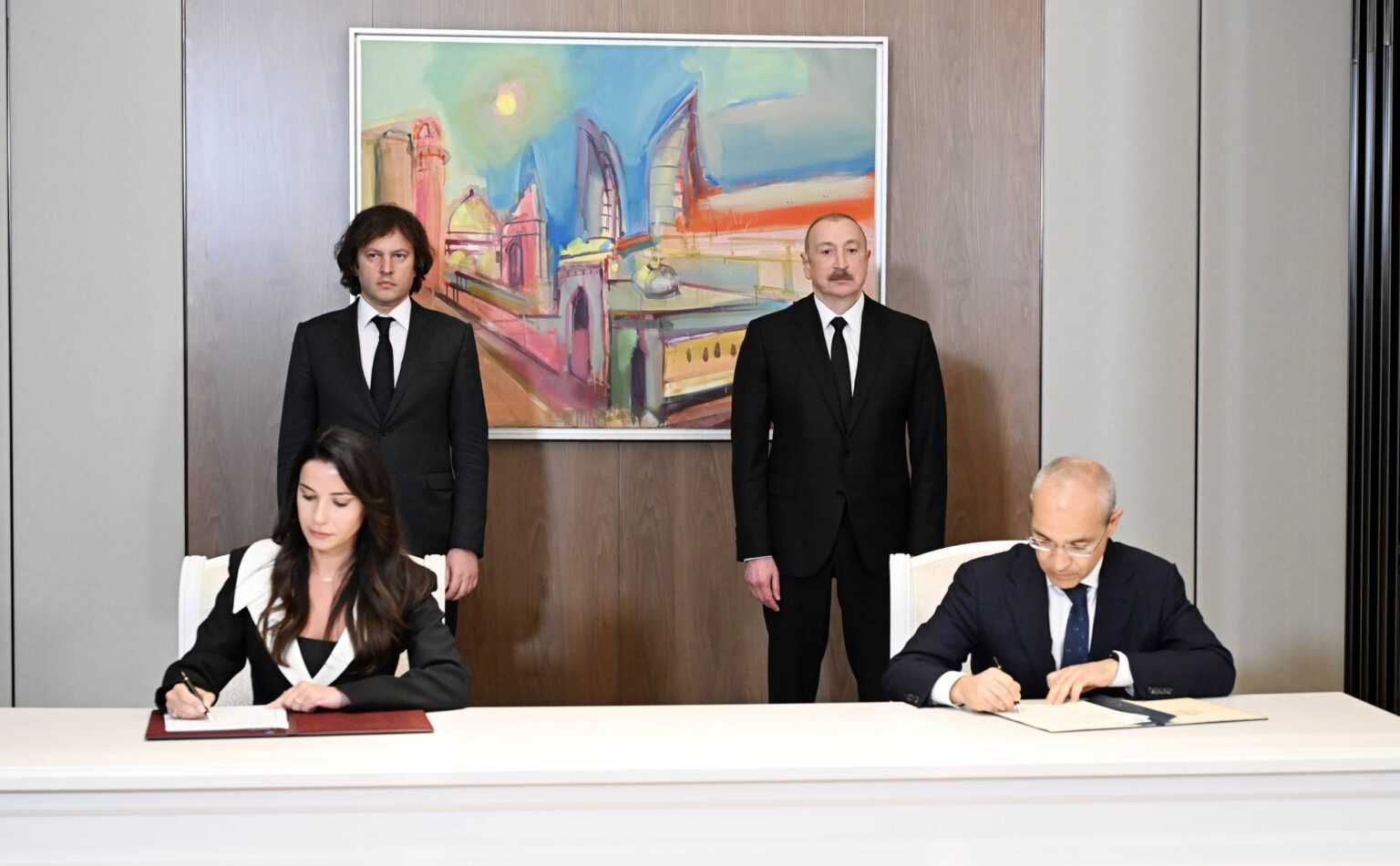
Tbilisi and Baku signed agreements on natural gas and electricity supply to Georgia, as well as a protocol foreseeing the resumption of railway service between the two capitals after a six-year pause, the Georgian government administration announced.
The agreements were signed after a May 18 meeting between Georgian Dream Prime Minister Irakli Kobakhidze and Azerbaijani President Ilham Aliyev in Baku, where the Georgian Dream government delegation attended the World Urban Forum (WUF13), held in partnership with the United Nations Human Settlements Programme (UN-Habitat).
The agreement came a month after Ilham Aliyev’s visit to Tbilisi, where he met, among others, Georgian Dream founder and Honorary Chairman Bidzina Ivanishvili.
According to a Georgian government administration press release, a package of agreements in the energy and transport sector includes “a 20-year intergovernmental agreement on the main terms of electricity supply and transit between Georgia and Azerbaijan” and “a 20-year extension of the 2003 agreement on the purchase and sale of gas from Azerbaijan,” which “guarantees the security of social gas supply.”
The agreements were signed by Georgian Dream Economy Minister Mariam Kvrivishvili and Azerbaijan’s Economy Minister Mikayil Jabbarov and Energy Minister Parviz Shahbazov. The details and conditions of the agreements have not been disclosed.
In addition, the press release said the sides also signed “a protocol of the bilateral coordination council,” under which “the new section of the Baku-Tbilisi-Kars (BTK) railway will become fully operational” and “daily passenger railway service between Tbilisi and Baku will resume from May 26 after a six-year pause.” The document was signed by Mariam Kvrivishvili and Azerbaijan’s Minister of Digital Development and Transport, Rashad Nabiyev.
Describing the agreements as “important,” Georgian Dream Prime Minister Irakli Kobakhidze spoke with Georgian journalists, among others, about the agreement related to the Baku-Tbilisi-Supsa pipeline. He said, “This pipeline had, in practice, been shut down for the past three years and was not operating, as a result of which the country was not receiving potential revenue. Under the new agreement, together with the Azerbaijani side, the operation of this pipeline will be restored.” He added that the pipeline “remains in Georgia’s ownership, but its proper operation will be ensured in cooperation with the Azerbaijani side, as a result of which the country will receive tens of millions in revenue annually.”
Speaking of a broader connectivity theme, Kobakhidze said, “We, together with Azerbaijan, are connecting the Caspian Sea with the Black Sea, and therefore Europe with Asia, and the development of cooperation between Georgia and Azerbaijan has a truly strategic significance, and in this regard these agreements are of historical importance, of milestone significance.”
The agreements were signed after the meeting between Kobakhidze and Aliyev, also attended by ministers from both countries, during which they focused on the “strategic partnership” between Georgia and Azerbaijan and “the prospects for further deepening cooperation.” They also discussed the “positive dynamics” in bilateral trade and economic relations and highlighted the role of the Intergovernmental Commission on Economic Cooperation, with the Georgian delegation expressing readiness to host its next session “in the near future.”
The sides also discussed global and regional geopolitical challenges, emphasizing “the importance of peace for the sustainable and stable development of the region.” The meeting also addressed “regionally significant projects jointly implemented by Georgia and Azerbaijan and their role in strengthening connectivity.”
The Azerbaijani presidential administration additionally said in its press release that Aliyev “recalled with satisfaction his state visit to Georgia in April this year, noting the contribution of this visit to strengthening bilateral relations.”
Forum, Further Meetings
Prior to meeting Aliyev, Irakli Kobakhidze addressed the World Urban Forum, saying that alongside Georgia’s “strong economic growth” in recent years, the country’s key policy priorities have become “balanced territorial development and modern urban planning.” He added that “our objective is not only to expand infrastructure and improve quality of life, but to ensure that growth remains sustainable, regionally balanced, and centered around the needs of our citizens.”
Kobakhidze also held several other bilateral meetings.
During the one-on-one meeting with Tomáš Taraba, Slovakia’s deputy prime minister and minister of environment, “the parties discussed the positive dynamics in the development of bilateral relations and prospects for deepening cooperation in various fields,” with the Georgian government administration press release further saying Kobakhidze “emphasized the significance of protecting national interests and maintaining relations based on mutual respect and thanked the Slovak side for its support of the country.”
The meeting with William Ruto, President of the Republic of Kenya, “focused on Georgia’s favorable geographic location and business environment,” as Kobakhidze spoke about “the positive dynamics of economic growth and the opportunities offered by the country to investors in terms of access to multimillion consumer markets.”
Also Read:
Copy URL
URL Copied