
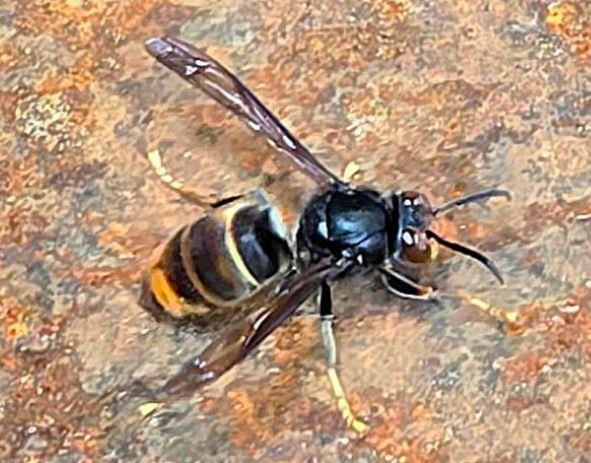
Yellow-legged hornet likely a stowaway, WSDA records suggest
Published 5:00 pm Monday, May 18, 2026
The yellow-legged hornet found last month in Washington likely hitched a ride on a ship that traveled from South Korea to the Port of Vancouver, according to Washington State Department of Agriculture records.
The lone live hornet either boarded the bulk carrier Mission Revival in Asia, or flew into the cargo hold while the roof was open for cleaning, according to an early assessment by WSDA pest program manager Sven Spichiger.
The day after the discovery, Spichiger leaned toward the stowaway theory, but didn’t rule out that the hornet was already in the Portland-Vancouver area, a more worrisome theory.
“Looks like a hitchhiker, but the cleaning protocol makes it flying on (the ship) here also possible,” Spichiger said in an email to an Oregon Department of Agriculture official.
The yellow-legged hornet, formerly known as the Asian hornet, is half the size of the northern giant hornet, formerly known as the Asian giant hornet and popularly known as the “murder hornet.”
Bee experts, however, say yellow-legged hornets are a bigger threat to spread and kill pollinators than northern giant hornets. Yellow-legged hornets have more offspring, are more mobile and mass in front of beehives, a killing trait entomologists call “hawking.”
Yellow-legged hornets have gained a foothold in Georgia and South Carolina, but had not been found elsewhere in the U.S. until April 30.
The Mission Revival arrived at the Vancouver port shortly before midnight on April 29. Two weeks earlier, the 623-foot ship had unloaded sugar and left Ulsan, South Korea, one of Korea’s largest ports.
Yellow-legged hornets are not native to South Korea, but they were detected there in 2003 and spread, though more slowly than in Europe.
Researchers have speculated Korea’s other hornet species slowed down yellow-legged hornets. In one test, entomologists placed a table in a forest and spread a mixture of brown sugar, vinegar and ethanol on it to lure five hornet species.
The species fought, and the yellow-legged hornet usually lost. The northern giant hornet won 91% of 104 fights with yellow-legged hornets. Northern giant hornets showed a “high rate of grappling behavior” by head-butting smaller yellow-legged hornets.
Two-week voyage
The Mission Revival left South Korea empty. The crew washed the cargo hold with sea water and painted it during the crossing.
The morning after the Mission Revival arrived in Vancouver, WSDA grain inspector Keoni Gutierrez boarded to inspect the hold before it was loaded with grain.
Gutierrez saw the hornet, took a photo, stepped on it and discarded it. The photograph convinced WSDA entomologists it was a yellow-legged hornet.
Mission Revival crew members confirmed Gutierrez’s report. They said they thought the hornet flew in after the ship docked. The hold was washed and painted, but no one saw the hornet until the roof was opened, they reasoned.
WSDA and U.S. Customs and Border Protection organized a search party and boarded the ship the next morning. WSDA entomologists searched the cavernous cargo hold, while border agents searched the rest of the ship. Nothing was found.
WSDA placed 40 traps, baited with brown sugar and grape juice, in the area. To date, WSDA has not reported trapping any yellow-legged hornets.
The department plans to hang more traps and conduct a public-awareness campaign, including by distributing 5,000 magnets that look like yellow-legged hornets.
If nests are found, eradication will require environmental reviews. The following is a list of laws WSDA will have to consider:
The National Environmental Policy Act; Endangered Species Act; Federal Insecticide, Fungicide and Rodenticide Act; Toxic Substance Control Act; State Environmental Policy Act; Salmon Recovery Act; Washington Pesticide Control Act; Washington Pesticide Application Act; Clean Air Act; Washington State Forest Protection Act; Occupational Safety and Health Act; Clean Water Act; National Forest Management Act; USDA Organic Act and U.S. Plant Protection Act.