
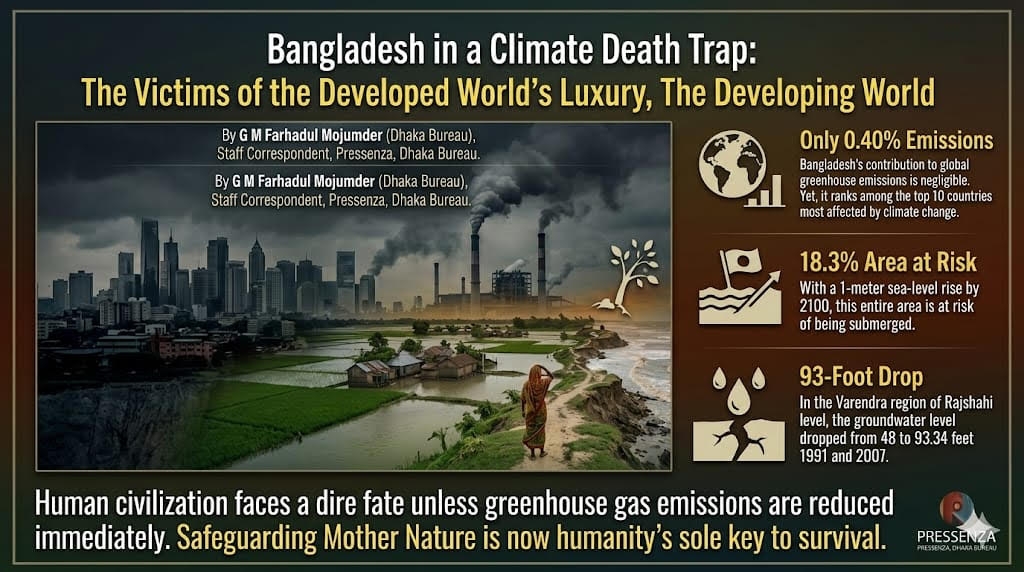
by G M Forhadul Mozumdar (Dhaka Bureau)
Although the Earth’s climate has been changing since the dawn of time, human-induced, unregulated activities in the twenty-first century have accelerated this shift into a catastrophic reality. In its latest report, the United Nations Intergovernmental Panel on Climate Change (IPCC) issued a stark warning to the global community: atmospheric emissions of greenhouse gases- particularly carbon dioxide, nitrous oxide, and methane- have reached an all-time high. As a result, our planet is warming at an unprecedented rate.
According to the IPCC, global governments are failing to limit the rise in global temperatures to 1.5 degrees Celsius, a threshold committed to in the 2015 Paris Agreement. The most brutal truth of this global warming crisis is that developing and underdeveloped economies, like Bangladesh, are bearing the brunt of the luxurious lifestyles led by developed nations.
0.40% of Emissions, But Bangladesh Ranks Highest in Damages
According to World Bank data, Bangladesh contributes a mere 0.40% to global greenhouse gas emissions. Yet, the country ranks among the top 10 nations most devastated by climate change. A combination of geographic location, high population density, poverty, and a lack of social safety nets has pushed Bangladesh to the precipice of extreme vulnerability.
Comprising mostly low-lying plains and deltaic land, more than 80% of Bangladesh’s landmass is flood-prone. In a country where two-thirds of the population depends directly on agriculture, erratic weather patterns are devastating the national economy and dismantling food security.
Tangible and Visible Impacts of Climate Change
* Rising Sea Levels: Along the Cox’s Bazar coast, the sea level is rising at an annual rate of 7.8 mm. Over the past four decades, approximately 3,000 square kilometers of Bhola Island have already been swallowed by the sea.
* The Catastrophic 2100 Forecast: The World Bank warns that by the year 2100, sea levels could rise by up to 1 meter (nearly 3 feet). This would submerge 18.3% of Bangladesh’s total land area, triggering mass poverty and hyper-inflation.
* Alarming Depletion of Groundwater: Data from the Department of Public Health Engineering (DPHE) reveals that in the high Barind tract of Rajshahi, the groundwater table dropped from 48 feet in 1991 to a staggering 93.34 feet in 2007.
* Frequent Natural Disasters: Following the devastating Cyclone Sidr in 2007, powerful cyclones such as Nargis, Aila, and Mahasen struck the coast within short intervals. Currently, even normal monsoon floods inundate 20% of the country, with both the frequency and intensity of floods on the rise.
Endangered Human Health and Livelihoods
The fallout of climate change extends beyond nature, directly striking public health and livelihoods. In the Sylhet and Sunamganj regions, unseasonal, flash floods have decimated rice crops- the lifeline of the Haor wetlands. Meanwhile, extreme and unusual temperature spikes have led to outbreaks of cholera, while infectious diseases like dengue are taking on epidemic proportions. The primary victims of this crisis are the country’s marginalized and impoverished communities, who lack the economic resilience or technological resources to adapt to these extreme conditions.
The Revenge of ‘Mother Nature’: Lessons from COVID-19
Over the past century, atmospheric carbon dioxide has increased by 23%, nitrous oxide by 19%, and methane by a staggering 100%. When nature pushes back against this destruction, no advanced healthcare system or human technology can withstand it. The recent COVID-19 pandemic stands as a haunting testament to this reality.
Nature favors no one, yet it denies no one. The pandemic served as a ruthless lesson—while humanity was locked indoors, nature took a breath of relief. We must remember that human immunity and survival originate from nature itself. Through photosynthesis, plants absorb carbon dioxide, providing us with oxygen and food.
The Earth does not belong to humans alone; it belongs to all animals, plants, and flora. If nature turns completely hostile, the potential extinction of the human race from this planet cannot be ruled out.
To protect Bangladesh from this impending mega-disaster, public awareness must be raised at all levels, and the developed world must acknowledge its historical responsibility. Unless greenhouse gas emissions are slashed immediately and sustainable ecosystems and biodiversity are protected, human civilization will face an unimaginably grim fate. Safeguarding Mother Nature is now humanity’s sole key to survival.
##########
The Author:
 G M Forhadul Mozumdar: Staff Correspondent, Pressenza- Dhaka Bureau.