
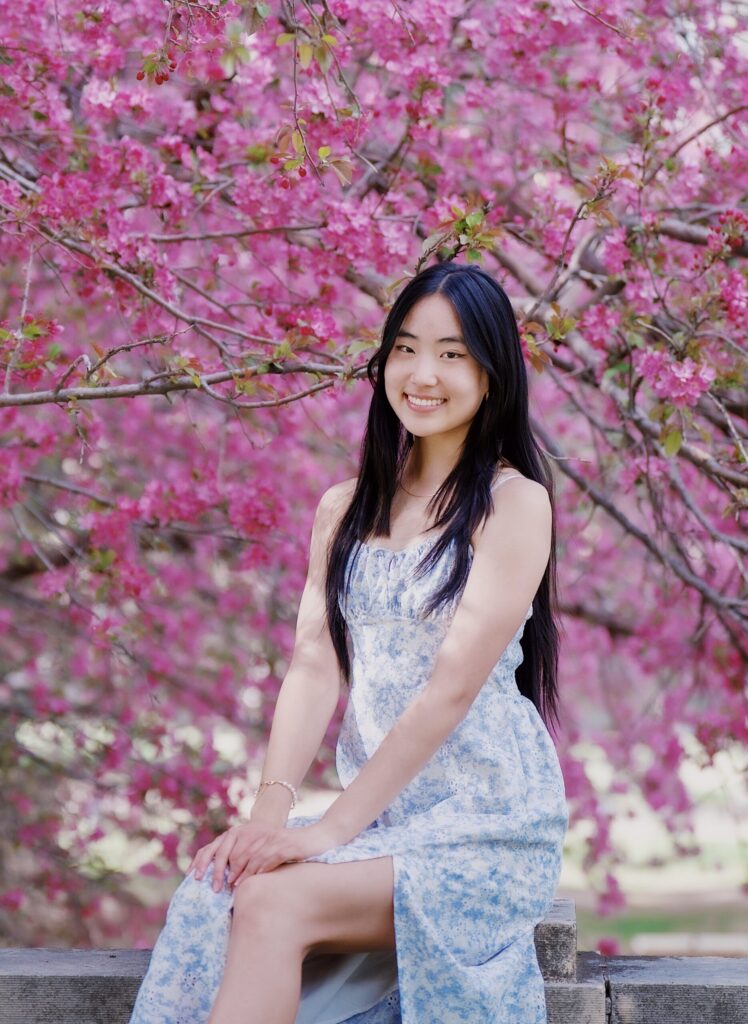
Like many of the Best and the Brightest Winners, Sophie Zhou is an exceptional student. She anticipates attending Stanford this fall. Her twin passions for Art and Computer Science have carved out for her an art-activist niche that she can set her life in.
She is also a member of the non-profit organization All In AI, which runs summer camps to teach underrepresented students about machine learning. Sophie is motivated by working with these students and enjoys running the free summer camps at her school.
Zhou is most proud of being self-taught – when struggling with something, she often had to just “figure it out.” She shared a story in her application that illustrated how often she grappled with stress. She experienced difficulties with verbal expression because she was the only family member fluent in English, but at times her skills fell short.
“The insurance rep snapped after six-year-old me stumbled over my words, while translating my mom’s broken English. The line went dead. I was old enough to translate – but not old enough to be told our circumstances.”
Art has allowed Sophie to identify and acknowledge her own emotions. She created images that gave words to feelings that were too painful for her to say aloud.
One of her pieces, depicting her mother’s “ruby-red hands” performing CPR on her – symbolically reviving her disconnected Asian heritage, elicited more reaction than anything she could have explained in words. Through her artwork, others were finally able to understand her emotions, without her having to disclose too many personal details of her circumstances.
Sophie describes her emotional growth facilitated by the creative process. “Constant redrawing wrestled authenticity out of me, forcing me to process my emotions. Art empowered me to make a statement.’
So as generative AI emerged – producing thousands of pieces of art per second and saturating the internet often with plagiarized art – Sophie felt that human artists were being overshadowed. It felt as though she was her six-year-old self again: powerless and unable to express herself. The identity she had reclaimed through art was shattered.
Zhou used her passion for computer science to push back against the AI plagiarizing art trend.
“As I investigated more scalable methods Of distinguishing AI art from human art I wondered, could I use computer science algorithms to tease out artists’ unique quirks, shaped by their context and influences or, “micro-clues’, in their work? For guidance, I cold-emailed Dr. Shu Kong, a professor researching generative Al, and joined his lab.”
Sophie’s work in this area resulted in a publication presenting a new state-of-the-art approach for detecting art plagiarism. Her work has the potential to protect the livelihood of artists all over the globe.
But she wasn’t finished yet. Zhou wanted her work to reach beyond research papers, so she created VanGotcha, an online game where players identify real Van Gogh paintings from AI-generated fakes.
VanGotcha educates artists on spotting plagiarism. The website even offers them the option to submit their own artwork, so the plagiarism detection algorithm can protect it in the future as well.
Seeing 2,000+ users join this effort has given Sophia hope that they can achieve something more for artist protection.
“Nowadays, I’m exploring Al-detection in video since Al-generated content threatens the notion of truth in media. It is an even harder technical problem, but the algorithms I can use to solve it are both intellectually fascinating and key to protecting artists for years to come.”