
A child is born in North Korea. But from the very moment of birth, that innocent child is declared a traitor.
North Korea is known as one of the strictest countries in the world, with laws so extreme that they are hard to believe. For example, elections are held—but there is no real choice. You can only vote for one candidate. If you don’t vote, you can be sent to prison.
There is only one TV channel, and you cannot change it. In fact, North Korea may be the only country where not just committing a crime—but even thinking about one—can lead to punishment.
Until 1945, Japan ruled Korea for 35 years. After World War II, Korea was divided into two parts: North Korea and South Korea.
North Korea came under the influence of the Soviet Union, while South Korea was influenced by the United States.
In 1948, Kim Il-sung became the leader, and the country was named the Democratic People’s Republic of Korea. However, true democracy never really existed there.
In 1950, the Korean War began between North and South Korea. Even after the war ended, no formal peace treaty was signed—so technically, both countries are still at war.
Power in North Korea has always remained within one family:
Kim Il-sung
Kim Jong-il
Kim Jong-un
Each ruler enforced strict laws to maintain control and prevent people from being influenced by outside cultures.
Here are some of the unusual and strict rules:
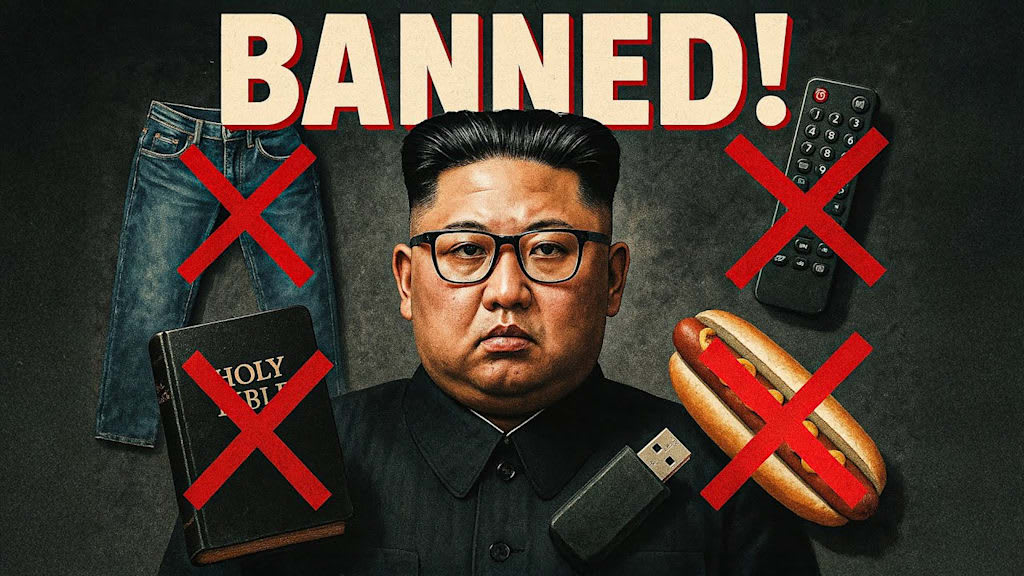
In 2024, sunglasses and certain wedding dresses were reportedly restricted.
In metro stations, instead of music, speeches of the Kim family are played—and people must stay silent.
Watching South Korean dramas or Hollywood movies can lead to severe punishment or labor camps.
Citizens do not have access to the global internet—only a closed internal network monitored by the state.
Calling someone abroad without permission is illegal.
All media—TV, radio, newspapers—are controlled by the government.
Hairstyles are restricted to approved styles only.
Western clothing like jeans or dyed hair is banned.
Even certain foods associated with foreign cultures are restricted.
Travel is also heavily controlled. To move from one city to another, you need official permission. Ordinary citizens cannot leave the country, and passports are only given to elite individuals.
Everything—homes, land, businesses—belongs to the state. People can only use them with permission.
Religious practice is also restricted. Although some churches exist, they are often just for display. Practicing religion can lead to punishment.
One of the harshest rules is collective punishment:
If someone speaks against the government or the Kim family, not only that person—but their entire family—can be imprisoned. This punishment can extend up to three generations.
This means that even a child born years later can be labeled a traitor because of their ancestors.
The government also maintains a strict class system called “Songbun.” A person’s status is decided at birth based on family history:
Core class: Loyal families, given top jobs and privileges
Wavering class: Average citizens
Hostile class: Considered disloyal, given the worst jobs
Citizens are constantly monitored. Informants live among people, secretly reporting behavior.
There are weekly “self-criticism sessions,” where people must publicly admit their mistakes—like not praising the leader enough or being influenced by foreign culture.
Voting is mandatory, but again—only one candidate is allowed. Elections serve more as a loyalty test than a democratic process.
Even daily life is controlled:
Electricity, water, and gas are rationed
Military service of about 10 years is mandatory
Mourning the deaths of leaders like Kim Il-sung and Kim Jong-il is compulsory
Every home must display their portraits
Children are taught to memorize speeches of the leaders from a young age.
North Korea even uses a different calendar called the “Juche calendar,” which starts from 1912—the birth year of Kim Il-sung.
There are several reasons why North Korea remains so isolated:
The regime fears that exposure to the outside world could lead to rebellion
International sanctions due to its nuclear program have further isolated the country
Much of this information comes from defectors—people who managed to escape after 1953—as well as satellite monitoring and smuggled footage.
Overall, North Korea remains one of the most closed and controlled societies in the world, where fear, strict laws, and surveillance shape everyday life.