
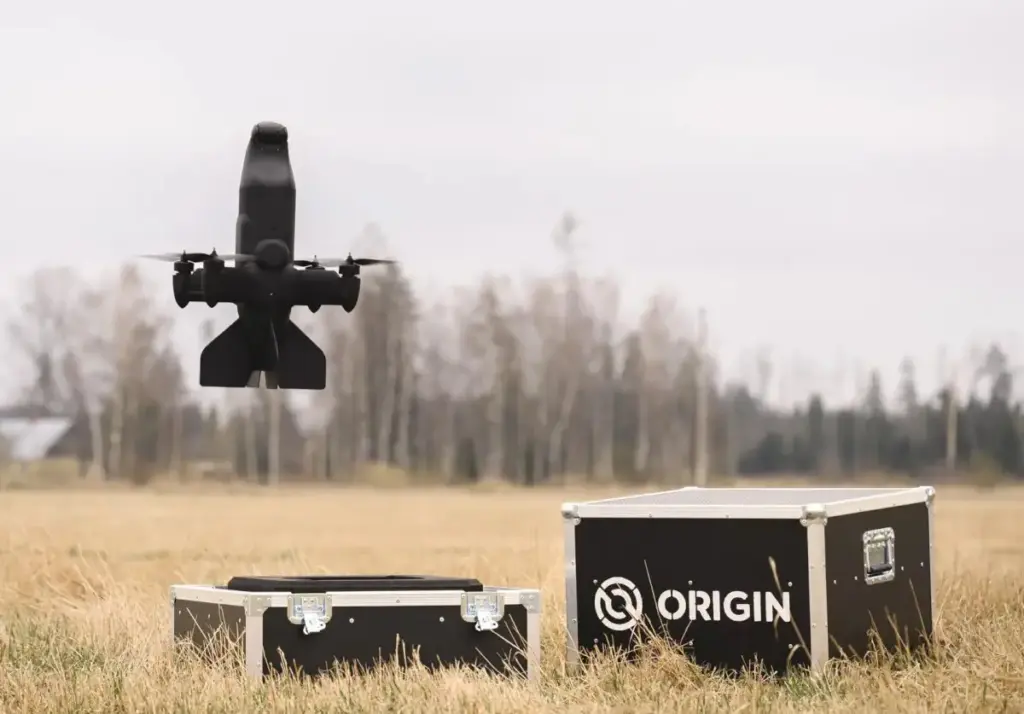
- A new contract for Origin Robotic’s counter-UAS systems supply has been signed with Latvia, under a multi-year framework agreement secured back in December 2025
- The framework is open to other European nations to join via government-to-government cooperation, enabling faster procurement and SAFE financing eligibility without launching a separate national process
- Technical specifications can be renegotiated annually, ensuring European armies always receive the latest version of BLAZE throughout the life of the agreement
Origin Robotics, a defence technology company specialising in advanced unmanned aerial weapons systems, has secured a multi-year framework agreement with the Latvian Armed Forces for the ongoing supply of its BLAZE autonomous interceptor drone systems. The first contract under its terms, financed through the European Union’s Security Action Fund (SAFE) instrument, was approved by the Latvian Cabinet of Ministers on April 21, 2026. The contract value and number of deliveries are not disclosed.
Across Europe and beyond, the proliferation of low-cost drones and loitering munitions, accelerated by the wars in Ukraine and the Middle East, has exposed critical gaps in air defence, driving urgent demand for fast, cost-effective interception solutions. The framework agreement establishes a reusable procurement vehicle that extends beyond Latvia’s own supply needs. Under a government-to-government cooperation model, other European countries can join the existing agreement directly, rather than launching their own procurement process from scratch. This allows allied nations to move faster and access Origin’s autonomous interceptor drone systems through a streamlined process. Contracts signed under the framework also qualify for SAFE financing, removing an additional barrier for EU member states seeking to strengthen their counter-UAS capabilities.
Agris Kipurs, CEO and co-founder of Origin Robotics, said: “What makes this agreement truly significant is its structure. It gives Latvia the security of procuring BLAZE capability for multiple years ahead, with no new lead times and no procurement gaps. Both sides can renegotiate the technical specification each year. That means Latvia will always be receiving the latest version of BLAZE. And because the framework is open to other nations, allies can join without starting their procurement from zero. This is a fundamentally different approach to defence procurement, and we believe it is the right model for a technology that evolves as fast as autonomous aerial systems.”
Traditional defence contracts lock in a technical specification at signing. For autonomous systems, where AI capabilities, computer vision accuracy, and sensor integration improve continuously, this means armed forces can find themselves receiving outdated technology by the time deliveries conclude. The framework agreement addresses this directly: technical specifications can be renegotiated once per year, ensuring that each delivery reflects the current state of the BLAZE platform. Buyers secure lead times and supply continuity for years ahead, while retaining access to the latest product version as the technology evolves.
BLAZE is designed, developed, and manufactured entirely in Latvia, qualifying it as a European-origin system under EU SAFE instrument criteria. The use of SAFE funding reflects the system’s compliance with European defence-industrial requirements and the growing urgency around counter-UAS capability across NATO’s eastern flank, where unauthorised drone activity near military sites and critical infrastructure has accelerated demand for autonomous interception solutions.
Latvia was the first European nation to order and take delivery of BLAZE, followed by Estonia and Belgium. Together, the three countries are the first on the continent to field a fully autonomous, warhead-equipped drone interceptor. Several additional allied countries are procuring BLAZE, with further announcements expected in due course.
Related
Discover more from sUAS News
Subscribe to get the latest posts sent to your email.