
The latest official figures point to a labour market feeling the strain.
Key points:
- The latest data from the Office for National Statistics (ONS) shows vacancies at a five-year low, payrolled employment down 100,000, and unemployment rising.
- Real wage growth has stalled and is set to turn negative as the energy price shock feeds through to inflation.
- The Bank of England’s dilemma is sharpening: inflationary pressures point toward tightening, but with wage growth decelerating and second-round effects conspicuously absent, the 2022 playbook does not appear to apply.
Today’s worse-than-expected ONS figures signal a renewed deterioration in the UK labour market. Vacancies fell to a five-year low in April, payrolled employment contracted by a substantial 100,000, and unemployment rose.
Some caveats apply. The payrolls figure is revision-prone, and the recently volatile unemployment rate continues to be afflicted by well-documented quality issues with the underlying Labour Force Survey. Overall, though, the data paints a consistent picture – the transmission from elevated business costs and heightened uncertainty into weaker labour demand.
Youth unemployment warrants particular attention, having risen to 16.2% – the highest in over a decade. The spike in joblessness among young people is a reminder that workers at the beginning of their careers feel these pressures first and hardest.
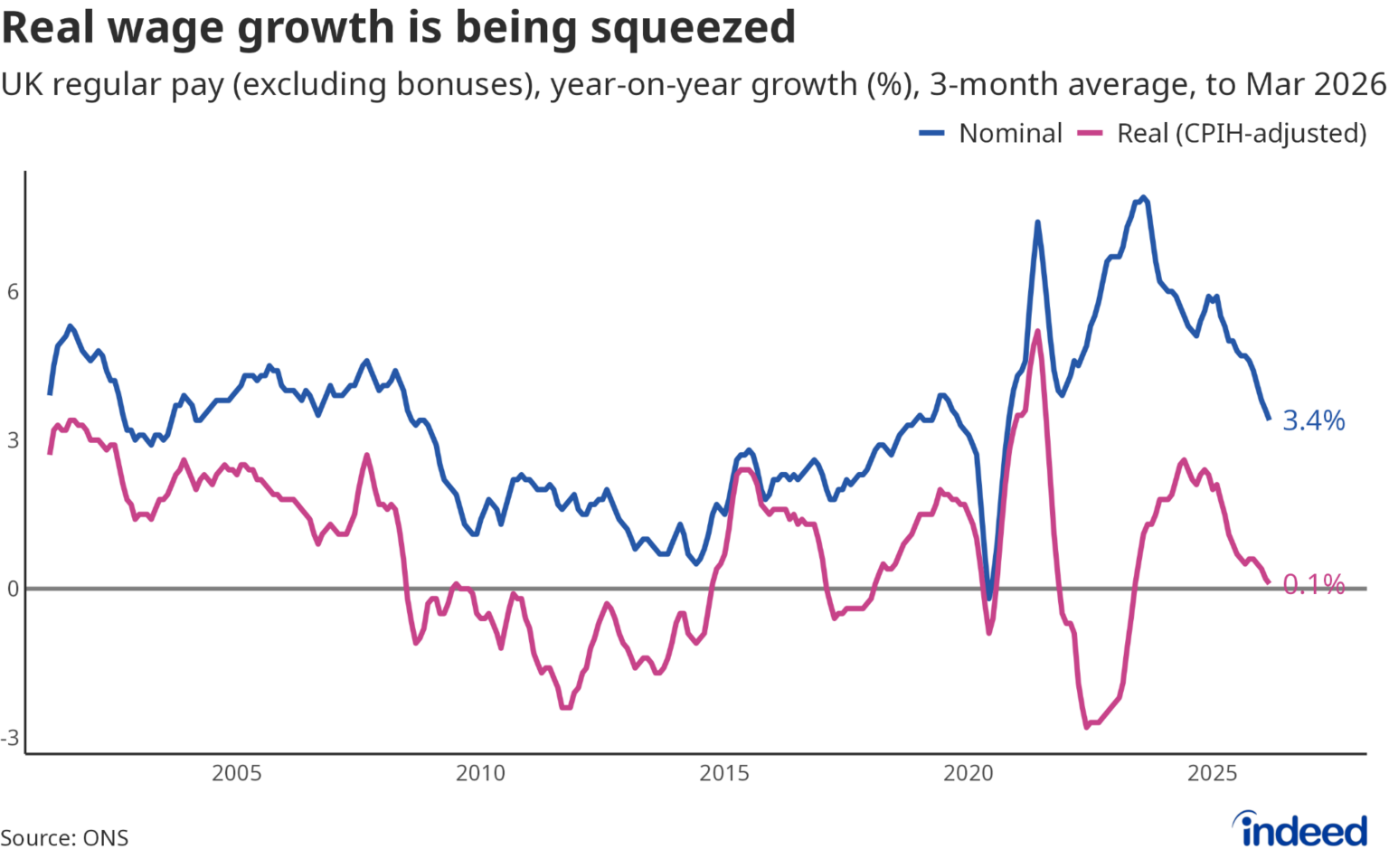
On pay, nominal regular earnings growth eased further to 3.4% in the first quarter. After accounting for inflation, that meant just 0.1% growth in real wages, with the squeeze set to intensify in coming months as the energy price shock passes through to consumer prices. The resulting squeeze on real household incomes will act as a further drag on domestic demand over coming quarters, compounding rather than offsetting the headwinds already facing the economy.
Q1 GDP growth was stronger than many anticipated, but there are good reasons to treat it with caution. Seasonal adjustment challenges cloud the picture, while the Iran conflict is expected to weigh materially on activity through Q2 and Q3. An unsettled domestic political environment adds to the uncertainty businesses must navigate when making hiring and investment decisions.
For the Bank of England, today’s data sharpens rather than resolves the MPC’s dilemma. Elevated global energy prices sustain the inflation argument for tightening. But the critical question is whether second-round effects – the wage-price dynamics that made sustained tightening necessary in 2022 – are genuinely in prospect. The evidence here is notably thin.
Labour market slack is building, wage growth is decelerating, and the bargaining position of workers has weakened materially relative to four years ago. With monetary policy settings already in restrictive territory, the burden of proof for further tightening is rising. The data today makes that case harder, not easier, to sustain.