
Photo : YONHAP News
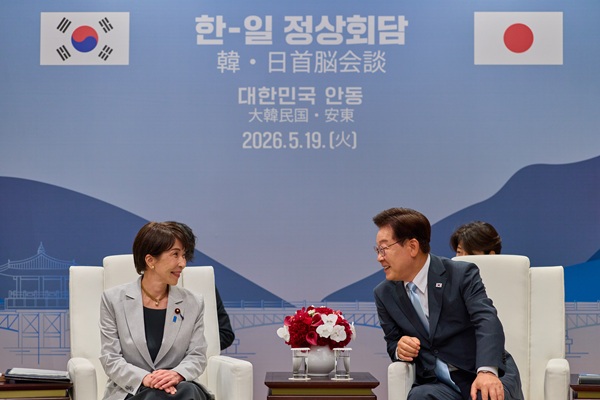
Anchor: South Korean President Lee Jae Myung and Japanese Prime Minister Sanae Takaichi held their fourth meeting in about six months on Tuesday. The two leaders met in the South Korean president’s hometown of Andong, South Gyeongsang Province, where they agreed to boost collaboration to overcome the energy crisis amid the Iran war.
Kim Bum-soo has more.
Report: South Korea and Japan are tightening their ties amid the Middle East crisis.
President Lee Jae Myung and Japanese Prime Minister Sanae Takaichi held talks in South Korea on Tuesday as the two East Asian neighbors struggle to ride out the energy crisis.
[Sound bite: President Lee Jae Myung (Korean-English)]
“During today’s meeting, Prime Minister Takaichi and I frankly discussed various pending issues as strategic partners to jointly respond to the rapidly changing international situation, building upon the trust we have established through our shuttle diplomacy. In particular, we shared the view that the need for close cooperation between our two countries has increased significantly regarding the instability in supply chains and energy markets stemming from the recent situation in the Middle East.”
[Sound bite: Japanese Prime Minister Sanae Takaichi (Japanese-Korean)]
“President Lee and I had a frank exchange of views on the situation in the Indo-Pacific region, including the situation in the Middle East, as well as on Japan-Korea relations. As a result, we agreed to continue our respective efforts to promote progress in the situation, including securing free and safe navigation in the Strait of Hormuz.”
The meeting took place in the southeastern city of Andong, where Lee was born and raised, following their previous talks in Takaichi’s hometown of Nara, an ancient Japanese capital.
Having made visits to each other’s hometowns, Lee and Takaichi sought to pave the way to work together to address the thorny issues around wartime history between the two nations.
[Sound bite: President Lee Jae Myung (Korean-English)]
“DNA analysis of the remains excavated from Japan’s Chosei Coal Mine will also begin soon. Through close working-level consultations between diplomatic authorities, specific procedures and methods for the DNA analysis have been agreed upon. This will be a small but meaningful first step for both countries to cooperate on historical issues, starting with humanitarian matters.”
Lee’s “two-track approach” is a core tenet of his Japan policy, separating historical and territorial disputes from bilateral cooperation on security and the economy.
[Sound bite: Japanese Prime Minister Sanae Takaichi (Japanese-Korean)]
“The president and I confirmed our commitment to sharing information and cooperating even more closely to sustain and strengthen concrete cooperation among the three countries, including on security and the economy. Regarding the North Korean issue, we discussed responses to North Korea, including nuclear and missile matters, and reaffirmed that Japan and South Korea, as well as Japan, South Korea and the United States, will respond in close coordination.”
During the news conference, Lee said he’d explained to Takaichi his vision for a “peaceful Korean Peninsula where there is no need to fight.”
Takaichi said she and Lee will hold frequent telephone talks to coordinate on issues in the international arena.
Kim Bum-soo, KBS World Radio News.