
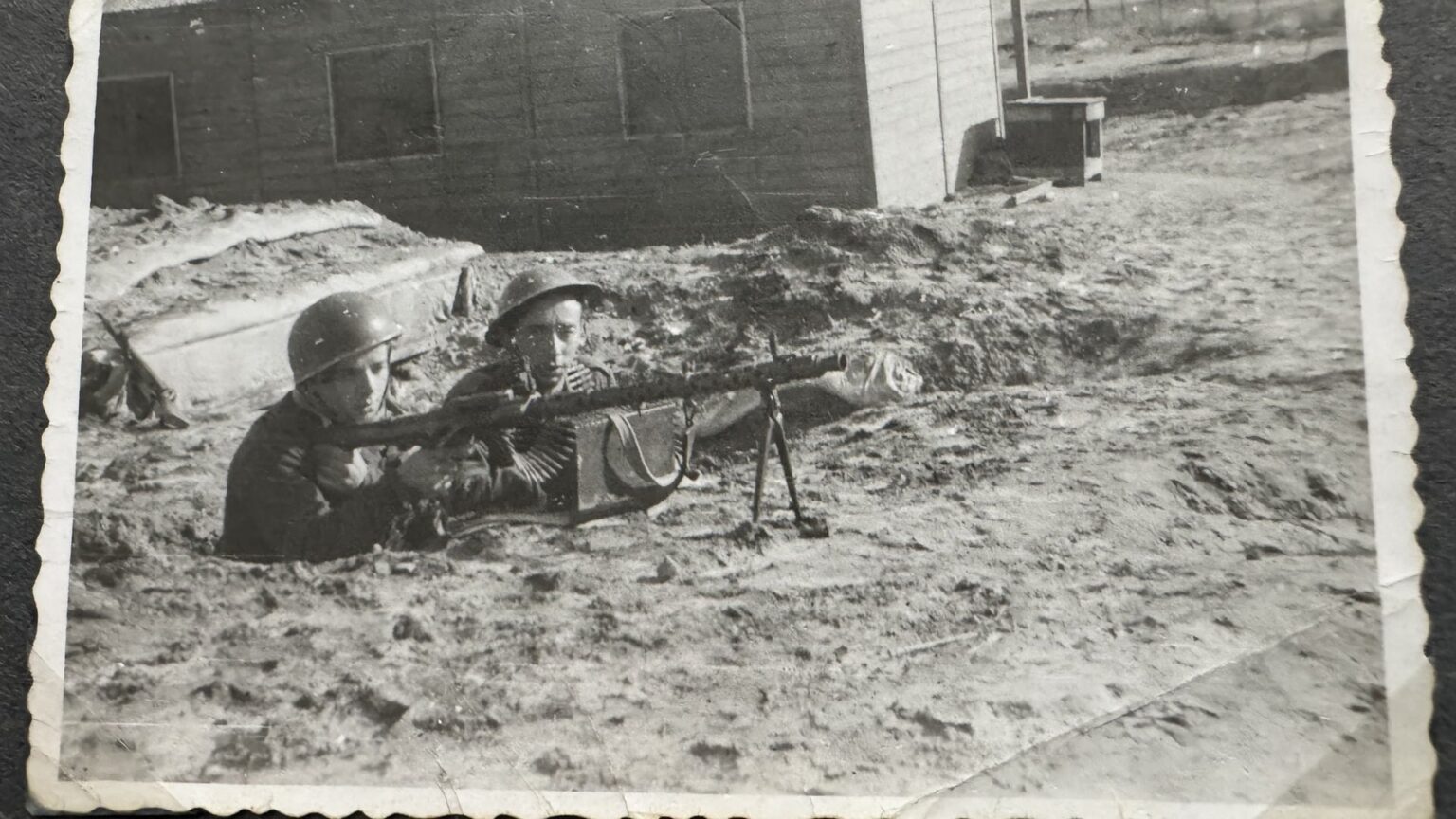
There is a photograph sitting on my desk as I write this.
It is from 1948, the year Israel declared itself into existence and was immediately fighting five armies for the right to keep existing.
Two young men are dug into a shallow trench in the sand. Both wear steel helmets. One has his cheek pressed to the stock of a light machine gun, his eye down the sight, his hands steady on the grip. The other crouches beside him, watching the field.
Behind them stands a single wooden barrack with three dark windows and a chimney. There is nothing else. No town. No reinforcements. No country, yet, to defend.
The man behind the gun is Yakov. Edna’s older brother. A Jew from Warsaw who was supposed to be dead.
There were four of them, in the end. Yakov and Harry, who fought. Edna, who survived as a child in Warsaw and lived a long second life. Miriam, Edna’s sister, whom I never met but whose name has been in this archive for as long as I have been working on it.
In the early years, all four came to the same small piece of ground in the Western Galilee: Lohamei HaGeta’ot, the kibbutz called House of the Ghetto Fighters. They lived there. They worked there. They helped build it from nothing into something.
In time, the family split, as so many survivor families did. Yakov and Miriam stayed in Israel, where they are buried now in the soil they fought for. Edna and Harry came to America, where they built second lives and are buried in the country that took them in.
And there were two more.
My parents.
My mother in Navy whites, a lieutenant in the WAVES, serving stateside. My father in Army green, fighting his way up the Italian peninsula in a Sherman tank.
They were on the other side of the same war Yakov had survived. They served so that there would be a world left in which Yakov could one day stand in that trench at all.
They are gone too now.
So when I say I sit at a table with ghosts, I mean six chairs, not four.
Two of them rest in Israel. Four of them rest in the United States.
All six paid for the bond between those two countries in the only currency that ever truly mattered.
Six lives. Two countries. One inheritance.
Lately, I find myself wanting to ask them something I never thought I would have to ask.
Do you think they can survive?
Not as ideas.
As places.
Israel, with an army stretched thin, an economy under strain, a government whose conduct I cannot defend, and an ally whose public support is shifting beneath its feet.
America, with its postwar consensus eroding, its institutions under open pressure, and its democratic habits, the small daily ones, the ones my parents took as ordinary, fraying in ways that are no longer easy to look past.
Two countries, each in trouble in its own way. Each tied to the other in ways neither can fully escape. Each built, in part, by the same generation of hands.
The numbers are stark.
Public sympathy in the United States, long tilted toward Israel, has shifted significantly in a short period of time. Among younger Americans in particular, attitudes have moved in ways that would have been difficult to imagine even a decade ago.
I read those numbers and I think about the four who came to Lohamei HaGeta’ot.
They would have understood those shifts in a way few people alive today can.
They had watched the world’s sympathy move before. Toward them, away from them, past them.
They knew that sympathy is not the same as protection, and protection is not the same as survival.
They learned, the hard way, that the only safety a Jew can ultimately rely on is the safety built with their own hands, on their own ground.
That is what Yakov was doing in 1948.
Sympathy is not protection. Protection is not survival.
It is the other two, my parents, that I find myself thinking about when I look at America.
They were not survivors of the Holocaust. They were Americans in uniform who had been told what they were fighting for and believed it.
They were not fighting only against something. They were fighting for something. A country that held elections and honored their results. Courts that constrained power. A press that could say what it found. Neighbors who could disagree out loud and still share a street the next morning. Ordinary democracy, the kind so ordinary it was easy to mistake for weather.
My mother did not come home from anywhere. She had been here the whole time, in Navy whites, doing the stateside work that kept the rest of it moving. My father came home from Italy to the country she had been holding open for him.
They returned, both of them, to an America that, for a time, understood what it had just done and what it had just stopped.
They lived inside a broad American consensus.
That the Nazis had been the worst thing. That the war had been worth fighting. That the democracy they had fought to preserve was worth the discipline of preserving. That the world that followed, including a Jewish state, deserved defending. That consensus is eroding.
Not everywhere. Not completely. But visibly.
In classrooms. In protests. In the language of public debate. In the polling. In the steady normalizing of things my parents would have called by their proper names.
There are Americans now who do not know what their grandparents knew, because no one taught them. There are Americans who have come to different conclusions about the same countries my parents and Yakov and Harry fought to make possible. And there are Americans, in growing numbers, who have come to different conclusions about democracy itself, about whether it is worth the patience it asks of them.
My parents would have been aghast.
Not only at America.
At Israel too.
The country Yakov took up that gun for is under strain that does not let up. The wars do not end. The costs accumulate. The alliances shift. The institutions that were supposed to hold the country to its better self are being tested by people inside the government who would rather they did not hold at all.
And the man at the top in Jerusalem is not a man I believe the four at the kibbutz would have recognized as their own. Not in tone. Not in bearing. Not in how he speaks about a country that, to their generation, was never something to possess, but something to hold with care.
The country my parents wore the uniform for is under a different kind of strain, but the pattern rhymes. The institutions that were supposed to hold America to its better self are being tested by people inside the government who would rather they did not hold at all.
And the man at the top in Washington is not a man I believe my parents would have recognized as their own. Not in tone. Not in bearing. Not in how he speaks about a country that, to their generation, was never something to wield, but something to keep.
Two countries. Two men at the top. Neither one a steward of what the six of them built.
I imagine them at the table.
Yakov, quiet, looking out the window.
Harry, not quiet at all, pushing his chair back and speaking in Polish.
Edna answering him, just as loudly.
Miriam there too, listening.
And eventually Edna would stop, look directly at me, and say:
This is not what we built it for.
And my parents would look at each other, and one of them would say:
This is not what we fought for.
This is not what we built it for. This is not what we fought for.
The four at Lohamei HaGeta’ot did not build Israel as an act of triumph.
They built it as an act of mourning.
Every founding was a funeral.
Every cornerstone was laid over someone who could not be there.
What they wanted was not power.
It was refuge.
A small, decent country where a Jewish child could grow up without learning to flinch.
An ordinary place.
My parents wanted something parallel for America.
Not greatness. Not dominance. A country that remembered what it had fought against, and what it had fought for. A democracy that worked well enough on a Tuesday in November that you did not have to think about it on a Wednesday.
They knew what power costs. They had seen what happens to people who have none. They had also seen what happens when power is used by people who have stopped remembering that.
They wanted both countries strong enough to survive, and decent enough to deserve to.
Strong enough to survive. Decent enough to deserve to.
That is the inheritance.
In the photograph. In the archive. In the kibbutz. In the silences. In the uniforms.
I am afraid for it.
Afraid that Israel is being led somewhere the four at the kibbutz would not recognize.
Afraid that America is being led somewhere my parents would not recognize, and that what is being lost there is not only memory but the thing itself. The habit of democracy. The expectation of it. The assumption, so deep in my parents that they rarely named it, that the country would still be a democracy on the day after tomorrow.
That assumption is no longer safe to make.
I am afraid that the bond between the two countries, built at such cost, is being strained by people on both sides who do not remember what it was for, and that the democracy which made America the kind of ally Israel could need in the first place is being treated, by some of the people entrusted with it, as optional.
I am afraid that when the last of their generation are gone, no one will be left who remembers in their body what the absence of these countries felt like. What the absence of a Jewish refuge felt like. What the absence of American democracy felt like to the world that had to live without it.
Yakov, in that photograph, was carrying more than a gun.
He was carrying his family. His city. The future.
A promise.
My parents, an ocean away, were carrying a different version of the same promise. A refuge on one side of the ocean. A democracy on the other. Each one meant to make the other possible.
The six of them spent their lives keeping that promise.
I am not sure, now, that we are.
Janet Bond Brill, PhD, is the author of Little Edna’s War, based on her mother-in-law’s Holocaust testimony, published on January 27, 2026, on International Holocaust Remembrance Day. Order Now