
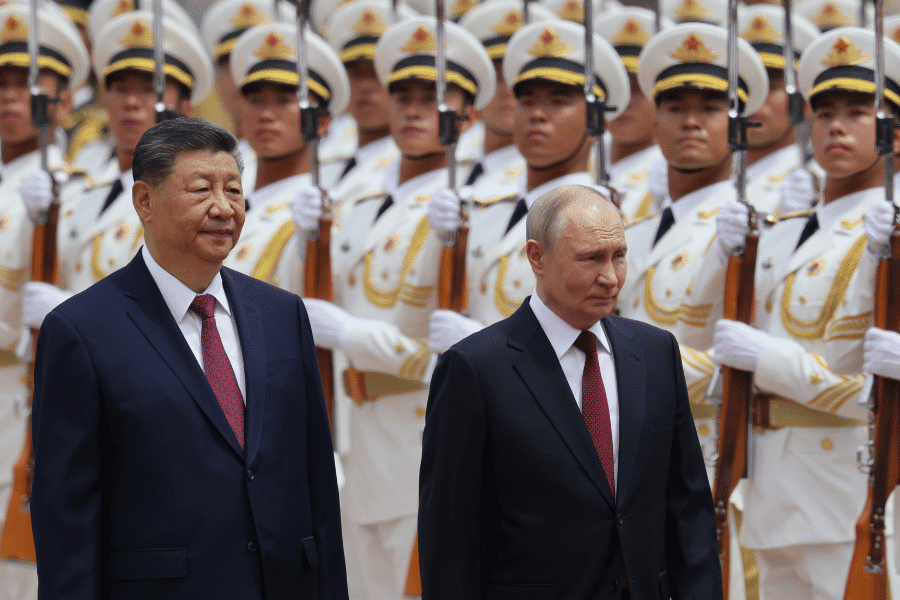
Beijing and Moscow’s friendship is more than cosmetic and has clear consequences for international security.
Brian Carlson heads the global security team at the Center for Security Studies. He said that the United States would be unprepared for a two-front war waged simultaneously in Europe and Asia by China and Russia. He noted the defense relationship between the two countries has expanded.
“It is not so much the direct cooperation of the two in military terms that is a concern, but just the fact that they are partners,” Carlson said. “They aren’t threatened by each other, which frees them up to pursue their own objectives.”
An alliance based on opposition to the United States
One shared objective is the desire to undermine what they see as an international order centered around Washington’s interests. The world, they argue, should be multipolar.
Despite the rhetoric, this push for a new world order comes with caveats.
“When China and Russia talk about multipolarity, they want themselves to have sovereignty, but they don’t necessarily grant that to smaller countries,” Carlson said. “So, Russia, for example, is not willing to say that Ukraine can decide on its own destiny, and they expect Ukraine to show deference to Russia. China, at least in Asia, probably has a similar view.”
China and Russia are focused on their own regional interests while granting the other autonomy to pursue theirs through either tacit support or non-interference.
Regardless, the China-Russia relationship is one of convenience, and convenience has limits.
Testing the limits of an alliance
So far, China has refused to supply arms to Russia for use in Ukraine and Xi has criticized Putin’s nuclear saber rattling — all while Russia’s economy and international standing continues to lag far behind China’s growing influence.
Territorial disputes could eventually re-emerge as this status imbalance grows.
“In the Russian Far East and Siberia, Russia has a small population, and right across the border, there’s a huge Chinese population,” Carlson said. “So, there’s concerns that China could covet that territory eventually. So far, China has been very careful to respect Russia’s interest there, so it hasn’t been a big source of conflict. But, over time, as Russia becomes weaker, and China becomes stronger, that can become more of an issue.”
Both nations’ growing nuclear capabilities make any chance of conflict between them concerning.
As recently as 2017, China deployed nuclear-equipped intercontinental ballistic missiles to its border with Russia — presumably as a deterrence measure aimed at the United States.
Russian officials were careful to publicly declare they do not see these missiles as a threat; as long as both countries’ “friendship without limits” continues, there is little chance this perception will change.
However, even the Soviet Union and China’s alliance in the 20th century gave way to dangerous diplomatic bickering.
Within just over a decade, these disputes escalated to a military conflict that nearly went nuclear. Slow and abrupt changes within the international system often occur in tandem with and in opposition to one another.
Over time walls fall and alliances splinter
The international communist revolution once seemed to divide the world in half until the Sino-Soviet split severed one of its foremost alliances. The Cold War looked as persistent as ever until the Berlin Wall fell and reforms by then Soviet leader Mikhail Gorbachev led to the dissolution of the Soviet Union. Carlson himself has witnessed how things can change.
“In 2005, the consensus was that the Russia-China relationship wasn’t so important, that the extent of the cooperation was quite limited and that the two countries’ interests would eventually diverge,” he said. “But I think the relationship has continued to get stronger and has defied the expectations of a lot of people.”
Just as their current partnership was unforeseen, Russia and China breaking relations would defy expectations. It is still possible, though.
Unfortunately, if this friendship’s limits are discovered, both nations will have armed themselves with enough nuclear weapons to make escalation an alarmingly dangerous risk.
Many in the West oppose the new world order envisioned by Beijing and Moscow. But few may want to discover what could happen if the two decide cooperation is no longer in their interests.
Questions to consider:
1. What reasons do China and Russia have to be allies?
2. Why might a friendship between the two countries break down?
3. If you were an advisor to the U.S. president, what might you advise in terms of relations with China and Russia?