

Prime Minister Luís Montenegro has admitted the government could once again suspend the collection of biometric data as part of the European Entry/Exit System (EES) at Portuguese airports if long queues and border control disruption continue through the summer, following months of warnings from Algarve hoteliers and tourism leaders.
Faced with the chaotic queues that continue to frustrate thousands of travellers at Portuguese (and European) airports, the PM warned the government is considering taking more serious action to safeguard its own reputation as a world-famous tourism destination.
“I won’t deny that we are unhappy with the response from border control services at the airports, especially in Lisbon,” he said on Monday during a visit to Moledo beach in Viana do Castelo.
Montenegro stressed that Portugal has obligations under European law but insisted the government cannot sit and watch as the situation damages tourism and the wider economy.
“If we have to take stronger action – more severe measures – we will do so,” the PM said. “We do not want to put the country’s security at risk, but we also do not want to damage the country’s economic activity.”
“We have European obligations and we are fulfilling them, but obviously we cannot be penalised,” he insisted. “We will prioritise security in the country, but at the same time we must safeguard Portugal’s economic interests.”
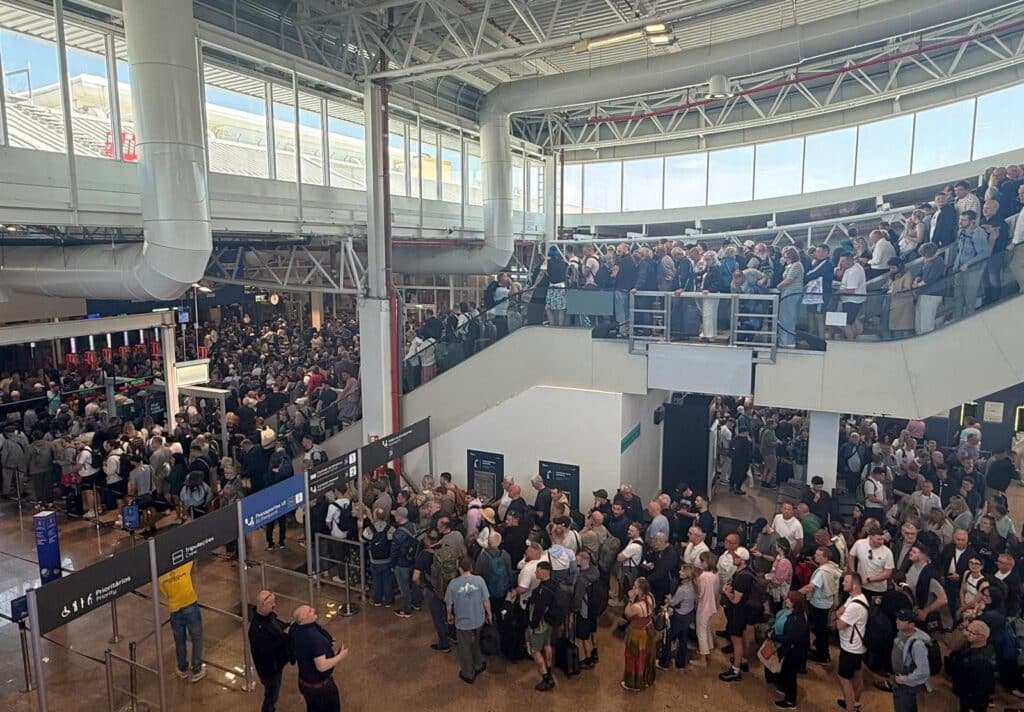
When pressed by journalists on whether the suspension of biometric data collection could happen again, Montenegro admitted it remained a possibility, “like we have done in the past”.
Before Montenegro’s remarks on Monday, the Ministry of Internal Administration had publicly rejected the idea of formally suspending the EES during the summer months.
Responding to questions from TSF radio, the ministry said Portugal remained committed to ensuring the system operates “in conformity with European Union law” and that “no suspension of this system is planned”.
However, the ministry also acknowledged that European rules allow temporary operational measures in exceptional situations, including the suspension of biometric data collection at certain border points if passenger traffic creates excessive waiting times.
According to the ministry, those operational decisions fall under the responsibility of the PSP.
The ministry stressed that all security procedures remain in place during temporary suspensions and that biometric collection resumes once waiting times return to acceptable levels.
Portugal has already used those emergency measures several times. On April 11 and April 12, biometric collection was suspended at departure areas in Lisbon, Porto and Faro because waiting times had risen above what was considered acceptable limits.
Algarve hoteliers take issue to highest levels of government
In the Algarve, one of the country’s biggest tourism breadwinners, hoteliers have been calling for the suspension of the EES rollout for months.
In February, the Algarve hoteliers’ association AHETA sent an urgent letter to PM Luís Montenegro warning of potential “chaos” linked to the implementation of the EES system at Faro Airport and calling for its suspension.
“At the time, we had a talk with the Secretary of State of Tourism about the matter. And we are going to meet with the Minister of Internal Administration on Friday to discuss the situation at the airports,” AHETA president Hélder Martins told The Resident on Monday.
Martins revealed that tourism representatives have been told there is flexibility to temporarily deactivate the system when pressure becomes too intense.
 Hélder Martins, president of AHETA, Algarve hoteliers’ association
“But the truth is that there are still queues even when the system is offline,” he lamented, alluding to Portugal’s long history of airport queues which successive government have failed to solve.
“The summer is around the corner. We want our visitors to see the Algarve as a top tourist destination, and not to leave with a bad image of the region,” Martins warned.
Despite the concerns, Martins said there had not yet been major signs of panic among tourists or travel operators.
“We are cautiously optimistic about this summer. There haven’t been any dramatic cancellations, and we are seeing more last-minute bookings, which is normal.”
He also said the energy crisis had not significantly affected tourism demand in the Algarve so far.
“This past Easter, fuel prices had already increased, yet many Portuguese continued travelling to the region,” he noted.
Another nightmare weekend at national airports
The renewed debate over Portugal’s border control failings followed a weekend in which travellers once again faced long waits at border control points in Lisbon, Porto and Faro.
PSP police confirmed that waiting times exceeded two hours at Porto Airport on Sunday, although the force denied reports circulating online that passengers had waited six hours.
According to the PSP, the worst delays recorded during peak periods between 9am and 12pm reached around 100 minutes in Faro, 110 minutes in Lisbon and 130 minutes in Porto.
Police blamed the disruption on technical and computer-related issues combined with a high number of arrivals from outside the Schengen area.
Around 69,000 passengers from non-Schengen flights passed through Lisbon, Porto and Faro airports that day alone, according to the PSP.
Meanwhile, fresh disruption struck Lisbon’s Humberto Delgado Airport on Tuesday morning after a technical failure affected border control systems, causing further delays for passengers.
According to Armando Ferreira, president of the National Police Union (SNP), the issue was not directly linked to the biometric Entry/Exit System itself, but rather to wider IT infrastructure problems.
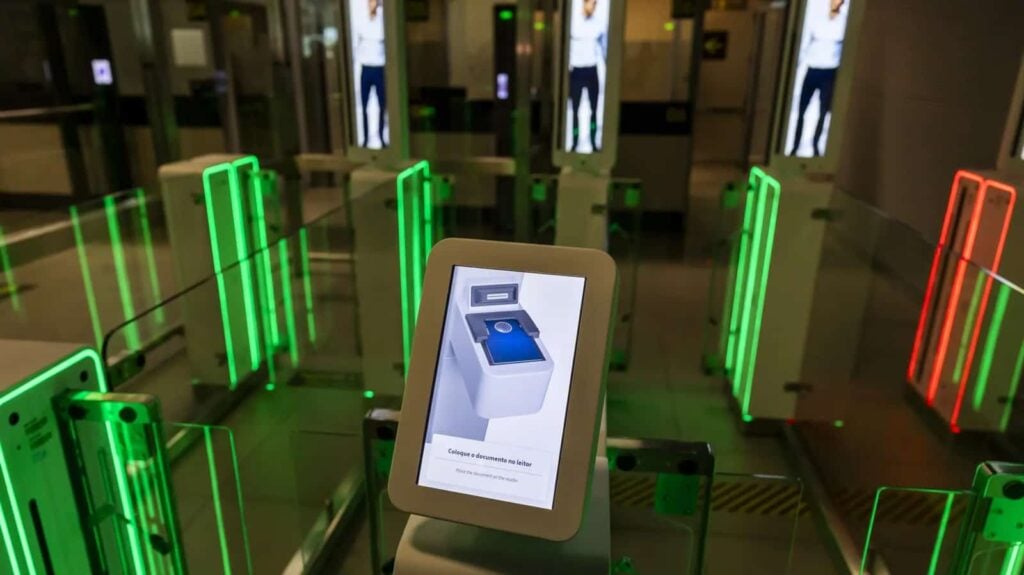
Lisbon arrivals area expansion nearly completed
Portugal’s Infrastructure and Housing Minister has announced that the expansion of Lisbon Airport’s arrivals area is nearly completed.
“We believe that in the coming weeks, next month, we can have a better quality of service,” Miguel Pinto Luz said.
Addressing the border control delays at Portuguese airports, the minister said that the government “is making every effort, internally and alongside the European Commission, to resolve the issue.”
Pinto Luz acknowledged that the EU Entry/Exit System (EES) “has real problems that are creating constraints” at airports and damaging “Portugal’s international image”.
“We are available to suspend biometrics whenever necessary because there is a basic principle. We cannot compromise the service provided by airports, we cannot compromise the image of the country, and therefore, whenever necessary and congestion occur, or machines or servers are not working, biometrics will be suspended,” he said.
Meanwhile, more manual border control booths are set to be introduced at the airport from May 29 to strengthen operational response and reduce waiting times, the Ministry of Internal Administration has announced.
In a statement, the ministry said it plans to increase the number of e-gates (automated border control) and will deploy additional PSP officers to border control starting in July.
Airlines: “Suspend EES until September!”
The latest pressure on the government has also been fuelled by renewed criticism from airlines, particularly low-cost carrier Ryanair, which earlier this month called for the suspension of the EES until September.
The Irish airline described the constant delays as “avoidable” and warned that the situation could become far worse during the peak summer season if no action is taken.
Ryanair said it had written to the governments of all 29 EES countries, including Portugal, urging them to temporarily suspend the system until September, following the example already adopted by Greece.
“It makes no sense for countries like Portugal to continue implementing the new EU Entry/Exit System (EES) when they are clearly not prepared to do so. As a result of this incomplete implementation of the system, passengers are being forced to endure excessive queues at passport control and, in some cases, miss flights,” said Ryanair chief operations officer Neal McMahon.
McMahon added, with a touch of irony, that “the average Ryanair flight time is approximately 1 hour and 15 minutes – meaning some passengers are spending almost as much time waiting at passport control as they are on the flight itself”.
He described the situation as “completely unacceptable”, insisting there was already a legal solution available under EU rules: “the suspension of the EES until September”.
Portugal’s Association of Airlines (RENA) has also appealed for a suspension of biometric data collection, arguing that Portugal was not prepared to implement the new system successfully.
“There needs to be more flexibility, on a European level, to suspend the system,” RENA boss Paulo Geisler said, calling for the suspension to run until at least the end of this summer.
The EES replaced passport stamping with a digital system that records facial images and fingerprints of passengers arriving from outside the Schengen area. It began progressively operating across Schengen countries, including Portugal, on October 12, 2025.
Since then, airports across Europe have faced repeated complaints over delays, technical problems and congestion. British newspaper The Times has already described the rollout as a “border fiasco”.
In Portugal, the system has intensified concerns about staffing shortages and operational weaknesses at airports already struggling to cope with heavy passenger traffic.