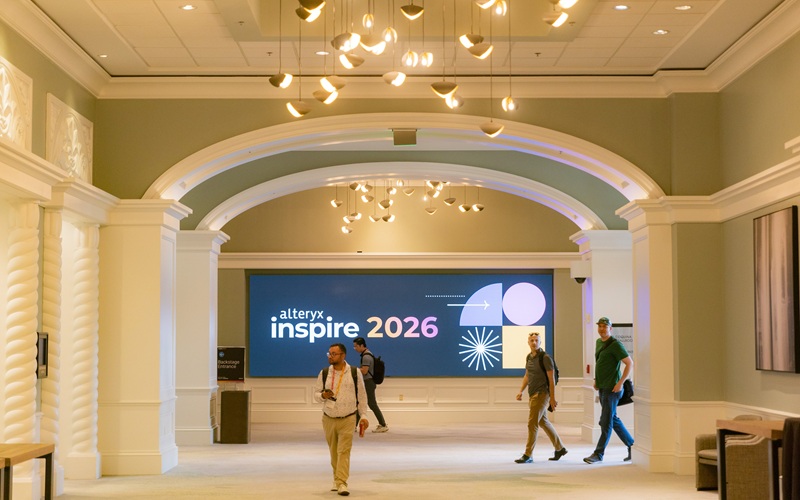
Techzine Global attended Alteryx Inspire 2026this month in Orlando to dig into the current mantra being laid down by the company that now calls itself an AI-ready data and analytics specialist. In fairness, we already knew Alteryx as a data analytics specialist… and what tech vendor worth their salttoday isn’t also an AI-ready player? With all the disruption (aka business transformation) in the enterprise – and with Alteryx now claiming to help “data analysts build a data foundation ready for anything”, what might that entail?
In terms of central platform development news, Alteryx used Inspire 2026 to detail new product capabilities designed to advance agentic automation across enterprises. New enhancements to the Alteryx One platform have been engineered to unify data, business logic and AI inside a single system.
It is (as it says on the t-shirt), all about moving beyond experimentation to operationalise analytics as intelligent outcomes.
According to Ben Canning, chief product officer at Alteryx, as enterprises scale AI, the bottleneck is no longer access to models – it is the business context those models run on.
Raw data, sushi software?
Because most AI agents today query raw data directly, with little understanding of how the business actually works, the logic that would make their answers trustworthy often lives in prompts that are difficult to audit, verify, or update. At the same time, industry analysts are saying AI and agent-based systems are most productive when managed at the business level.
“This shift is increasing demand for a model that allows business teams to define and maintain the logic AI operates on while giving IT the visibility, governance, and control needed to support enterprise scale,” states Canning and team. “Alteryx turns the workflows analysts already trust into the layer agents run on – so AI stops generating ‘fast guesses’ and starts doing the work, the same way every time, on logic the business owns and IT can stand behind.”
Workflows become process execution systems
By combining trusted data, business logic and AI within the Alteryx One platform, Canning and his colleagues tell us that organisations can turn workflows into systems that execute processes and deliver consistent, reliable outcomes at scale.
The result (or so we are promised) is AI that is visible, understandable, repeatable and auditable, with outputs that remain consistent across channels and aligned with business logic an organisation has already validated.
Alteryx CEO: Agentic-ly build, rather than code
The Alteryx Inspire conference keynote was delivered with opening Remarks from CEO, Andy MacMillan with key company executives also delivering a full “day zero” pre-brief day for press and analysts to get a deep dive on the platform and tools.
Reminding us that “this is not the Alteryx that we knew before”, MacMillan explained that the firm staunchly believes that “business analysts will be the ones who drive AI transformation” due to the way these professionals are taking advantage of the change to agenticly build, rather than agenticly code.
Refreshingly open, CEO MacMillan spoke about the journey that Alteryx has been on (Clearlake Capital Group and Insight Partners L.P. announced that their affiliated funds have completed the acquisition of Alteryx on March 13, 2024) and said that one product move had been wrong for the company, But, now, today, with Alteryx One as the company’s flagship platform working to connect data and business context and AI, the mission is to ensure 80% of the customer base is using the service by the end of this year.
Along with a focus on key partnerships (a Google Edition is of primary importance), the company is putting a lot of investment into its Alteryx Designer tool – this is the company’s desktop application for data preparation, blending and analytics, using a drag-and-drop, code-free workflow interface.
Data is not the challenge
Once again reminding us that the firm thinks business analysts will become the architects of AI, MacMillan insisted that, in modern business today, looking for data itself is not the challenge; it’s turning it into action that’s tough.
Why is this so?
It’s because so much company information is held in spreadsheets and applications that need to be accessed individually and manually in important, but disparate and disconnected systems. This is because expense reports will sit in SAP Concur, B2B marketing, lead generation and behavioral data is held in Marketo, HCM data sits in Workday, CRM data might sit in Salesforce, subscription billing data might sit in Zuora or Stripe Billing for example.
With this reality in mind, Alteryx’s mission is all about bringing these information silos together and dovetailing it with unified data, logic & AI.
Operationalising business logic for AI
Taking over from her CEO, a marketing overview session was delivered by chief marketing officer Michelle Huff, who underlined the fact that AI today needs a holistic set of inputs in order to automate real world workflows effectively. She says that without the right logic applied to enterprise data analytics, errors result that don’t just mislead, they typically start to scale instantly.
“This means we have been working hard to codify all the things users need to apply analytics in a way that is understandable, repeatable and trusted. In order to build a trusted AI stack, firms need to think about the business logic layer they are running,” said Huff. “If companies wanted trusted AI outcomes, they need to have trust in the data that they use (and not be using stale data) and so from a logic standpoinit, business users need to be able to understand the logic for AI in use.”
What’s inside so-called “business logic” itself then? This entity can be defined as follows:
- Business rules.
- Calculations.
- Workflows.
- Operational context.
- Structured and unstructured data.
- Governed execution controls.
The AI-assisted workforce
Alteryx chief revenue office (CRO) Steven Birdsal took over proceedings. Resonating the suggestion that agentic functions will now help human operatives focus on higher value work, Birdsal provided an overview on how the company segments its market across strategic customers, enterprise users, mid-market and others.
Talking about the company’s Annie & Adam customer agents (agents with human pictures), the pair join Atlas – the company’s headless AI technical sales support function. Alteryx Atlas is a user-managed cloud persistence option for Alteryx Server – it uses hosted MongoDB Atlas to manage application data, configuration schemas, and job queues to ensure high-availability environments.
Annie was trained on the company’s entire website and selected data pools over a period of around 3 months.
A product strategy overview followed, delivered by Alteryx chief product officer Ben Canning. Talking about how the company’s platform works as one genuine operational data model (not just a pricing package of tools), Canning looked back at what is now a full year of the Alteryx One platform being in existence. Over a quarter of our customer workflows now touch the Ask Alteryx service, a technology repository with over 130 tools inside it designed to help users navigate the full breadth of services the company offers.
Ask Alteryx
Ask Alteryx is an embedded, generative AI-powered analytics assistant within Alteryx Designer. Using conversational, natural-language prompts, it helps users build, document, and troubleshoot data workflows, automatically adding preconfigured tools to the canvas and providing contextual recommendations to accelerate insights.
Announced this year, updates to Ask Alteryx, Alteryx Designer, improved connectivity, and Live Query for BigQuery help users work faster and access enterprise data directly where it lives – including BigQuery’s native AI capabilities for processing unstructured data at scale, without moving data or writing code.
Alteryx One App
The Alteryx One App is a unified desktop interface that serves as the single entry point for the Alteryx One platform. It bridges desktop and cloud workflows, allowing users to seamlessly launch Designer, access cloud applications and manage shared workspaces. It serves as a unified starting point for accessing Designer, cloud services, data and AI tools.
These Alteryx One experiences are available to support Designer and cloud workflows:
- Desktop app (Windows): Is a Windows application that serves as the central interface to launch Designer and access cloud apps.
- Web companion: A web experience that lets users use Alteryx cloud capabilities without Designer integration.
Alteryx core takeaways
The company drove home its central messages by summarising the core takeaways it wants Alteryx Inspire 2026 attendees to go away with.
Firstly, the company insists that the next platform war is about trust, not data. To explain this point, we can say that two people asking the same question can’t get two different answers – that’s just not good business – and that means that whoever owns business logic needs to own enterprise AI.
Questioned on whether that means bad news for the operations function that will need to support this new, more empowered upper layer, Alteryx insists that this technology proposition has been met positively by the DevOps function and the wider operations team if we extend the definition outward to DBAs and sysadmins.
Alreryx also says that business logic is an enterprise asset – and it lives with analysts, not in models, not in dashboards, but in workflows that are visible, understandable, repeatable and auditable. The bottom line from the organisation is that Alteryx is striving to be “the logic layer” for digital business today. The company is saying data analytics should be built in Alteryx, governed in Alteryx… and still invoked from every AI surface a business already uses.