
And in the last few minutes, the European Commission’s president Ursula von der Leyen issued a strong statement along the similar lines.
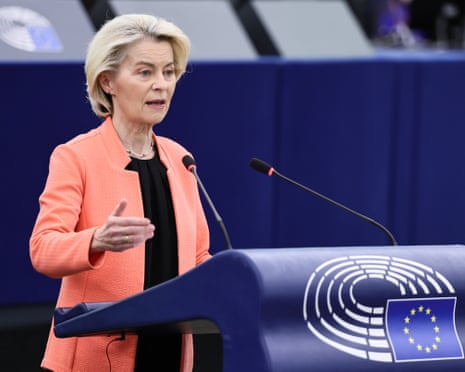
European Commission President Ursula von der Leyen speaks at the European Parliament in Strasbourg, France. Photograph: Ronald Wittek/EPA
In a post on X, she said:
“Russia’s public threats against our Baltic States are completely unacceptable.
Let there be no doubt: a threat against one Member State is a threat against our entire Union.
Russia and Belarus bear direct responsibility for drones endangering the lives and security of people on our Eastern flank.
Europe will respond with unity and strength. We will continue reinforcing the security of our Eastern flank with strong collective defence and preparedness at every level.”
Updated at 07.10 EDT
Key events
-
1m ago
Closing summary
-
24m ago
Finns suspected of Russian sanctions violation over truck exports
-
26m ago
Italy condemns ‘unacceptable’ treatment of Gaza flotilla activists by Israel
-
1h ago
French lawmakers back Macron choice to run Bank of France
-
1h ago
China ‘eaten much of German industry’s lunch,’ report warns as it urges Berlin to stop admiring Beijing
-
2h ago
Ukraine involved in ‘very active’ talks with UK over decision to relax sanctions on Russian crude
-
3h ago
‘Europe’s security is indivisible,’ Lithuania’s foreign minister says
-
3h ago
US plans to shrink forces available to Nato during crises, Reuters says
-
3h ago
EU reiterates call for Russians not to be allowed to benefit from Middle East conflict after US, UK relax sanctions on oil
-
3h ago
Russia’s threats against the Baltics ‘completely unacceptable and ‘threat against our entire union’, EU’s von der Leyen says
-
3h ago
Russia’s aggressive stance ‘may lead to situations … in which we will need to react firmly,’ Poland’s Tusk warns
-
3h ago
Hungary’s Magyar hopes to meet Ukraine’s Zelenskyy as he seeks new opening in relations
-
3h ago
Tusk and Magyar discuss regional cooperation, energy and EU reforms in Warsaw
-
5h ago
‘Russian claim’ on Latvia, Baltics is ‘totally ridiculous, and Russia knows it,’ Nato’s Rutte says
-
5h ago
Russia ‘remains most direct threat to Euro-Atlantic security,’ Nato’s Rutte says
-
5h ago
Tusk, Magyar brief media after talks in Warsaw
-
5h ago
Nato’s Rutte briefing press ahead of Nato ministerial in Sweden on Friday
-
5h ago
EU agrees to implement US trade deal struck last summer after night talks
-
6h ago
People in shelters in Lithuania during earlier drone alert – in pictures
-
6h ago
Lithuania lifts drone alert
-
6h ago
Morning opening: Drone alerts in the Baltics, again
-
6h ago
Putin praises ‘unprecedented’ relations with China with focus on foreign policy, trade, energy
Please turn on JavaScript to use this feature
Closing summary

Jakub Krupa
… and on that note, it’s a wrap for today!
-
Lithuania’s president and prime minister were rushed to underground bunkers this morning and residents of the capital, Vilnius, urged to take shelter during a warning issued after a drone violated the country’s airspace (10:05, 10:11, 10:41, 11:51).
-
The incident comes a day after a Nato figher jet show down what was suspected to be a stray Ukrainian drone over Estonia on Tuesday.
-
Several EU leaders, including commission president Ursula von der Leyen (13:05), Nato’s secretary general Mark Rutte (11:37, 11:40) and Poland’s prime minister Donald Tusk (13:03), warned against Russia’s increasingly assertive position towards the Baltics after yesterday’s threats from Moscow.
In other news,
-
The European Parliament will finally vote on the US trade deal on 16 or 17 of June after MEPs won significant amendments to the text of the tariff deal agreed with Donald Trump at his Scottish golf course last July (11:07).
If you have any tips, comments or suggestions, email me at jakub.krupa@theguardian.com.
I am also on Bluesky at @jakubkrupa.bsky.social and on X at @jakubkrupa.

Jon Henley
Europe correspondent
Earlier today, Lithuania’s president and prime minister were rushed to underground bunkers and residents of the capital, Vilnius, urged to take shelter during a warning issued after a drone violated the country’s airspace.
A person holding a mobile phone that displays a warning of a possible air raid in Vilnius. Photograph: Andrei Shauliuha/AFP/Getty Images
Air and train traffic in and around the city was suspended after the mobile phone “take shelter” alert, the first issued in an EU and Nato country since the start of Russia’s 2022 full-scale invasion of Ukraine.
You can read our full report on today’s air alert in Lithuania here:
Updated at 10.01 EDT
Finns suspected of Russian sanctions violation over truck exports
Three Finnish citizens are suspected of exporting trucks and trailers worth $20 million to neighbouring Russia in violation of sanctions imposed over the war in Ukraine, Finnish Customs said Wednesday.
A preliminary investigation conducted by the customs agency found that a Finnish company had transported 135 trucks and 29 trailers worth 17.5 million euros ($20.3 million) to Russia during 2022-2023, saying the vehicles were being exported to Kazakhstan or Turkey.
However, the customs agency found that the vehicles were customs cleared into Russia by a company importing and reselling trucks in the country.
The customs agency has not identified the company by name, but public broadcaster Yle said it was Idan liikennevalitys IL Oy.
“For the first time in a criminal investigation involving sanctions violations, Finnish Customs has requested that the value of the goods exported to Russia be confiscated for security,” said Petteri Nevalainen, the agency’s economic crime investigations chief.
The company’s owner and two employees are suspected of aggravated regulation offences, and one of them has been held in pretrial detention since the beginning of the investigation in March.
Prosecutors are to decide whether to press charges in the coming weeks.
ShareItaly condemns ‘unacceptable’ treatment of Gaza flotilla activists by Israel
Meanwhile, Italian prime minister Giorgia Meloni slammed as “unacceptable” the treatment of Gaza flotilla activists detained by Israel, after an Israeli minister posted a video of them bound and forced to kneel, AFP reported.
Italian prime minister Giorgia Meloni. Photograph: Angelo Carconi/EPA
“It is intolerable that these protesters, among whom there are many Italian citizens, are subjected to this treatment, which violates human dignity,” Meloni said in a statement, referring to the video posted by far-right national security minister Itamar Ben-Gvir.
ShareFrench lawmakers back Macron choice to run Bank of France
Over in France, French lawmakers narrowly approved President Emmanuel Macron’s former chief of staff to govern the central bank, with Emmanuel Moulin winning just enough votes to secure the job, AFP reported.
Secretary general of the French Presidency Emmanuel Moulin arrives for his hearing before the Finance Committee at the National Assembly in Paris. Photograph: Abdullah Firas/ABACA/Shutterstock
Macron critics say the centrist head of state is seeking to install allies in top positions to shield key government institutions before his five-year term ends next year.
Marine Le Pen’s far-right, anti-immigration party is gearing up for what it considers its strongest opportunity yet to take power in the 2027 presidential election.
Moulin, Macron’s choice for the position, had faced questions about his ability to act independently.
Lawmakers in the lower house voted overwhelmingly against him, but enough Senators backed his appointment for it to be approved.
An influential policymaker, Moulin, 57, has held a series of top posts in finance and the presidency, AFP noted.
He served as secretary general of the Élysée Palace for a year and was before that chief of staff to centrist Gabriel Attal during his brief stint as prime minister in 2024.
He served as director general of the French Treasury between 2020 and 2024, overseeing economic policy and public debt.
Updated at 09.12 EDT
China ‘eaten much of German industry’s lunch,’ report warns as it urges Berlin to stop admiring Beijing

Lisa O’Carroll
In other news, Germany must stop admiring China’s success in the EU or it will sleepwalk into the kind of deindustrialisation the US experienced 25 years ago, a leading Brussels thinktank has said.
What happened in the US 25 years ago should be a ‘warning shot for Germany’s car and machine-building cities like Wolfsburg’, the home of Volkswagen. Photograph: Krisztian Bocsi/Getty Images
With China’s surplus with Germany having doubled between 2024 and 2025 from $12bn (£9bn) to $25bn, creating a $94bn trade imbalance, the Centre for European Reform (CER) said Europe’s largest economy risked a repeat of what happened in the US in 2001 when a sudden surge in imports permanently hollowed out towns in the American midwest.
“China Shock 1.0” not only led to losses of up to 2.5m jobs but was also marked by a rise in suicides, divorce and drug use in US towns that lost industries to the Chinese, according to the CER report.
That fraying of the US social fabric, it said, was “an eerie warning shot for Germany’s car and machine-building cities like Wolfsburg and Stuttgart”, a reference to the homes of Volkswagen and Mercedes-Benz, two brands emblematic of German engineering and design success.
“Germany remains hesitant, even as China has already eaten much of German industry’s lunch and is preparing to start on dinner,” said the CER.
Entitled “China Shock 2.0: the cost of Germany’s complacency”, the thinktank report concluded: “Berlin cannot keep admiring the problem,” adding that the risk for Berlin was acute, yet the German political leaders had “struggled to see the problem clearly”.
ShareUkraine involved in ‘very active’ talks with UK over decision to relax sanctions on Russian crude
Volodymyr Zelenskyy’s office says it is seeking clarification from Downing Street on the UK’s decision to lift sanctions on some Russian oil, amid accusations from the Conservatives that Keir Starmer is helping the Kremlin make money.
Ukraine’s President Volodymyr Zelenskyy attends the 8th European Political Community (EPC) summit in Yerevan earlier this month. Photograph: Ludovic Marin/AFP/Getty Images
Ukraine’s president has not yet commented on the decision to issue a new licence for imports of diesel and jet fuel made from sanctioned Russian oil. The UK has also permitted the maritime transport of Russian liquefied natural gas.
Zelenskyy has previously urged western partners to maintain a tough sanctions regime against Russian oil exports, pointing out that Moscow uses cash from hydrocarbon sales to fund its war against Ukraine.
In recent months Kyiv has intensified long-range strikes against Russia’s oil infrastructure, hitting ports on the Baltic and Black Sea, as well as targets in the Urals, more than 1500kms from the frontline. Zelenskyy has dubbed these remote attacks “long-range sanctions”.
“There is currently very active communication between our diplomats and the Office [of the President] and the British side to clarify the details,” an aide to Zelenskyy said on Wednesday.
Share‘Europe’s security is indivisible,’ Lithuania’s foreign minister says
Lithuania’s foreign minister Kęstutis Budrys responded to von der Leyen’s statement, thanking her for support for the region.
“Thank you, @vonderleyen, for your strong message of solidarity. Europe’s security is indivisible. EU’s strength lies in its unity & our adversaries know that. Together we are strong and resilient.”
ShareUS plans to shrink forces available to Nato during crises, Reuters says
Just as the EU’s von der Leyen (13:05) and Poland’s Tusk (13:03) issue their stark warnings about the security situation in the region, the Trump administration is planning to tell Nato allies this week that it will shrink the pool of military capabilities that the US would have available to assist the alliance’s European nations in a major crisis, Reuters reported quoting three sources familiar with the matter said.
Under a framework known as the Nato Force Model, the alliance’s member countries identify a pool of available forces that could be activated during a conflict or any other major crisis, such as a military attack on a Nato member, Reuters said.
While the precise composition of those wartime forces is a closely guarded secret, the Pentagon has decided to significantly scale down its commitment, said the sources, who requested anonymity to speak candidly about the plans.
Several details were unclear, such as how quickly the Pentagon plans to shift crisis-mode responsibilities on to European allies. The sources said, however, that the Pentagon plans to announce its intention to lessen its commitment at a Friday meeting of defence policy chiefs in Brussels.
ShareEU reiterates call for Russians not to be allowed to benefit from Middle East conflict after US, UK relax sanctions on oil
Elsewhere in Brussels, the European Commission was asked about the US and UK decisions to relax strict sanctions on Russian crude oil as fuel prices rise.
The commission was pointedly asked if their decisions do not undermine the broader approach to put as much pressure on the Russian economy as possible.
The chief spokerperson, Paula Pinho, said:
“We will not comment on what other countries are doing on sanctions regarding Russia.
We remain committed to our sanctions on imports of Russian oil and gas, and we need to reiterate the call for Russians not to be benefiting from the ongoing conflict in the Middle East. It’s too ironic.”
Speaking shortly after, UK prime minister Keir Starmer said the country would cancel a planned rise in motor fuel tax, and insisted there “is not a question of lifting existing sanctions in any way” more broadly.
More on this on our UK blog with Andrew Sparrow:
Updated at 07.10 EDT
Russia’s threats against the Baltics ‘completely unacceptable and ‘threat against our entire union’, EU’s von der Leyen says
And in the last few minutes, the European Commission’s president Ursula von der Leyen issued a strong statement along the similar lines.
European Commission President Ursula von der Leyen speaks at the European Parliament in Strasbourg, France. Photograph: Ronald Wittek/EPA
In a post on X, she said:
“Russia’s public threats against our Baltic States are completely unacceptable.
Let there be no doubt: a threat against one Member State is a threat against our entire Union.
Russia and Belarus bear direct responsibility for drones endangering the lives and security of people on our Eastern flank.
Europe will respond with unity and strength. We will continue reinforcing the security of our Eastern flank with strong collective defence and preparedness at every level.”
Updated at 07.10 EDT
Russia’s aggressive stance ‘may lead to situations … in which we will need to react firmly,’ Poland’s Tusk warns
Meanwhile, Poland’s prime minister Donald Tusk issued a stark warning against a possible escalation in the conflict with Russia, warning that Moscow’s aggressive stance “may lead, in near future, to situations in which it will be necessary to react firmly.”
Polish prime minister Donald Tusk speaking at a joint press conference with Hungary’s PM Péter Magyar in Warsaw, Poland. Photograph: Wojciech Olkuśnik/East News/Shutterstock
Tusk warned that Russia’s continuing aggression on Russia “means this threat to other borders is indeed real,” as he cautioned that the heightened tensions “may also affect our neighbours, especially the Baltic states, through no fault of their own.”
“Russia’s aggressive policy towards Ukraine and its neighbourhood may lead, and in near future, to situations in which it will be necessary to react firmly.”
He said he was convinced that “the whole of Nato, including our American allies, will take very seriously the threats and provocations that may arise, and are already arising at the moment, especially with regard to our Baltic neighbours.”
He said the situation was “serious.”
“We would like to avoid bad events, but I am not one of those who will close their eyes to reality and pretend that nothing is happening.
I do not want to scare anyone, there is no direct threat to Poland at this time, that is not what we are talking about, but the threat of provocations of various types is becoming a fact.”
ShareHungary’s Magyar hopes to meet Ukraine’s Zelenskyy as he seeks new opening in relations
Hungary’s Péter Magyar said he hoped to hold talks with Ukraine’s president Volodymyr Zelenskyy in June as the two countries try to repair their bilateral relations after years of tensions caused by pro-Russian Hungarian administration of Viktor Orbán.
Prime minister of Hungary Péter Magyar attends a joint press conference with Polish prime minister Donald Tusk in Warsaw, Poland. Photograph: Wojciech Olkuśnik/East News/Shutterstock
Earlier this week, the foreign ministers of both countries started formal talks about the rights of the ethnic Hungarian minority in Ukraine, which remain one of the stumbling blocks for Ukraine’s process of seeking the membership of the EU (Europe Live, Monday).
In sharp contrast with Orbán’s rhetoric, Magyar said that “Ukraine is a victim [of aggression] and has the right to defend itself by all possible means” to safeguards its territorial integrity.
He said the war should be ended as soon as possible, with a lasted peace guaranteed by the international community, pointedly saying that the guarantees needed would have to be stronger than those adopted in the Budapest memorandum of 1994.
He suggested that he could meet Zelenskyy in the city of Berehove in western Ukraine, in the Zakarpattia region, where many ethnic Hungarians live.
ShareTusk and Magyar discuss regional cooperation, energy and EU reforms in Warsaw
I have listened back to Donald Tusk and Péter Magyar’s press conference in Warsaw.
Hungary’s prime minister Péter Magyar and Poland’s prime minister Donald Tusk hold a joint press conference in Warsaw, Poland. Photograph: Wojtek Radwański/AFP/Getty Images
The pair talked a lot about the hopeful signal that the Hungarian election have sent around the world, with Tusk saying Magyar’s win pushed back on claims that liberal democracy was failing in Europe and could not defend itself from populism and authoritarian tendencies.
They also spoke about the importance of returning to closer cooperation in the Visegrad Four format with the Czech Republic and Slovakia after years of tensions and conflicts with Viktor Orbán.
Tusk and Magyar also spoke about closer energy cooperation which could help Hungary diversify from Russian energy sources, and on their planned reformist agenda in the EU, pushing the bloc to become more economically competitive.
But two main lines from the leaders came on other topics, so let me bring them next.
Updated at 06.45 EDT