
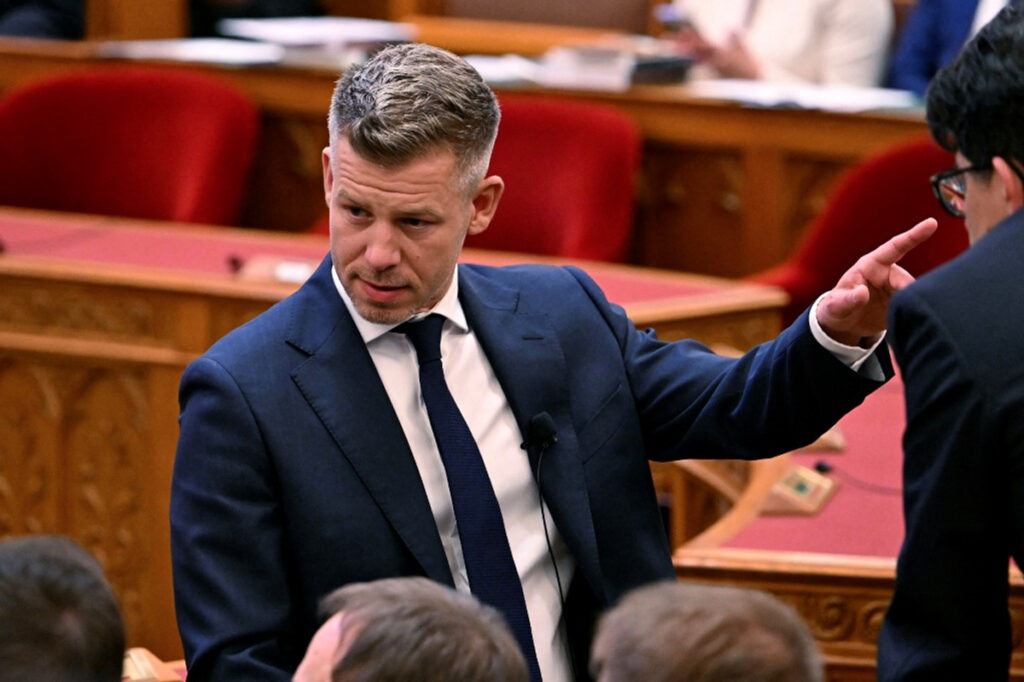
Hungary is seeking to revive the Visegrad Four as a more influential force in EU diplomacy and potentially expand it to include Austria, Romania and Western Balkan states, Prime Minister Péter Magyar said on Wednesday.
The V4 – currently made up of Hungary, Poland, Slovakia and the Czech Republic – was originally designed to coordinate Central European positions within the European Union, but has lost cohesion in recent years amid deep political divisions, particularly over Russia policy.
Follow our coverage of the war on the @Kyivpost_official.
Those tensions peaked under Magyar’s predecessor, Viktor Orbán, whose pro-Kremlin stance clashed sharply with Poland’s strongly anti-Russian government led by Donald Tusk.
Magyar, who defeated Orbán in April’s election, chose Warsaw for his first foreign visit as prime minister, signalling a reset in regional ties.
“The Visegrad Group may regain its vitality and its influence within the European Union,” Magyar said at a joint press conference with Tusk. “I am personally ready for us to expand this Visegrad cooperation to include other countries.”
He floated the idea of widening the format to include Austria, Croatia, Slovenia, Romania, Nordic states, and Western Balkan countries outside the EU.
Hungary, currently holding the rotating presidency of the V4, could also host a leaders’ summit in Budapest before the end of June, he added.
Other Topics of Interest
Ukraine Needs $43B in External Financing for 2027, Finance Minister Says
Finance Minister Serhiy Marchenko presented Ukraine’s external financing needs on Monday for 2026-27 at the G7 finance ministers’ meeting in Paris, warning that international support remains critical as Russia continues to strike civilian and energy infrastructure.
Polish Prime Minister Donald Tusk welcomed the prospect of renewed cooperation, saying he had “waited many, many years” for the moment the leaders of the four countries could once again sit at the same table to coordinate policy.
“Hungary and Poland will act as one fist… in Brussels and in geopolitical matters,” Tusk said, stressing shared regional interests.
He also offered Polish assistance in reducing dependence on single energy suppliers, highlighting Warsaw’s rapid pivot away from Russian oil and gas.
Magyar said Hungary was open to deeper energy cooperation, acknowledging Poland’s experience in diversifying supply.
During his visit, Magyar also contrasted Hungary’s record with Poland’s use of EU funds, praising visible infrastructure development after travelling by train from Kraków to Warsaw.
“This is a good illustration of how EU funds are being used… unfortunately in Hungary over the past 20 years we have not experienced this,” he said.
Magyar is expected to meet Polish Solidarity leader Lech Wałęsa later on Wednesday before returning to Budapest via Vienna.