
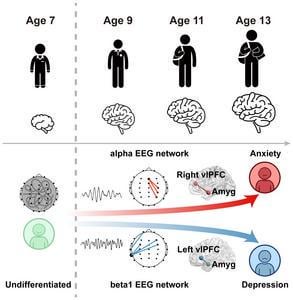
A study tracking children over a period of seven years identified distinct brain-wave patterns emerging from age 9 can forecast a child’s vulnerability to anxiety or depression by age 13. Anxiety is linked to activity on the right side of the brain, while depression is tied to the left.
https://www.eurekalert.org/news-releases/1128856
3 Comments
A longitudinal study tracking children over a period of seven years identified distinct brain-wave patterns emerging from age 9 can forecast a child’s vulnerability to anxiety or depression by age 13. These predictive markers reveal divergent, hemisphere-specific neurodevelopmental trajectories. Anxiety is linked to activity on the right side of the brain, while depression is tied to the left. The findings from the novel study in Biological Psychiatry, published by Elsevier, provide a robust, externally validated foundation for early detection and targeted precision prevention.
Anxiety and depression, the two most prevalent mental disorders worldwide, are increasingly affecting younger populations, with a sharp peak during adolescence. Yet, when symptoms become severe, the window for optimal intervention has often passed. To understand how these highly comorbid disorders develop, investigators tracked the dynamic maturation of children’s brains longitudinally to identify biological warning signs in children at risk before the onset of symptoms.
Researchers collected resting-state electroencephalogram (EEG) data at ages 7, 9, and 11, and assessed clinical symptoms and fMRI scans at age 13. They used advanced EEG, connectome-based predictive modeling (CPM), and machine learning to analyze the data.
The key findings are as follows:
Age 9 was identified as a critical neurodevelopmental turning point. At age 7, predictive brain networks were entangled, but from age 9, they diverged into distinct predictive pathways.
Distinct markers were found in the alpha and beta-1 EEG networks that predicted future anxiety and future depression, respectively.
Changes over time between ages 9 and 11 predicted symptom intensity in adolescence, with early-life anxiety/depression severity associated with more severe symptoms later in development.
Brain-wave signals are deeply rooted in the brain’s emotional center (the amygdala): anxiety is driven by a circuit on the right side of the brain, while depression is driven by a mirror circuit on the left.
https://www.biologicalpsychiatryjournal.com/article/S0006-3223(26)00099-5/fulltext
Well at least that indicates that I’m using my entire brain
Yeah, this is super interesting but also kinda terrifying. The idea that we can spot risk for mental health issues in brain waves of 9-year-olds is a huge leap forward for early intervention. It makes total sense that anxiety and depression would have different neurological footprints – anxiety is often about hyper-vigilance (right brain), and depression can involve rumination and negative self-focus (left brain).
But as a parent, this also feels like a lot of pressure. Knowing a kid has a vulnerable pattern at age 9 means we have a 4-year window to build up their resilience, coping skills, and support system. It’s not a diagnosis, it’s a forecast. The real question becomes: what do we do with this information? How do we create environments that buffer against these risks without stigmatizing the child? Hopefully this research leads to practical, accessible tools for families and schools, not just more anxiety about anxiety.