
FLAGSTAFF, AZ (AZFamily) — The Coconino County Sheriff’s Office is using autonomous technology and training its own artificial intelligence models to improve search and rescue operations in northern Arizona.
Deputy Paul Clifton, the Assistant Search and Rescue Coordinator, said the technology helps process large amounts of drone data that would be unrealistic for humans to review manually when time is of the essence.
“As opposed to looking at thousands of photographs with the human eye that fatigues in 10 minutes, we’re leveraging automation tools,” Clifton said.
Pixel detection software analyzes drone imagery
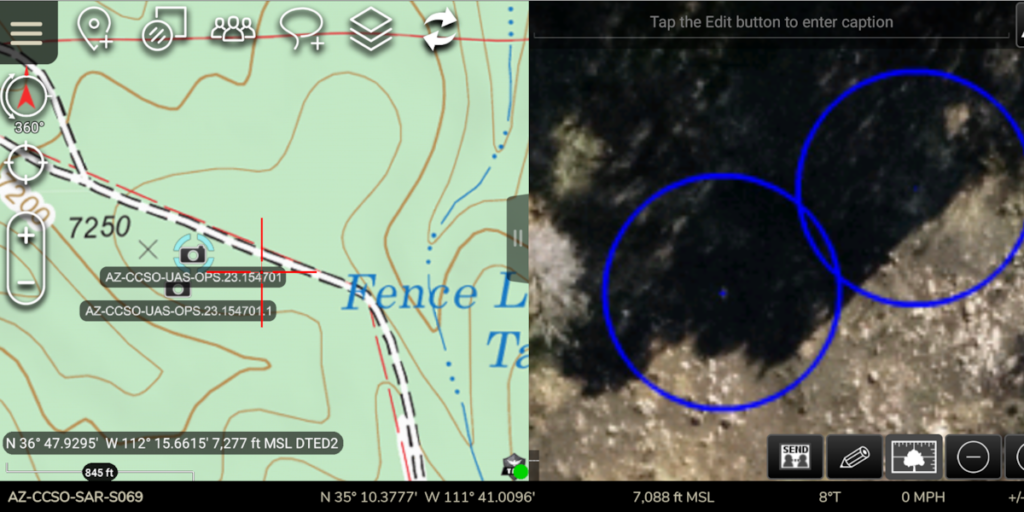
Once a drone flies over a search area, the department uses a program called LOC8 to analyze the footage. The software examines drone imagery pixel by pixel to identify abnormalities in natural environments.
The software can search for specific colors based on what a missing person was last seen wearing. It even accounts for different shades of light reflecting off objects, Clifton said.
“Maybe it reduces the number of photos you have to look at from a thousand down to twenty,” Clifton said. “You can say, I don’t care about blue or yellow or anything. I’m looking for red because we believe that that’s what the person was last seen wearing.”
If the software detects an item that’s worthy of a closer look, it gives searchers a precise GPS location to find it.
Drones equipped with AI obstacle avoidance
Coconino County has been using drones since 2018. They now use the latest versions of Skydio drones that have AI-powered obstacle avoidance using six onboard cameras.
The system creates a sphere of vision that prevents crashes, even in areas with poor GPS signals, such as canyons, Clifton said.
Training custom AI models
The Coconino County Sheriff’s Office is working with a company in Scotland to develop AI models that are finely tuned for Northern Arizona’s unique environment. The technology can re-analyze video from past flights and retrain the model to better identify targets in the future.
“Northern Arizona versus Southern Arizona, the context, the environments are very different,” Clifton said. “And the ability to train models that work in your environment is super important.”
Clifton said they’re still testing the custom training feature, but their work to fine-tune models could be useful for other public safety departments operating in similar environments.
See a spelling or grammatical error in our story? Please click here to report it.
Do you have a photo or video of a breaking news story? Send it to us here with a brief description.
Copyright 2026 KTVK/KPHO. All rights reserved.