
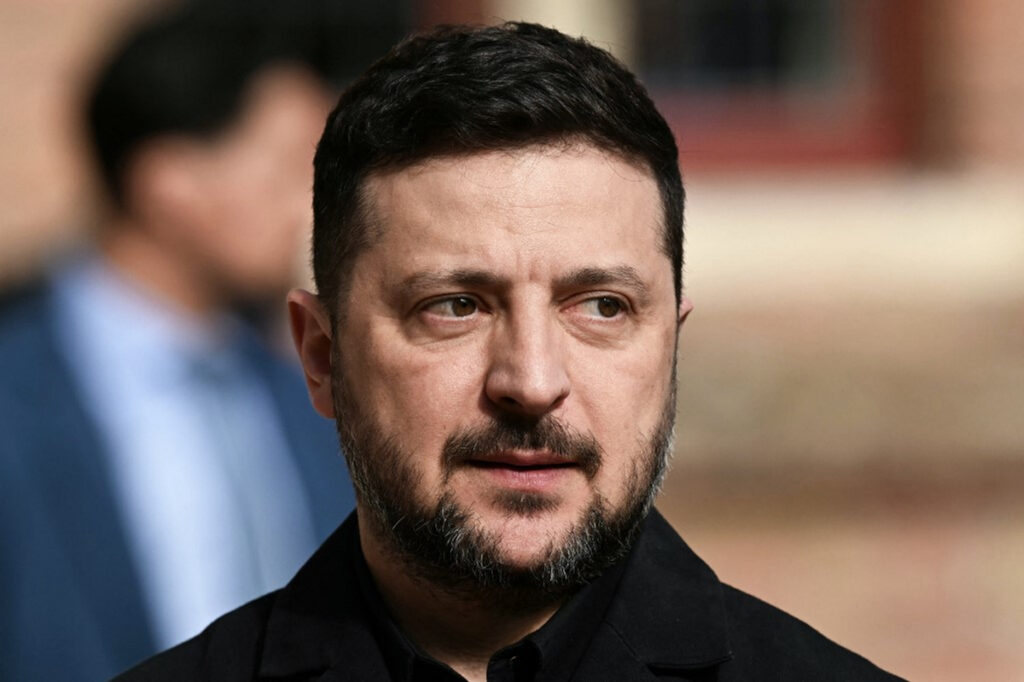
In his evening address on Wednesday, President Volodymyr Zelensky revealed that Moscow is weighing new threats against Ukraine’s north, including the Chernihiv and Kyiv directions.
“We discussed what is currently happening in the direction of Belarus and Russia’s Bryansk region,” Zelensky said. “It is from there that the Russians are considering scenarios for additional attacks on Ukraine.”
Follow our coverage of the war on the @Kyivpost_official.
Ukraine is already reinforcing the area, Zelensky said, adding that the military command has received relevant instructions.
The most revealing part of the address, however, was the Ukrainian leader’s tone.
“Frankly, we are tired of this constant threat to Ukraine – that at some point they may try to drag Belarus into an expansion of the war,” he said.
“They must understand the consequences for themselves. They will be significant.”
The Four-Year Sword Over Ukraine’s North
The “Belarus option” is not new. It has been hanging over Ukraine since the first days of Russia’s full-scale invasion, when Russian troops used Belarusian territory to drive south toward Kyiv, Bucha, Irpin and Chernihiv.
Since then, Belarus has functioned as a permanent threat on Ukraine’s northern flank. Even when Alexander Lukashenko’s own forces have stayed out of direct ground combat, Belarusian territory has remained useful to Moscow – as a launchpad, a pressure point and a psychological weapon.
Other Topics of Interest
US Urges Ukraine to Support Easing Belarus Potash Sanctions
The US is reportedly urging Ukraine to support easing restrictions on Belarusian potash fertilizer imports and to lobby European countries to do the same, arguing it could reduce Minsk’s dependence on Moscow.
Kyiv is cautious, as Belarus remains a key Russian ally and has allowed its territory to be used in attacks against Ukraine.
Kyiv is tired because Belarus has become a cheap, low-risk tool for Vladimir Putin. A military exercise, troop movement or missile deployment can force Ukraine to prepare for another possible northern escalation, even while the heaviest fighting remains in the east and south.
What Zelensky’s Warning Reveals
President Zelensky’s remarks point to three things.
First, Russia may be looking for ways to stretch Ukraine rather than break through directly. If Moscow cannot achieve gains on hardened eastern front lines, it can still try to create uncertainty in the north through sabotage threats, cross-border pressure, air attacks or the appearance of a new front.
Second, Zelensky’s focus on Russia “considering scenarios” from Belarus emphasizes that Minsk is no longer an independent actor. The integration of the Russian and Belarusian militaries is effectively complete. Lukashenko does not get a vote on how his airspace or logistics hubs are used.
Third, by bringing these intelligence assessments into the public eye before a single shot is fired, Zelensky is attempting to strip Russia of the element of surprise. More importantly, he is issuing a stark warning to the international community: do not wait for another invasion from the north before increasing pressure on Minsk.
“I expect Ukraine’s Foreign Intelligence Service to be as active as possible in diplomatic work concerning Belarus,” he said. “We need to increase pressure and strengthen coordination with our partners.”
The End of Diplomatic Patience
For the first years of the full-scale war, Kyiv maintained a delicate approach toward Minsk, seeking to deter Lukashenko from committing his own ground troops while avoiding steps that could hand Moscow a pretext for escalation.
Zelensky’s latest address suggests that patience is thinning. His warning of consequences shows a leader who is done playing defense on the northern flank. If Russia again uses Belarus to threaten Kyiv, Ukraine is signaling that it will no longer treat the Belarusian border as a legal shield for Russian assets.
Kyiv is not saying exactly what it will do. But it is saying that the northern threat will not be passively endured.
“There are additional tasks for our intelligence regarding this threat. For now, these tasks are not public.”
The president also tied the warning to Ukraine’s broader long-range campaign against Russia’s war infrastructure, praising the Special Operations Forces for a confirmed strike on an oil refinery nearly 800 kilometers from the border.
He said the hit showed that Ukraine’s “long-range sanctions” were working effectively.
Clearly, Ukraine has options, including far from the front line.
Russia has for too long been able to keep Ukraine’s north under pressure – a threat never fully neutralized – while avoiding the costs of Belarus’s direct entry into the war.
By making Moscow’s scenarios public, the Ukrainian leader may be laying the groundwork to finally take that option away from the Kremlin.