
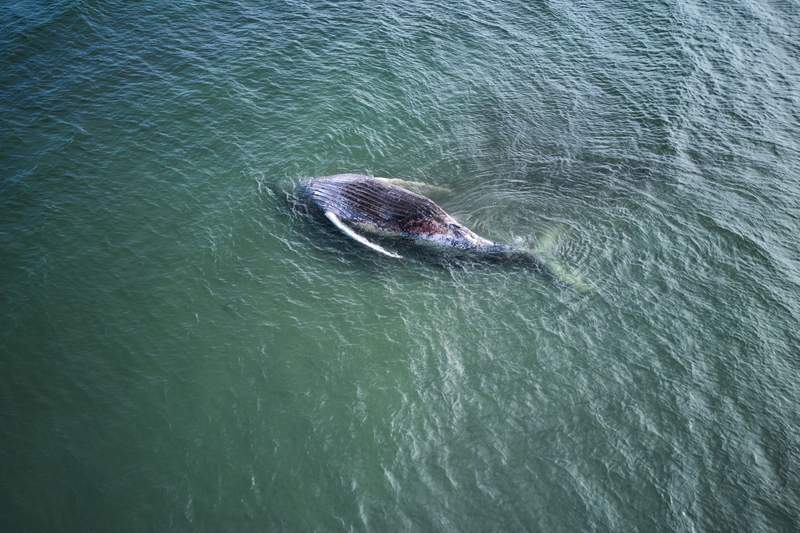
Danish authorities have abandoned an initial attempt to tow the carcass of a humpback whale known as “Timmy” to the mainland after efforts to remove the animal – prompted by fears the bloated carcass could explode off the holiday island of Anholt – ran into difficulty.
Officials tried to tow the whale into deeper water on Thursday so it could be transported to a port in Jutland, but – in an unfortunate reminder of the final weeks of its life – the animal became stranded once again on a sandbank.
“We were unable to carry out the planned transportation,” Jane Hansen of the Danish Environmental Protection Agency said.
The operation has therefore been temporarily suspended “while the emergency services explore alternative options for transporting the whale.”
“The aim remains to transport the whale to the port of Grenaa, as the facilities there are best suited for the post-mortem and the collection of scientific samples,” Hansen said.
A new attempt is not expected to be possible until after the upcoming long bank holiday weekend.
A livestream broadcast by the News5 showed the whale – inflated with decomposition gases – lying off Anholt, surrounded by seagulls in the early evening.
The Danish environmental agency cautioned that if left there, the carcass could cause significant nuisance to residents and tourists. It warned the public not to approach the animal due to the risk of infection. The sunny weather expected over the weekend may increase the risk of the carcass exploding.
Islanders want carcass gone
As far as Anholt’s residents are concerned, the sooner the whale is removed the better.
“It is a strong wish of the locals that the whale is transported away promptly so it does not disturb holidaymakers,” said Pia Lange Christensen, director of the tourism organization Visit Aarhus, which also covers the island of Anholt.
The season has just begun, she told dpa ahead of the abandoned operation. “In the coming weeks, more and more tourists will come to the island, which is a very popular holiday destination.”
For Denmark, a country with a long coastline, whale strandings are not unusual, Christensen noted. “And it does not normally take long for the authorities to remove the animals,” she added.
The weakened whale had previously been stranded several times off Germany’s Baltic coast, before a private initiative transported it alive to the North Sea and released it.
The whale was later found dead off Anholt, where it has now presented the Danes with a significant challenge.
It was not all negative, however, Christensen noted. “At least the whale has brought attention to Anholt,” she said.
Meanwhile, the Environment Ministry in the German city of Schwerin is attempting to obtain a tracker that the private initiative had attached to the whale, to analyse the data it contains. It is as yet unclear how long the marine mammal survived after its release.