

- A new Utah poll finds overall feelings on AI are a nearly equal mix of positive and negative.
- A third of working Utahns are using AI to get their job tasks done.
- Political affiliation, age and income are significant factors when it comes to AI sentiment.
An explosion of proposals to build massive data centers across the county on behalf of so-called “hyperscaler” clients that are pushing billions of dollars into expanding their access to computing power has touched off a firestorm of controversy, including in Utah thanks to a recently unveiled effort by Canadian businessman Kevin O’Leary.
O’Leary is hoping to build, according to the developers, one of the largest data center complexes in the world on a 40,000 acre plot in western Box Elder County. The plan has been met with a wave of public pushback thanks to a process that, so far, has limited resident participation and raised a myriad of questions around water use, air quality, tax subsidies and the unprecedented scale of a facility that, when complete, would consume more than twice the power of the entire state.
And the single biggest driver of those new industrial-strength digital processing centers is the race among the world’s biggest technology brands to power their efforts to build the ultimate imitator of human capabilities — artificial intelligence.
New statewide polling by the Deseret News, in partnership with the University of Utah’s Hinckley Institute of Politics, reveals a marked disconnect when it comes to residents’ feelings about artificial intelligence versus the data complexes that underpin the fast-advancing AI technology sector.
How Utahns feel about AI versus data center developments
 Cattle graze on land proposed to be used for the Stratos Project data center in the Hansel Valley area of Box Elder County on Tuesday, May 12, 2026. This swath of land is the more eastern of the two largest sections of land proposed to be used for the data center. | Isaac Hale, Deseret News
 The new survey revealed a majority of residents, 53%, have some level of opposition to O’Leary’s proposed project. And while 69% agree with the statement that “the costs of new data centers to Utah’s water and energy resources outweigh their economic benefit such as jobs and tax revenue,” they have a significantly more nuanced take when it comes to AI.
When asked, “How would you rate your feelings towards the use of AI?,” 38% said they felt somewhat or very positive about AI, 37% said their feelings were somewhat or very negative and 25% reported being neutral.
While overall sentiment about AI came in at nearly a dead heat, parsing the group on demographic characteristics reveals some more telling dynamics about who is thinking what when it comes to artificial intelligence.
Among self-identified Republicans in the poll, 50% said they felt somewhat or very positive about AI compared to just 23% of self-identified Democrats.
Generational divides were also stark. Gen Zers were the most enthusiastic about AI, with 59% expressing positive feelings, while 40% of millennials and 35% of Gen Xers said the same. Baby boomers had the most pessimistic views of AI, with only 28% seeing the new technology as somewhat or very positive.
A similar trend was also apparent across income groups. Over half, 51%, who reported earning over $100,000 a year said they were somewhat or very positive about AI as did 38% of those in the $50,000-$100,000 annual salary range. Just 21% of those who earn less than $50,000 each year said they had positive feelings toward AI.
A slight skew also evidenced itself in AI sentiment when filtered by gender, with 43% of men in the AI-positive group versus 31% of women, according to the poll.
What we love/hate about AI
 Artificial intelligence service ChatGPT is pictured on a computer in Salt Lake City on Wednesday, Jan. 18, 2023, in this photo illustration. | Spenser Heaps, Deseret News
 Pollsters also explored which functions represented the most concerning and most exciting potential uses of AI technology.
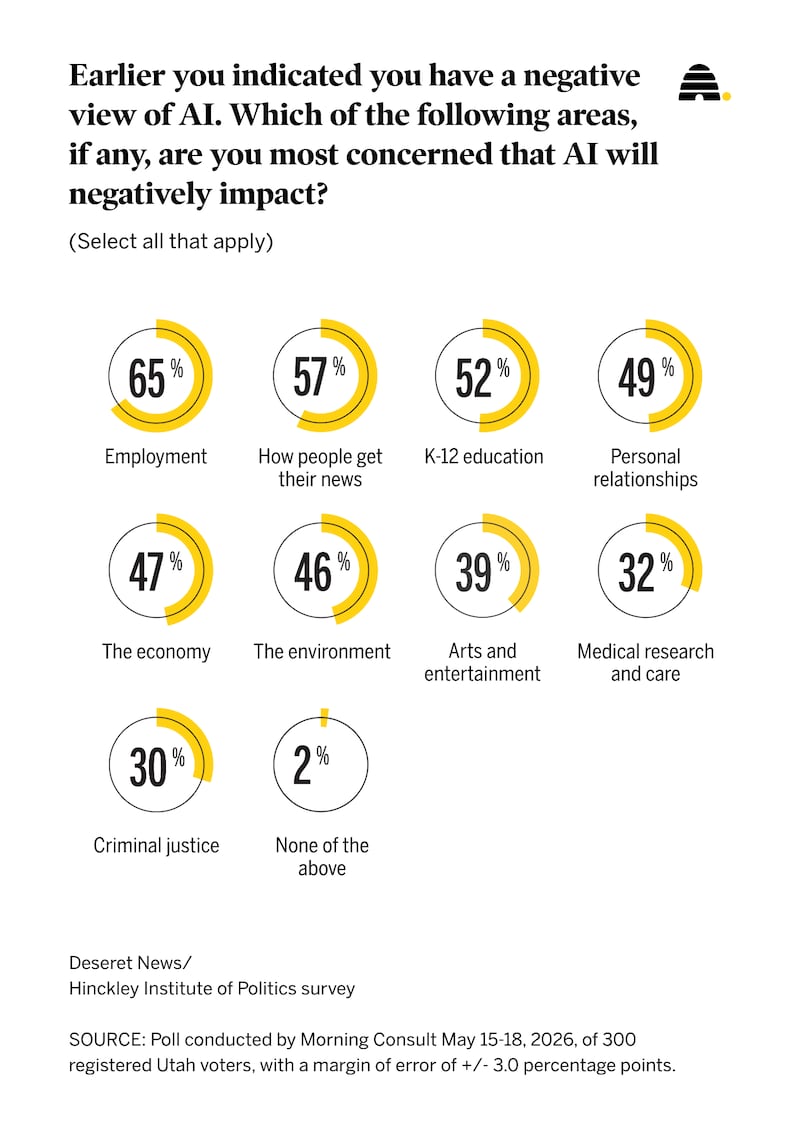
Among respondents who said they had some level of negative feelings about AI, the top three most concerning areas were employment, source of news and K-12 education, identified by 65%, 57% and 52%, respectively.
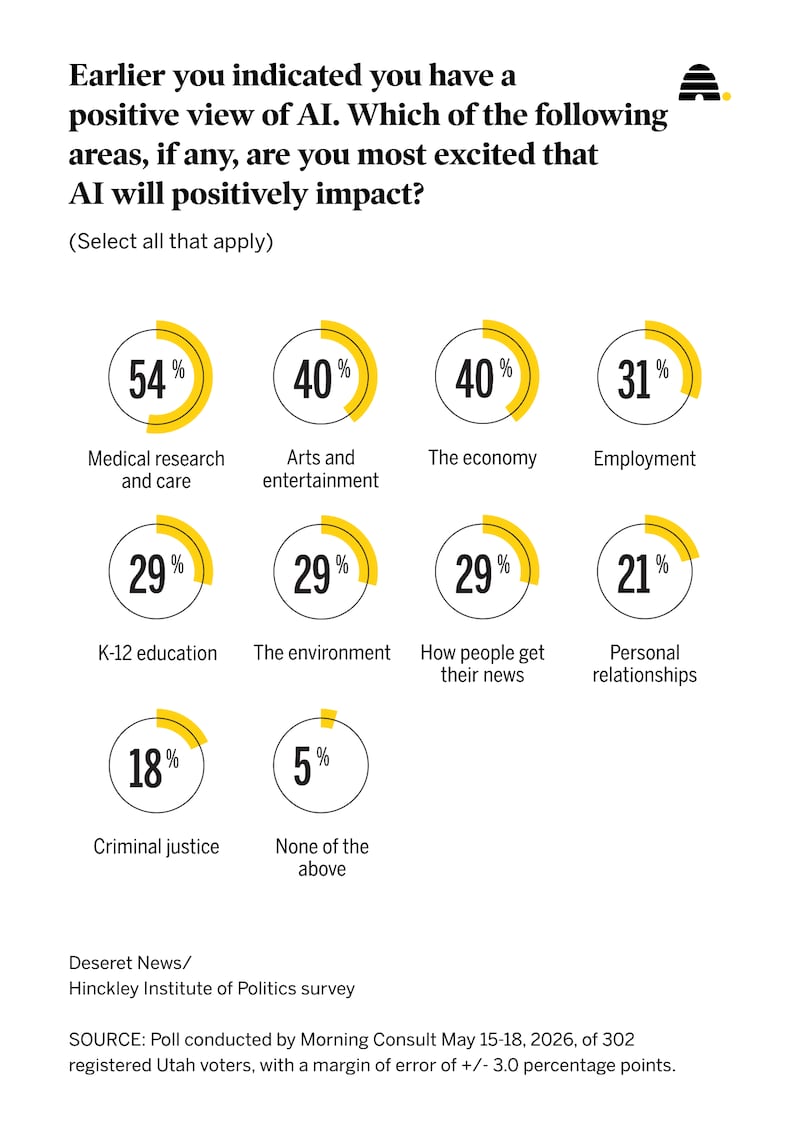
For those who reported positive feelings about AI, medical research, the economy and arts/entertainment rated as the areas garnering the most AI-related excitement, totaling 54%, 40% and 40%, respectively.
Concerns over jobs also loomed large in a national survey conducted by Quinnipiac University in March.
“Americans are not rejecting AI outright, but they are sending a warning,” associate professor of Business Analytics and Information Systems Tamilla Triantoro wrote. “Too much uncertainty, too little trust, too little regulation, and too much fear about jobs.”
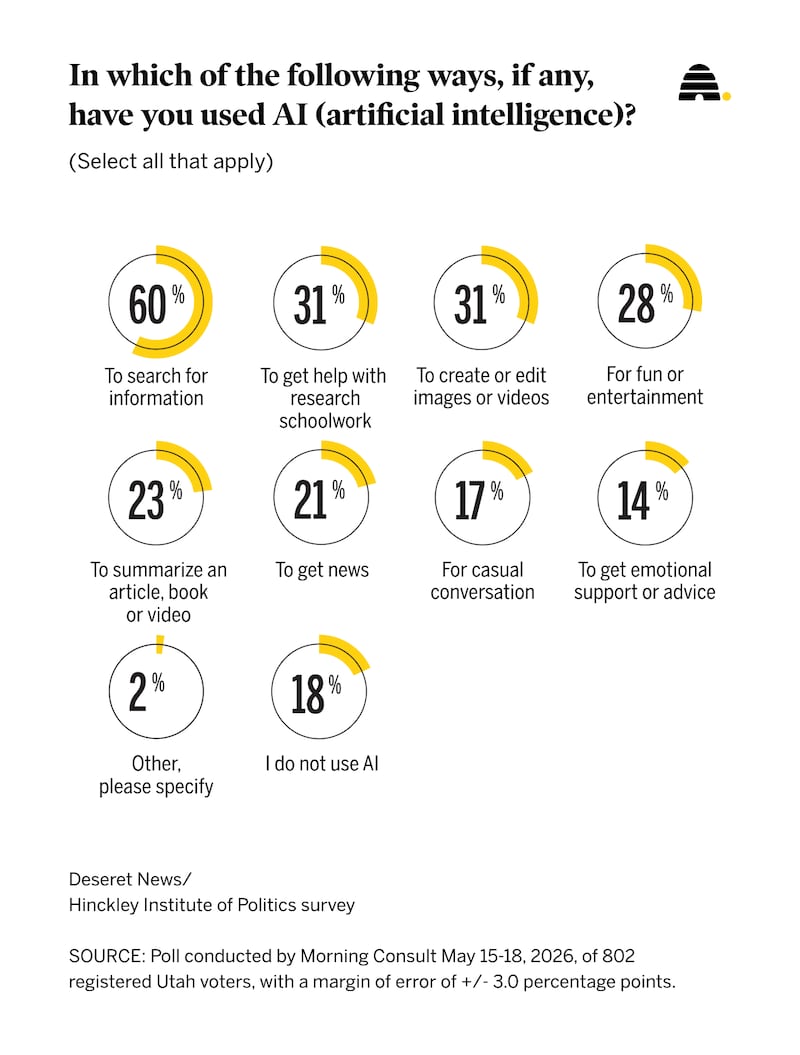
While 18% of Utah poll participants said they don’t use AI, those who do reported a wide range of real-life applications ranging from emotional support, 14%, to the top category, searching for information, an AI task that 60% of Utahns reported using.
Two categories tied for a common AI use by 31% of respondents — helping with research and/or schoolwork as well as creating/editing images or videos. Another 28% said they engage with AI for fun or entertainment. About 1 in 4 poll participants, 23%, use AI for summarizing articles, books or videos and 21% report they turn to AI for news.
Among poll participants who said they’re currently employed, 12% reported they’re using AI for most of their work, 22% said AI tools come into play for some of their work tasks and 17% said “not much” of their work was done with AI. A quarter of employed respondents said none of their work is accomplished with AI.
Morning Consult conducted the poll of 802 registered Utah voters May 15-18. It has a margin of error of plus or minus 3 percentage points.
What the rest of the world is saying about AI
While the sentiments shared by Utahns in the new poll showed a fairly even split when it comes to positive or negative feelings about AI, an analysis published by Pew Research Center last fall reflects a slightly less optimistic view.
In a survey conducted across 25 countries, Pew found 42% of people were equally concerned and excited about the increased use of AI in daily life, 34% were more concerned than excited and 16% were more excited than concerned.
Americans in the Pew survey were even more cynical about AI’s increased use, with 50% reporting more concern than excitement, 38% equally concerned and excited and just 10% more excited than concerned.
A separate Pew survey published last November found a much narrower partisan divide than found in the Utah poll when it comes to AI-related sentiments.
Pew said it found nearly identical shares of Republicans and Democrats saying they are more concerned than excited about the increased use of AI in daily life – 50% and 51%, respectively. Pew researchers noted the results represented a shift from previous findings.
“Since 2021, Republicans have been more likely than Democrats to say they feel more concerned than excited about AI’s growing use,” the Pew report reads. “But the share of Republicans who say this has decreased 9 percentage points since 2023.”