
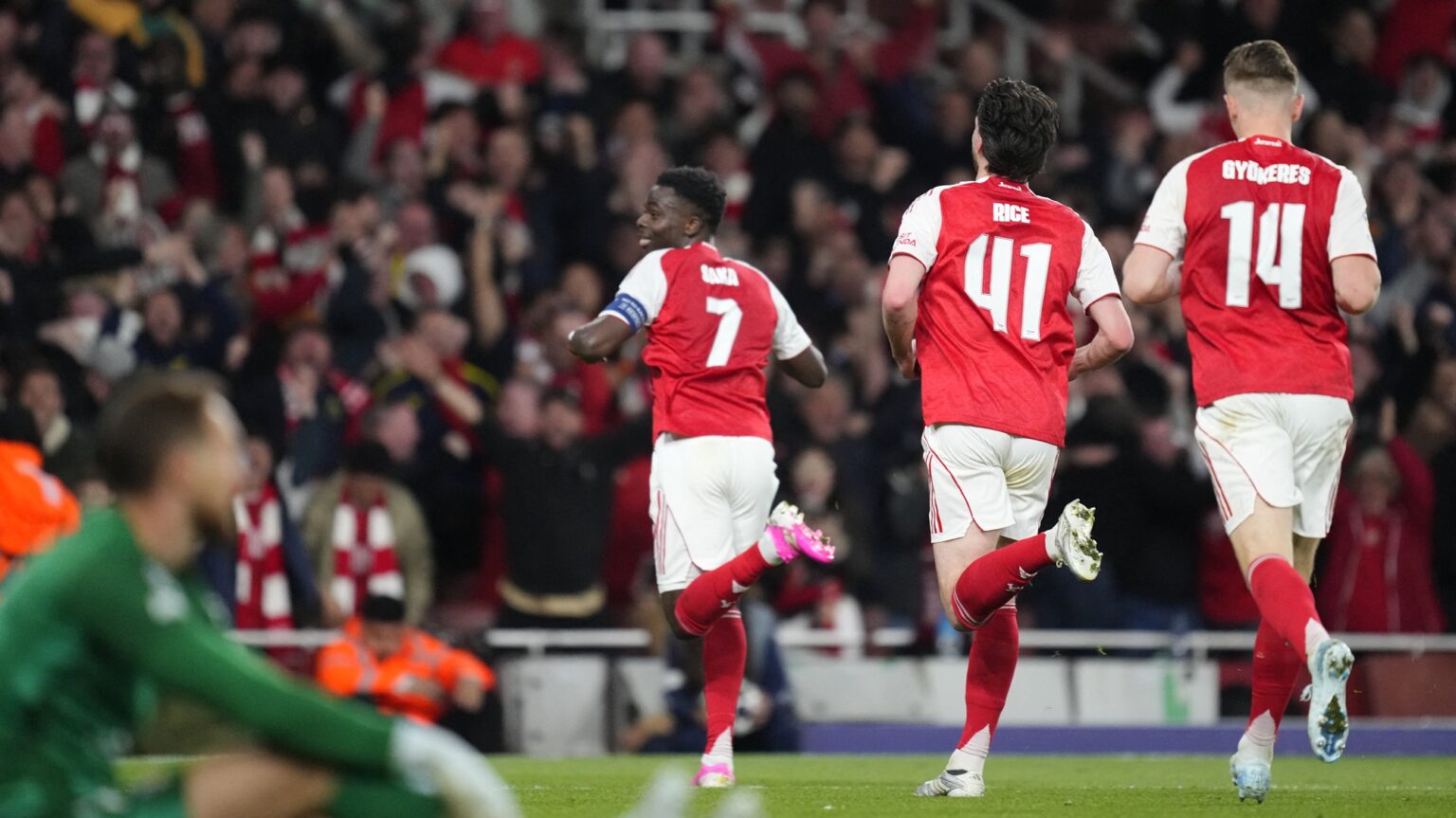
Next Saturday, 30 May, the Final of the 2025–2026 UEFA Champions League season will be played at the Puskás Arena in Budapest, Hungary. This makes Budapest the 29th city in Europe to host the final of the primary European football club competition. So, let’s take a look at the paths the two finalists, the English side Arsenal and the French side Paris Saint-Germain, have taken to get to the Final.
First up, Arsenal.
Barring a historic blowout, Arsenal fans will cherish this season regardless of the outcome of the big game next Saturday. For the first time since their legendary 2003–2004 ‘invincibles’ season, after 22 years of waiting, the Gunners have won the English Premier League again!
That wait was made even more painful by getting agonizingly close to glory twice in the last three years. Arsenal finished second in the league three times in a row (!). In two of those seasons, they bottled comfortable leads against Pep Guardiola’s Manchester City.
There was a brief period this spring when it certainly seemed that would be the case yet again. After losing to City 2–1 in April, the Manchester Blues got within three points of Arsenal at the top with one game in hand. However, this time, it was Guardiola’s men to do the ‘bottle job’. They drew Everton and Bournemouth, while the Gunners won all four of their league games since—this means that Arsenal are going into the last matchday as confirmed champions of England.
Mikel Arteta took over the managerial duties at Arsenal in December 2019, after spending three years in Pep Guardiola’s coaching staff at Manchester City. He won the FA Cup right away in his first season. Although that win came in the chaotic season disrupted by the COVID-19 pandemic. After six years and some ‘oh, so close’ runner-up finishes in the league, he has now taken them to triumph again.
In the Champions League, Arsenal topped the 36-team league phase table this season, winning all eight of their games in an impressive feat. Among those wins was a 4–0 bashing of their eventual Semi-Final rivals, Atlético Madrid, in October, and a 3–1 victory over German champions and another fellow eventual UCL semi-finalists, Bayern Munich, in November. The Gunners scored 23 goals and only conceded four in the UCL league phase.
Brazilian winger Gabriel Martinelli scored the most, six out of the 23 goals, followed by the new star signing, the Swedish international centre-forward Viktor Gyökeres, with four.
Their league-topping finish spared the Gunners the play-off round, and thus got to face off against Bayer Leverkusen from the German Bundesliga in the Round of 16. After tying the road game 1–1, they got the job done at home, winning 2–0. In the Quarter-Finals, Arteta’s boys beat out reigning Portuguese champions Sporting CP with 1–0 on aggregate (winning 1–0 away and tying 0–0 at home).
Given that Arsenal scored just four goals in their four UCL knockout games, fans online began talking about their misgivings about Arteta’s defensive tactics and overreliance on set-pieces in offence ahead of the Semi-Final against Atlético Madrid. Given that Atléti head coach Diego Simeone also had a reputation for basing his tactics on a firm defence over overwhelming offence, this tie in the semis got branded the ‘haram derby’ in online football forums.
And, to be frank, the clash somewhat lived up to that expectation.
The first tie ended in a 1–1 draw in Madrid, Spain, with both sides scoring from penalties: Gyökeres on the Arsenal side and Julián Alvarez on the Atlético Madrid side. At the rematch at the Emirates in London, UK, Bukayo Saka put away a rebound at the end of the first half, which was enough to tilt the tie to Arsenal’s favour for good. The Gunners advanced to the Budapest Final 2–1 on aggregate.
Martinelli scored no goals for Arsenal in the knock-out stage, yet he remains the top scorer for the team in the UCL campaign with six goals. Gyökeres was able to add one to his tally since the league phase to make it four, while Saka, Kai Havertz, and Noni Madueke have scored three each.
Last season, Arsenal and Paris Saint-Germain met in the UCL Semi-Final. Then, PSG ended up advancing with 3–1 on aggregate.
Related articles: