
South Korea is promoting its defense industry and increasing arms exports under the stated goal of “becoming one of the top four global defense powers.”
Seoul is hoping to increase its defense capabilities while bolstering its economy under its firmly rooted policy of “self-reliant national defense.”
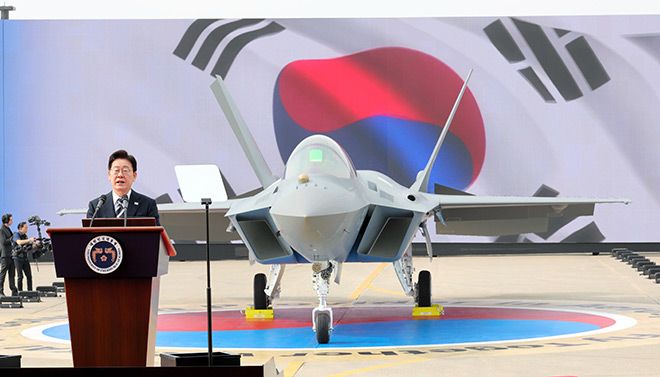
South Korean President Lee Jae-myung attended a rollout ceremony on March 25 for the first delivery of the KF-21 fighter jet model in the southern city of Sacheon.
“The success of the KF-21 does not simply mean strengthening our defense capabilities,” Lee told the ceremony. “It signifies our Republic of Korea has secured a new momentum for competing confidently with the world’s leading defense industry powers.”
The KF-21 is South Korea’s first fighter jet model to have entered the mass production stage.
Indonesia covered part of the development expenses for the KF-21, which Seoul is considering exporting overseas.
At a meeting in Seoul on April 13 with Polish Prime Minister Donald Tusk, Lee referred to a 2022 bilateral comprehensive deal worth $44.2 billion (7 trillion yen), regarding arms supply to Poland. He also expressed a will to further expand cooperation in the defense industry.
South Korea was the world’s ninth biggest exporter of major arms in 2021-2025, according to Stockholm International Peace Research Institute figures. The volume of South Korean arms exports in that five-year period was up 24 percent from 2016-2020.
In 2025 alone, South Korea ranked fourth in arms export share, following the United States, France and Israel.
Sales to Poland have fueled the South Korean export surge.
South Korean media reports say Poland has provided large volumes of weapons to Ukraine to help it fend off Russian invaders. Warsaw has replenished its supply by procuring K2 tanks, K9 self-propelled howitzers and other weapons from South Korea.
In the backdrop of developments in South Korea’s defense industry is the awareness of “self-reliant national defense” rooted in the country’s history and geopolitical situation.
In 1968, a North Korean guerrilla unit invaded South Korea and closed in on the Blue House presidential office in Seoul.
This and other incidents prompted then-South Korean President Park Chung-hee to instruct officials to start developing domestically produced weapons, according to documents of the Korea Association of Defense Industry Studies and other sources.
Homegrown arms and defense equipment have since grown in volume amid the country’s economic growth.
Conservatives and progressives disagree on most everything in South Korean politics, but there is no sharp division between the camps over self-reliant defense.
“The defense industry is currently one of our ‘national high-tech strategic industries’ and is making a great contribution to our national economy,” said Seo Hyuk, head of the Defense Policy Research Center with the Korea Defense Industry Association.
Seo said he believes the Lee administration’s goal of making South Korea one of the top four global defense industry powers is feasible, even though diversification of export destinations and the types of arms to be exported will present a challenge in the years to come.
Japan’s recent decision to lift its self-imposed ban on exporting lethal weapons has also aroused a sense of alarm in South Korea.
The Yonhap News Agency said South Korean defense industry officials are “closely watching” the possibility that Japan may emerge as a competitor, mainly in the field of warships.
(This article was written by Daisuke Shimizu and Akihiko Kaise, both in Seoul.)