
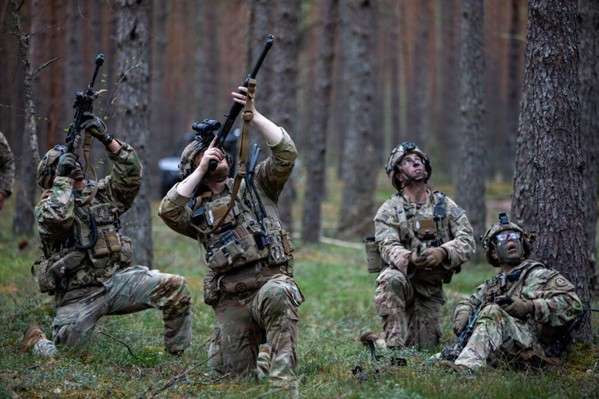
U.S. soldiers practice in Lithuania the acoustic identification of attack and reconnaissance drones, a skill that Ukraine considers essential for survival on the front line.
Ukraine has been demonstrating this for more than two years with blood: it’s no longer enough to look ahead and to the sides, you have to learn to listen to the sky. With the Project FlyTrap 5.0 exercise, developed from April 30 to May 19 in the Pabradė training area, Lithuania, it has brought to the table a skill that no Western manual had recorded until now: distinguishing an attack drone from a reconnaissance one by the sound it emits.
Single-use suicide drones produce a sharper and faster buzz, while reconnaissance drones, flying at higher altitudes on more stable platforms, generate a flatter and more constant sound. A difference that, in real combat, separates timely reaction from aerial ambush.
- Cover of the U.S. Army’s Center for Army Lessons Learned (CALL) report.
The Ukrainian precedent is not anecdotal, it is doctrinal
Ukraine did not discover this through theoretical innovation but through vital and operational necessity. Its troops identify Russian Shahed drones and their decoys by their acoustic signature and have complemented that human capability with networks of passive sensors (low-cost directional microphones Sky Fortress, $400-1,000 per unit, connected to local computers that classify, timestamp, and transmit compressed alerts to the nearest shooters).
A report from the U.S. Army’s Center for Army Lessons Learned (CALL), published on April 30, recommends that the U.S. Army adopt a similar architecture, especially along NATO’s eastern flank.
The CALL report does not talk about expensive systems or classified technology, it talks about cheap microphones, local processing, and muscle memory (so that when someone shouts “air!”, everyone knows what type of threat is approaching before looking at the sky).
U.S. soldiers practice in Lithuania the acoustic identification of attack and reconnaissance drones, a skill that Ukraine considers essential for survival on the front line.
Ukraine has been demonstrating this for more than two years with blood: it’s no longer enough to look ahead and to the sides, you have to learn to listen to the sky. With the Project FlyTrap 5.0 exercise, developed from April 30 to May 19 in the Pabradė training area, Lithuania, it has brought to the table a skill that no Western manual had recorded until now: distinguishing an attack drone from a reconnaissance one by the sound it emits.
Single-use suicide drones produce a sharper and faster buzz, while reconnaissance drones, flying at higher altitudes on more stable platforms, generate a flatter and more constant sound. A difference that, in real combat, separates timely reaction from aerial ambush.
- Cover of the U.S. Army’s Center for Army Lessons Learned (CALL) report.
The Ukrainian precedent is not anecdotal, it is doctrinal
Ukraine did not discover this through theoretical innovation but through vital and operational necessity. Its troops identify Russian Shahed drones and their decoys by their acoustic signature and have complemented that human capability with networks of passive sensors (low-cost directional microphones Sky Fortress, $400-1,000 per unit, connected to local computers that classify, timestamp, and transmit compressed alerts to the nearest shooters).
A report from the U.S. Army’s Center for Army Lessons Learned (CALL), published on April 30, recommends that the U.S. Army adopt a similar architecture, especially along NATO’s eastern flank.
The CALL report does not talk about expensive systems or classified technology, it talks about cheap microphones, local processing, and muscle memory (so that when someone shouts “air!”, everyone knows what type of threat is approaching before looking at the sky).