
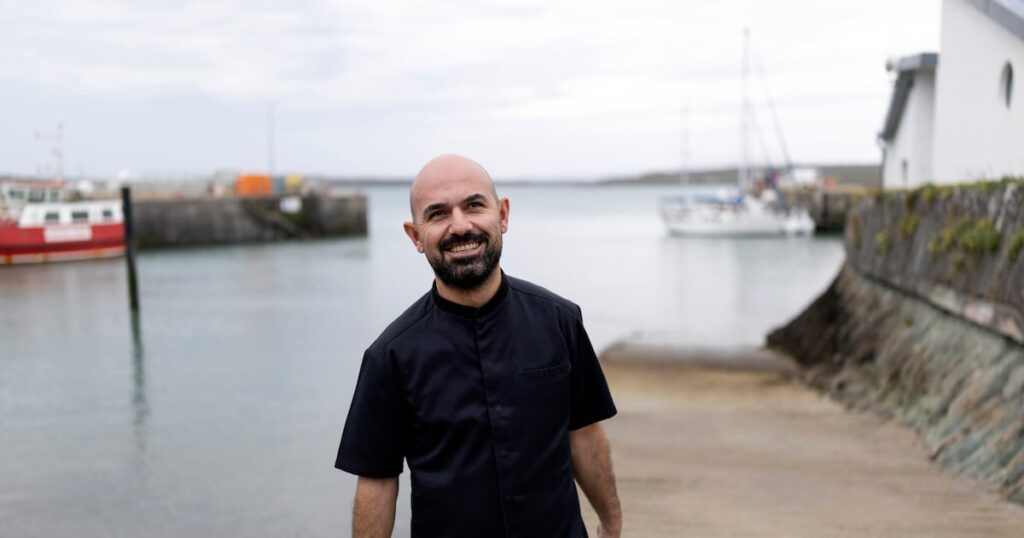
In the last census in 2022, the population of Baltimore, Co Cork, was recorded as 414. However you frame it, that is a small number of people living in a seaside village. It is thus all the more remarkable that one of the 414 residents has had an astonishing impact on helping make Baltimore a dining destination.
Turkish-born Ahmet Dede currently has two restaurants in the village. One, Dede at the Customs House, opened in 2020 and holds two Michelin stars. The other, a more causal space around the corner, is Baba’de, which opened in 2024.
On Monday evening, Dede won the Best Chef accolade at the Irish Restaurant Awards. He wasn’t actually there: he was at home in Baltimore with his partner and their two small children. “Four of my team were there,” he says by phone the day after the awards. The first he knew of the win was when they called him from the Clayton Hotel on Dublin’s Burlington Road to tell him the news.
“Winning means a lot. You work hard all year, your family and team support you, you are going through ups and downs. I had a glass of beautiful West Cork whiskey and when they come back, we will have a glass of champagne in the restaurant, and a bit of a celebration. It is great; it is amazing for the whole team.”
A couple of weeks before his win, I’m sitting with Dede in his Customs House restaurant. It is fully booked for the evening. The tasting menu – the only option – is €210 a head, with wine pairings of three different prices. Lunch is €120.
Dede has plans to open a third venue in the village. “There might be another project, a wine shop and a wine bar, with potential accommodation.” There isn’t yet a timeline for opening, but apparently a lease is soon to be signed.
Baltimore has always been a lovely destination in itself, between its scenic southwest Cork location, and its proximity to Sherkin Island, a short ferry-ride away. But for any rural village with a small population to have two outstanding culinary offerings with not just a national but also an international profile is definitely unusual. And it represents an unquantifiable addition to the local economy, between employing staff, and visitors who come to eat at Dede’s restaurants and stay over in Baltimore.
[ Baba’de restaurant review: You won’t eat like this anywhere else in IrelandOpens in new window ]
Now one of Ireland’s most famous chefs, Dede never set out to work in food professionally. “I was a footballer,” he says. “I was the goalkeeper and the captain of my team. When I was 14, I was playing with teams of people older than me. I was training with a professional team on the second division in Turkey. I was on the path to professional football.”
During one training session, he dislocated an elbow. That was the end of his football career. “I could have been great,” he says now, with full confidence. “I followed a different path after that.”
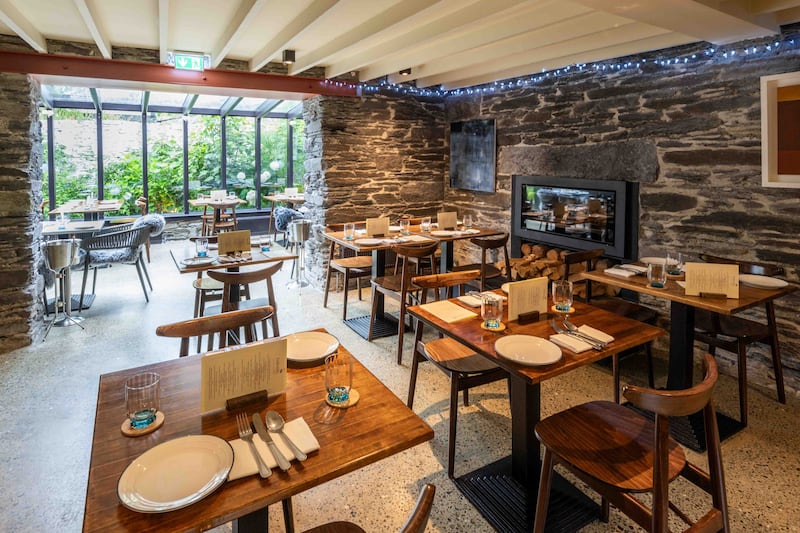
Ahmet Dede’s Baba’de restaurant in Baltimore. Photograph: Andy Gibson
Dede spent his first 23 years in Ankara, the youngest of three boys. Their father was a carpenter, and their mother stayed at home. She and Dede’s grandmother “were always at home, cooking and cleaning and taking care of the children”, he says.
“Men never cooked at home. The man was always working, and the woman was the housewife. I remember them getting ready for winter: making pickles, making pasta, drying things, using food preservation. I would come home from primary school and high school, and they were always cooking. They would be making pastry, stuffing vine leaves, grilling. They let me them help. It was a great training ground for a chef. I was very curious.”
On cookery shows such as MasterChef, Top Chef, Next Gen Chef, contestants regularly cite a key source of their culinary inspiration as coming from women family members in the home. Did the fact that it was women who were cooking at home then translate into women chefs cooking on a professional level in Turkish society?
Dede shakes his head. “Kebab chefs were always men, for instance.”
It was clear from his skill at professional football, that Ahmet Dede was ambitious. After the dislocated elbow, he diverted that ambition towards cooking. He had early had an appreciation and interest in food.
What is the first thing he recalls eating at home in Turkey that thrilled him?
“Olives. Green and black olives. That briny, amazing taste. I was one and a half, gobbling up olives. My family had to hide the olives from me.” Then he’s down a flavour memory path.
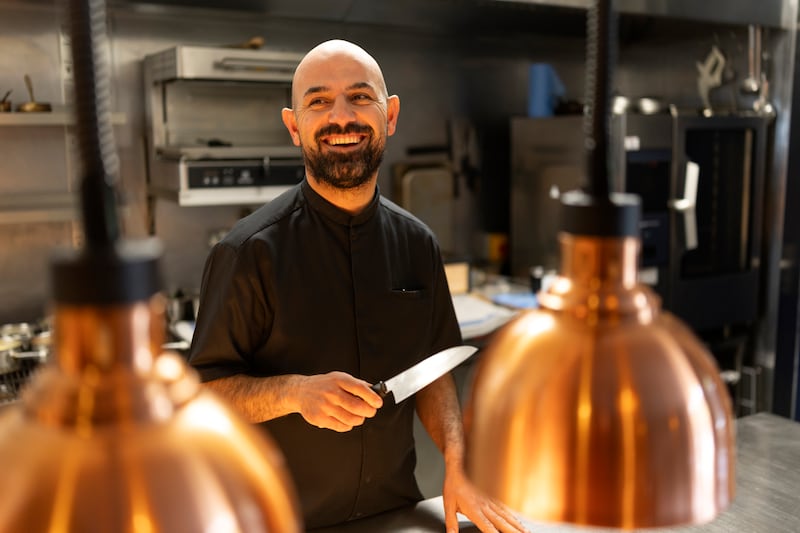
Ahmet Dede: ‘My family had to hide the olives from me.’ Photograph: Chris Maddaloni
“I loved cherries. Our apartment was on the second floor, and there was a cherry tree growing outside it. I would put out my hand and pick cherries. Sometimes I climbed into it. There was a mulberry tree too. We grew quince, walnuts, apricots. And strawberries. We had lemon trees. My auntie lived across the street. She had sour cherries. And plums. I was eating all these, at four and five.”
A childhood game with friends took Dede to many other gardens to sample other fruits. “We would run into different people’s gardens and steal fruit and run away. We climbed trees. That’s how we grew up, stealing fruit from trees, with all the neighbours complaining about us.”
What was the first non-Turkish food he had that was memorable to him?
“I remember my uncle had a restaurant in Kusadasi. My brother works there now. His wife is Belgian, and we would go for summer holidays. She made braised meat with local beer, and lots of fresh herbs, with creamed potatoes and scallions on top. It was very European. Poached chicken with lots of herbs. She made bisque with lobster and langoustine heads. I never ate lobster or cockles or crab until I was 17, and I loved it. I remember the smell of the bisque when it was being made and wondering what it was.”
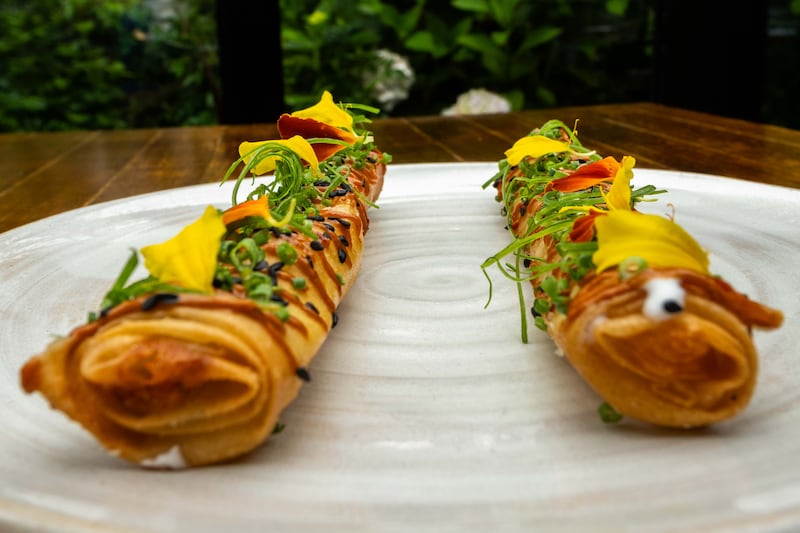
Langoustine spring rolls at Baba’de. Photograph: Andy Gibson
As he began to train as a chef, Dede refocused some of what he had learned during his years in sport as a captain of his team. “The discipline of it. The leadership role. Winning, The hunger of it. Learning from your mistakes. Looking at your team, and working out how to motivate them, how to get the best out of them. I was the captain of the team, so that was my job.”
He came to Dublin in his mid-20s with his former partner. “I thought: what will I do? I don’t want to work in a pub or a shop. I want to do something I would love. And I was very good at cooking, and very dedicated to it.”
He worked for a time in Extreme Pizza in Rathmines, which has now closed. All the while, he was trying to get on a 16-week cookery course with Fáilte Ireland. He was twice rejected.
“I kept chasing this course. On my third application, I said to them: You have to take me.”
It was third time lucky. Dede did the course. He started to be acquainted with some of the fine dining restaurants in Dublin, as part of his college research. He visited Chapter One, which proved to be inspirational.
“I knew from day one when I entered the Chapter One kitchen, and saw how passionate everyone was, that this was what I wanted to do. I knew I was going to get a Michelin star myself one day.”
He came to Baltimore in 2017. In 2020, he and Maria Archer opened Dede. The first time the Michelin inspector came calling, he introduced himself at the end of the meal.
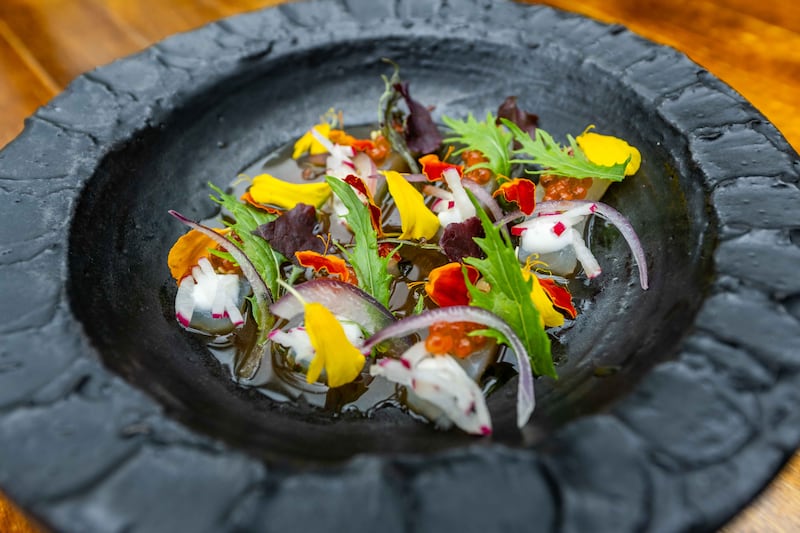
Haddock lakarde at Baba’de. Photograph: Andy Gibson
“The inspector ate his food, and then came into the kitchen,” Dede says. “I introduced myself and we started talking. We had a long chat. We talked about the menu, the food, the ingredients. He asked me a lot of questions.”
Dede had only one question for the Man from Michelin: “Are you going to give us a star?”
I am very surprised to hear all this. I had been under the impression that Michelin inspections were done undercover. Apparently restaurant staff do notice inspectors from time to time – dining alone and a phone number not originating from Ireland is one giveaway – but I had not known these secretive observers ever announced themselves.
“They don’t do it any more,” Dede says.
He got his first Michelin star in 2021. A second followed in 2023; an astonishing achievement for any new restaurant. In an episode of MasterChef the Professionals, which aired in December 2024, the three finalists spent five days of filming in Baltimore. They worked with Dede in the Customs House restaurant, before going on to the Inish Beg to cook a lunch, using skills they had been taught in Baltimore. The exposure the BBC programme gave them resulted in even more bookings.
“We were booked solid for 10 months after it aired,” says Dede. “People travelled from all over the world.”
[ Michelin-star restaurants in Ireland: The complete 2026 guideOpens in new window ]
As we talk in the Customs House, there is some discreet background noise around the preparation of the evening’s dinner. (For the record, The Irish Times was not hosted at either the Customs House, or at Baba’de, beyond a glass of water.)
I am shown the menu for the evening. Dede explains that he’s not really interested in having any signature dish. He wants to keep changing things around. “I don’t keep one particular dish on the menu forever.”
There are 10 courses on the dinner tasting menu, all of them with Turkish elements. A four-part meze starts the meal. Sogan dolma (onion stuffed with minced meat), smoked labneh (strained yoghurt), and isot (red pepper); Coolea cheese on toast, meadowsweet (herb); Efes beer cup, hummus, kofte, pomegranate; and haddock lakarde (cured), potato and celeriac tart, spicy carrot.
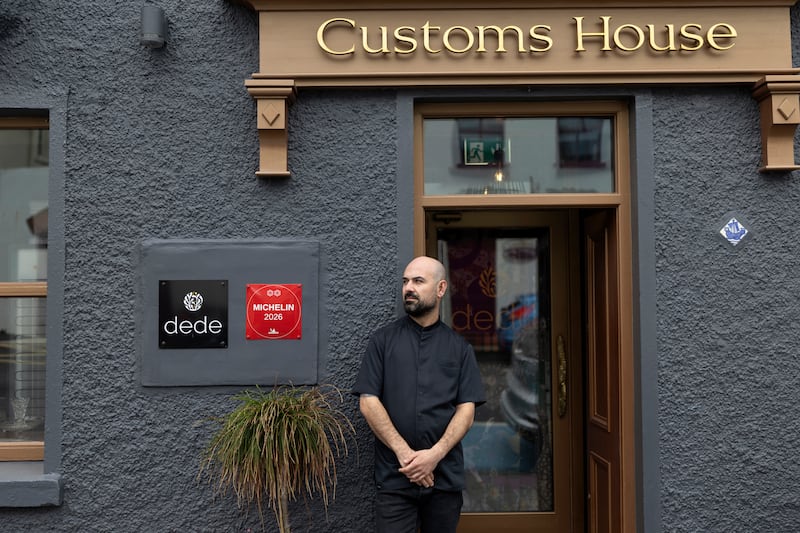
Ahmet Dede: ‘I knew I was going to get a Michelin star one day.’ Photograph: Chris Maddaloni
It ends with a four-part meze of tiny desserts. In between, there is a kebab course, kofte, bread, cod, beef, wild sorrel and various other courses, all using local ingredients.
“Our Turkish fusion cuisine is a true reflection of this region’s bounty, brought to life through a partnership with local farmers, producers and fishermen who share our commitment to sustainability, organic practices and waste reduction,” the menu reads. “Each dish is thoughtfully designed to honour the flavours and traditions of chef Ahmet Dede’s Turkish heritage.”
The menu at Baba’de around the corner – a lovely, calm space with wishbone chairs covered with thick sheepskins – is at a much more accessible price point. A lobster bisque is €10. Langoustine spring rolls are €18. Steak tartare is €16.
So what keeps the man from Ankara, population 5.6 million, in Baltimore, population 414? “I feel at peace here,” he says, gesturing to beyond the window, where boats rock in the harbour, and the smell of the ocean hits you as soon as you step outside.