
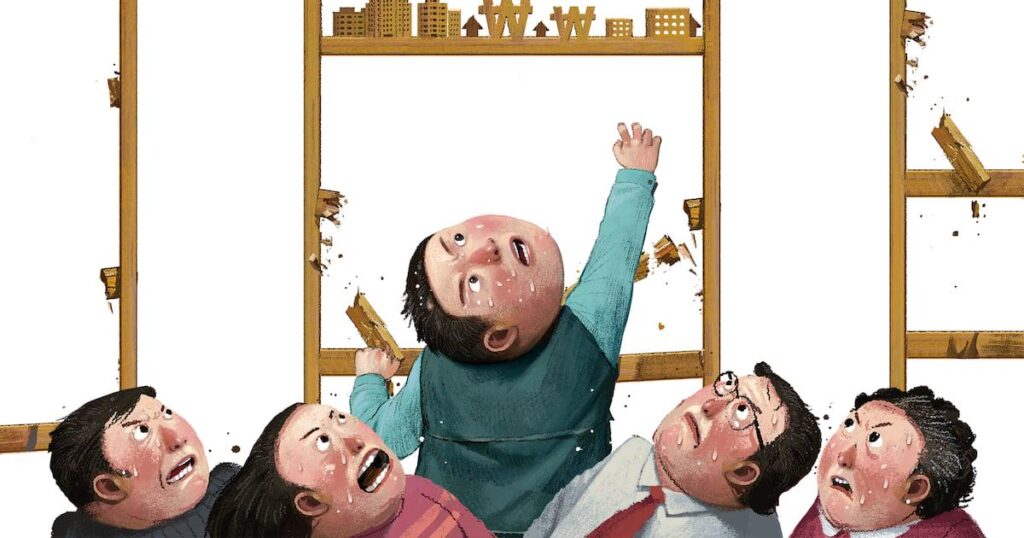

On the 22nd at 7 a.m., Park, 27 years old, was greeting office workers heading to work at a convenience store near Samsung Electronics’ Seocho headquarters in Seocho-gu, Seoul. On that day, the front page of a newspaper displayed on the store’s shelf featured an article stating that employees in Samsung Electronics’ semiconductor division would receive performance bonuses of 0.6 billion Korean won per person next year. Park, who is preparing for employment, works 10 hours a day at the convenience store and earns 1.8 million Korean won per month. Park said, “Hearing that Samsung employees I greet as customers receive 0.6 billion Korean won in performance bonuses leaves me feeling hollow and angry without realizing it.”
The ‘gap’ in Korean society, which has emerged in areas such as assets, income, education, and employment, is spreading into ‘anger.’ Seoul National University’s National Future Strategy Institute and Chosun Ilbo commissioned Hankook Research to conduct a survey targeting 3,043 men and women nationwide over four days from the 27th to the 30th of last month. The survey’s theme was ‘Inequality and Conflict in Korean Society.’ According to the results, 78% of respondents answered that they ‘feel anger toward the unfair social structure.’ Respondents cited economic disparities such as assets (85%), housing (81%), and income (78%) as the most severe areas of inequality.
Regarding the cause of economic disparities, 87% of respondents said it was ‘due to differences in inherited wealth from parents.’ Alongside asset and housing gaps represented by real estate, the recent issue of performance bonuses exceeding 100 million Korean won at Samsung Electronics and SK Hynix, driven by the semiconductor boom, is analyzed as potentially exacerbating social anger by deepening frustration over income inequality.
In this survey, the proportion of respondents who ‘feel anger toward the unfair social structure’ was highest among those in their 40s, 50s, 60s, and the middle class. This indicates that the backbone of Korean society is shaking. Kim, 45 years old, a department head at an oil refining conglomerate, said, “Even though I consider myself to work at a decent company, seeing the ‘N% performance bonus’ at semiconductor firms leaves me so frustrated and angry that I cannot focus on my work.”
Kang Won-taek, director of Seoul National University’s National Future Strategy Institute, diagnosed, “This survey shows that Koreans’ anger has already transitioned into a collective emotion transcending social classes.” Director Kang added, “Considering that anxiety still holds expectations for the system, while anger stems from the judgment that those expectations have been betrayed, the frustration and anger of ‘efforts being betrayed’ could act as a spark leading to extreme social division.”
https://www.chosun.com/english/national-en/2026/05/23/KXHJTNRP65CENF44U27G4EWYQM/
Posted by Ok-Huckleberry5836
12 Comments
Minister 김용범’s AI diviend policy might have more traction now, given the growing resentment.
>“Even though I consider myself to work at a decent company, seeing the ‘N% performance bonus’ at semiconductor firms leaves me so frustrated and angry that I cannot focus on my work.”
If someone has such issues with envy and entitlement, then they really need to seek professional help.
It’s fascinating though that people who earned their wealth through doing absolutely nothing, like the Chaebeol heirs, didn’t do that to them but people who have worked hard and are just benefiting from some crazy times for their company.
I know people who work for both SK Hynix and Samsung Electronics.
One, a close friend in her forties, joined Hynix pretty much straight from high school in Cheongju. She came from a single parent family. Worked her backside off pulling long shifts for decades, looked after her mum diligently. Lived in the same villa until marriage. The complete opposite of a life of privilege. She just got lucky.
Another is my brother-in-law, he also came from a difficult background and put himself through university and graduate school, worked hard his whole life (6 days a week, nearly every week, for the last 10 years or so).
The reality is that a lot of the people now crying about the bonuses actually look down on a lot of the people receiving them.
Especially the factory floor workers. The ones doing shift work. The ones who “only” graduated high school. The ones who didn’t study abroad. The ones who weren’t born in Seoul or maybe attended a 지방대.
Imo, a lot of the resentment stems from people’s self-inflicted entitlement issues.
One thing I learned long ago,jealousy and envy are useless feelings to pursue internally. Usually I feel happy for people who have some luck come their way. Good luck to them. I’ve been lucky and unlucky in life, that’s how it goes. Everything we have we own, through hard work and luck etc. I’m happy for anyone who works for a living and experiences good fortune. Don’t be bitter.
This is just a puff piece trying to make unions and their collective bargaining rights look bad.
The entitled people who gave these quotes are just losers who should shut the fuxk up.
Why are they angry at fellow workers? If anything get angry towards the top brass.
I hope this is the catalyst for workers in Korea to start reclaiming their power and organize.
Chaebols are dragons sitting on hoards of gold.
i’m sorry, perhaps i don’t understand the culture, but please grow up. that is a crazy level of entitlement.
here in the States, there is a growing movement to tax billionaires because there is a concentration of wealth taking place, the economy as a whole is benefiting only a certain class of people, and society at large is suffering as a result. to me, it is much less a jealously issue and more the introduction of collective welfare. key economic drivers should benefit the society that enables its success. that’s the core principle here. admittedly, it’s a bit socialist, but you get the idea.
but, this attitude to look at people you don’t even know and feel so entitled that you anger yourself in daily life because someone else has more than you do… wow. just wow.
sure, i think we have a cultural similarity here where the vast success of key economic drivers should benefit society at large in some way. samsung and sk hynix are key economic drivers of korea that drive their success because of korean society. so, there is an argument to be made that it should benefit korean society at large in some way. there are means to do that, again, albeit a bit socialist. but to carry this attitude where you anger yourself and develop resentment, ruminating over and over again because someone else has more than you do??
am i missing something? am i missing a cultural reality here that i lack respect for? can someone enlighten me?
K-MAGA hates worker solidarity. It was dismaying to see this very sub say doctors should not be allowed to strike and just take the paycuts and the 80+ hr work weeks.
Thankfully the trolls seem to be absent this time. Striking is a basic right. Period.
The Chosun Ilbo’s reports of this nature demonize a specific group by putting forward an unrepresentative figure who can say words that suit their taste. The problem is that most of these conservative media articles are pathetic articles that talk on and on by using a person who received money from the media or does not even exist.
I lived in Korea for 15 years. I worked with Samsung and pretty much all of the large companies.
I made a lot – some years 5억 (20 years ago when that was a lot of money). But I still realized that my life was not sustainable. Korea did a remarkable job building the country from nothing. But they never created a system where people could prosper on meritocracy.
Success in Korea is really about your parents. First, being in a neighborhood with good schools. If a neighborhood has good schools, housing prices are insane.
If you are able to overcome this obstacle by studying your butt of or just being naturally talented at multiple choice tests, you can get into a good university.
And you might get a good job at a big company like Samsung. And you can get a decent salary. But even with that decent salary, you can never buy an apartment in or even near Seoul – unless your parents give you the money.
So even though I was at the top – first name basis with many famous Korean CEOs, high income, on TV, etc. – I bailed. I could see that society just wasn’t going to work out. I had bought a small apartment in Seoul (Apgujeong-dong). Fine for a single guy. But if I wanted a family I needed USD3 million for livable apartment in Seoul (way more now). Or spend 1+ hours each way on a bus. Insane.
I even worked with the government. I remember asking highly educated officials about demographics (20+ years ago). No clue. Train reck coming and no one cares.
I still have a house outside of Seoul. I come every other year or so. The changes are mind boggling. In my network, most of the pediatricians have gone out of business. So many schools have closed. So many shops are closed as no one to work in them.
Korean society will all but disappear in 30 years. Who will live in Korea?
Reading stories like this makes me think “why are Koreans always so angry about political and socio-economic issues?” Do they put a lot of emotion and passion into social issues more than other Asian countries?
Think about starting a business around the areas where SK Hynix factory production workers live.