
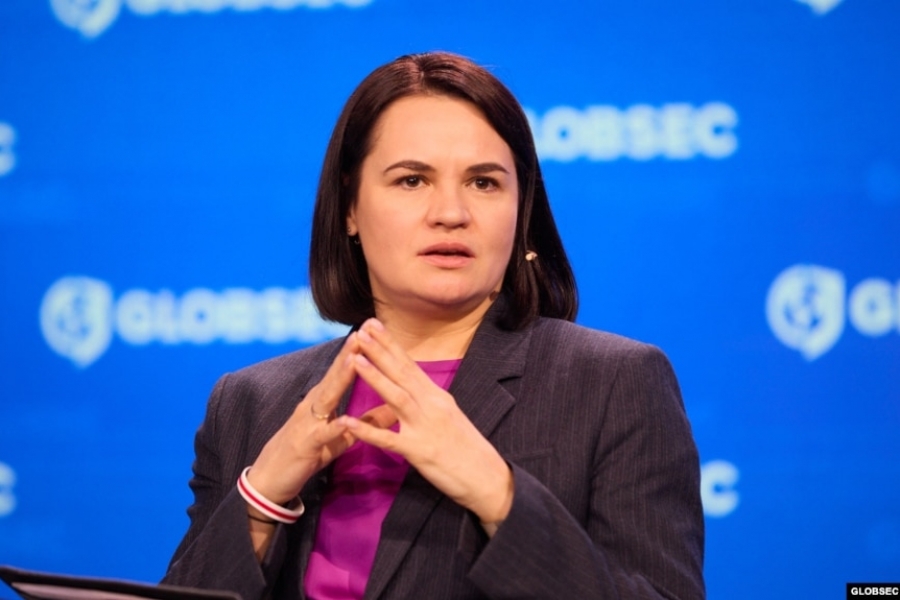
Sviatlana Tsikhanouskaya, in an interview with Radio Free Europe/Radio Liberty,
commented
on an informal letter sent by the US State Department to the authorities of Lithuania, Poland, and Ukraine. The conversation took place during the international security conference GLOBSEC in Prague.
Павялічыць
Photo: GLOBSEC
— We must understand that this letter is not an instruction for policy management. It can be a proposal. But, of course, our American partners understand well that each country makes its own decision on how to communicate or not communicate with Lukashenka, because many interests are affected here. This is first and foremost security.
Of course, our position is that now is in no way the time to ease sanctions against Lukashenka’s regime, neither in Ukraine, nor in Lithuania, nor in Poland. Because if repression continues in Belarus, if people are still being imprisoned, then there can be no talk of any systemic changes that we are striving for.
A safe and free Belarus is also in the interests of our neighbors. They are not naive and they also understand that as long as Lukashenka is there, balloons fly over Lithuania, Belarus demonstrates “Areshnik” and nuclear weapons, and conducts exercises. Lifting sanctions here is not the right approach.
— However, the USA has already lifted sanctions specifically from Belaruskali. And when President Trump’s representative John Kohle comes to Belarus and talks with Lukashenka, he speaks about the possibility of lifting sanctions in exchange for the release of political prisoners. Does this mean you more strongly support the European Union’s approach that the regime should not be talked to and sanctions should be maintained?
— We are very grateful for the efforts of the US to free people, because people are dying in prisons, people are in a very difficult state. I am confident that the United States of America has enough power to free all people.
This includes President Trump’s personal power and the tools he uses.
— But what if this requires lifting transit sanctions from Lithuania, Ukraine, and Poland as well?
— The humanitarian track of freeing people is an American track. We must understand that a country can offer certain steps to other countries but should not exert pressure. And this is also the US position. We have discussed this many times with America, with John Kohle, with [US Deputy Assistant Secretary of State] Chris Smith. And therefore, the formula we developed should apply: American sanctions for the release of people, and European sanctions for the liberation of the country.
Now there is an even greater escalation by the regime — it’s impossible even to consider such a possibility of lifting sanctions. Our European partners understand this well. We, of course, will raise this issue during meetings in Ukraine, but I am confident that there will be no appetite for lifting sanctions there, because new ones were just recently introduced. And Ukraine, more than anyone, understands that only systematic pressure on the Belarusian regime, on Russia, can stop them in their aggressive actions.
Therefore, each country chooses its own path. I am grateful to Europe for its principled stance, for its systematic approach, and for its good understanding of the situation around Belarus.
The United States asked Lithuania, Poland, and Ukraine to lift sanctions on Belarusian potash to allow the transit of this product through their territory. This is evidenced by an informal appeal from the US State Department to the three capitals, which Radio Free Europe/Radio Liberty reviewed.
The one-page document originating from the US State Department states:
«Now that the United States has lifted American sanctions from Belaruskali, American companies are interested in purchasing and transporting Belarusian potash. This will require transit through EU countries bordering Belarus, or through Ukraine, to avoid transportation through Russia».
The appeal also notes that «the United States is interested in exploring potential routes for the transit of Belarusian potash to alleviate global shortages through Poland, Lithuania, or Ukraine and looks forward to future discussions on this topic with you».
The Ministry of Foreign Affairs of Ukraine confirmed to Radio Free Europe/Radio Liberty that it had received this letter. The Ministries of Foreign Affairs of Poland and Lithuania have not yet responded to inquiries.