
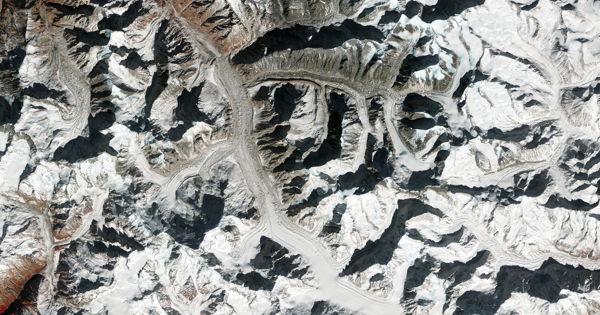
Record-breaking ice loss in Central Asia in 2025. The event is part of a broader global pattern of recent record-breaking glacier melt years, following extreme losses previously observed in, among others, the European Alps and the Pyrenees (2022), western North America (2023), and Svalbard (2024)
https://press.vub.ac.be/record-breaking-ice-loss-in-central-asia-in-2025
3 Comments
A new international study led by Lander Van Tricht (Vrije Universiteit Brussel, ETH Zürich), shows that glaciers in Central Asia experienced their most extreme mass-loss year on record in 2025, designated as the ‘International Year of Glaciers’ Preservation by the United Nations, following an initiative from Tajikistan.
Central Asian glaciers are a critical water source for millions of people living downstream in arid regions. During the dry summer months, glacier meltwater sustains rivers that support agriculture, hydropower production, ecosystems and drinking water supplies across countries such as Kyrgyzstan, Tajikistan, Uzbekistan and Kazakhstan. “Glaciers in Central Asia act as natural water towers,” Van Tricht explains. “As glaciers shrink, meltwater can temporarily increase, but eventually runoff declines as less ice remains. This raises major concerns for long-term water security in the region.” The strong dependence on these shared water resources, combined with their unequal distribution between countries, already contributes to recurring tensions and so-called water conflicts in Central Asia.
Using field observations from 16 glaciers across the Tien Shan and Pamir mountains, combined with regional glacier modelling, the researchers estimate that glaciers in Central Asia lost around 30 km³ of ice in a single year, equivalent to nearly 2% of the region’s remaining glacier volume. For comparison, this corresponds to roughly 30% of all glacier ice that still remains today in the European Alps. The study shows that the extreme losses were caused by exceptionally warm spring and summer temperatures, combined with a strong reduction in snowfall frequency during the melt season. These conditions triggered an unusually early disappearance of seasonal snow cover, exposing darker glacier ice earlier in the year and strongly amplifying melt through the snow-ice albedo feedback.
“2025 stands out as an exceptional year because the extreme losses occurred almost everywhere across Central Asia simultaneously,” said Dr Lander Van Tricht, lead author of the study. “Nine of the 16 monitored glaciers experienced their most negative mass balance ever observed, while many others ranked among their worst years on record.” The strongest losses occurred in the western Pamir and western Tien Shan, where some glaciers lost between 2 and 4% of their total ice volume in a single year. Regional modelling further indicates that 64% of all experienced their most negative year since at least 1991.
https://iopscience.iop.org/article/10.1088/1748-9326/ae6712
This is nature’s loot box. We are going to melt the wrong glacier and set free something primordial and scary at this rate.
Asia will struggle sooo much with water availability for their population in the next years already