
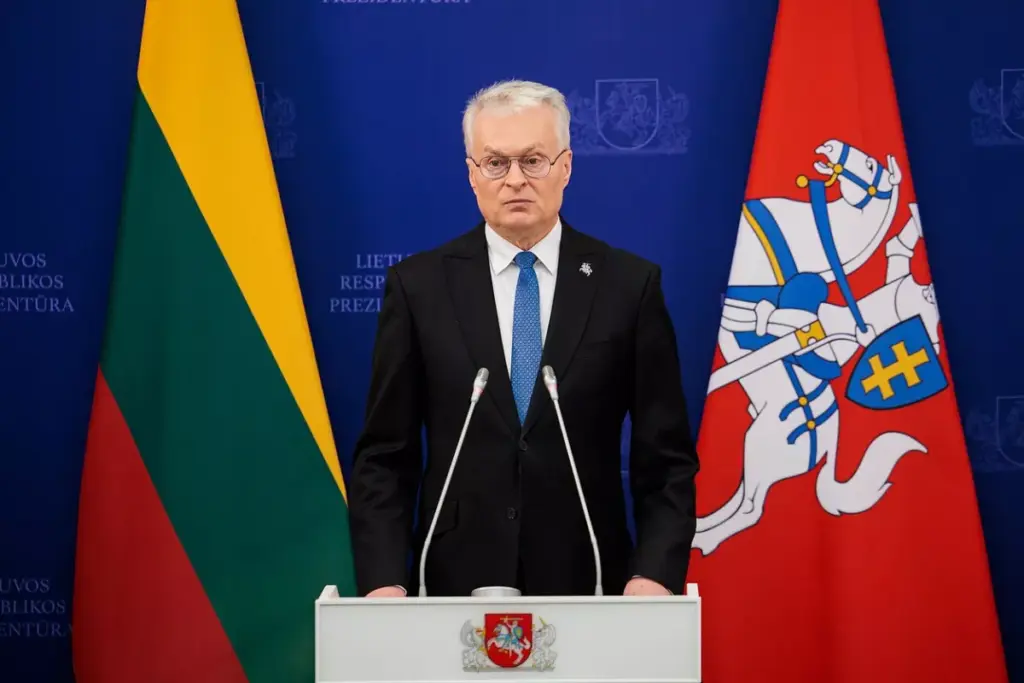
Lithuanian President Gitanas Nausėda said that responsibility for informing the public about drone-related airspace violations should lie with the military rather than the head of state, amid growing concerns over such incidents.
Speaking to LRT, Nausėda questioned expectations that national leaders should comment on each reported drone, stressing that the armed forces are better positioned to provide timely and accurate information.
“I do not understand why heads of state should report on every drone, because the army, which has information here and now, firsthand, can do this best. And, in fact, they are the ones who should do it,” he said.
He illustrated his point with a hypothetical scenario: “If we imagine a hypothetical situation where 15 drones enter the country in a day, and the head of state goes on air 15 times, describing each of them in detail, it seems to me that he would quickly become very annoying to everyone, and, frankly, this is not how it should be done.”
Nausėda’s remarks followed an incident in the Utena district, where a possible drone-related airspace violation had been reported. He noted that he had mentioned two drones on social media, while official alerts were issued through emergency services.
The president also criticised how some schools responded during an air alert, describing certain actions as “wrong” and potentially dangerous. He emphasised the need for clear, standardised procedures in such situations, rather than ad hoc decision-making at the local level.
Addressing broader security concerns, Nausėda expressed confidence in NATO’s air policing mission, stating that its actions are grounded in professional threat assessments.
At the same time, he warned that the regional environment remains tense and requires vigilance, cautioning against treating the situation as “ordinary peaceful life.”
By Tamilla Hasanova