Perhaps of interest, a lot of linguists think that this way of talking about emotions or feelings as entirely separate in some languages is related to the origin of how we think, and that we had a “bicameral mind” that was genuinely in two parts up until around 2000 years ago.
An_Bo_Mhara on
I’m Irish and everyone knows we don’t actually have feelings.
We are always “grand”
afuckingpolarbear on
This also means sorry in irish
InformalInsurance455 on
Grant Morrison said this first and better in The Invisibles fwiw
Our ‘feeling’ come out after too much drink, a punch-up, then tears and reconciliation with the recipient of said punches.
amakalamm on
So you are saying there was a sadness on me when I was being brutalized by all those sadistic Irish teachers when I was at school?
sits79 on
Thank you for spelling _recognise_ correctly.
Responsible-Study111 on
I like that
MollyPW on
Feelings are on us, we have languages and age, we get death.
Immediate_Play4539 on
The animation style of this photo reminds me of The Simpsons.
broken_neck_broken on
Tá do mháthair orm. 😏
metalslime_tsarina on
I really don’t like this airy fairy breakdown that gets shared so often
wh0else on
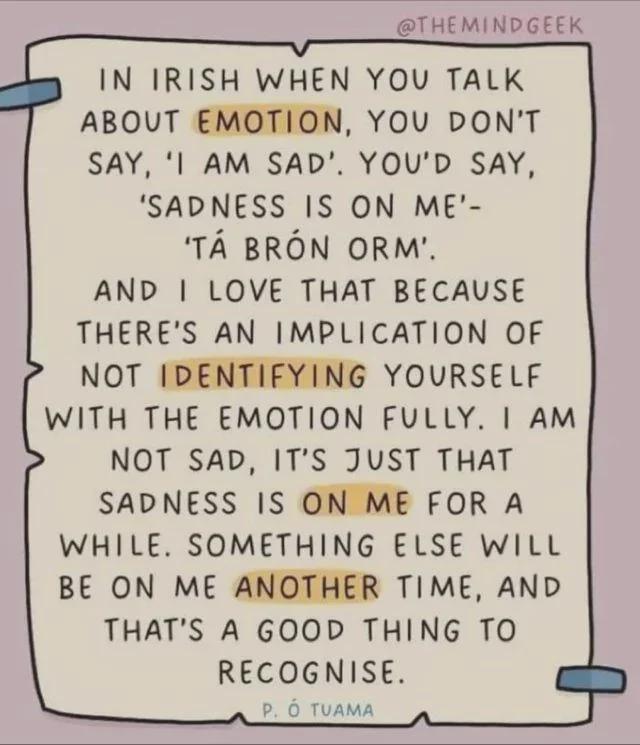
This is a quote from Pádraig Ó Tuama’s lovely podcast, _Poetry Unbound_ which is excellent. He introduces and reads a modern poem by permission of the author, then discusses context and layers of meaning, then reads it again so you can listen with that new context. It’s very well done.
cookiemunster27 on
I was taught to say this when I’m sorry?
GroltonIsTheDog on
This kind of linguistic semantics breakdown is always absolute toss.
Fluffy_Anything_3559 on
Or maybe the grammar of Celtic languages just evolved differently from that of Germanic languages. Irish is a modern language spoken by normal people, not a secret mystical fairytale tongue.
twentythreeskidoo on
Ta ocras orm is my favourite
GtotheBizzle on
Another one I like is “I’m very tired” is translated to “tá tuirseach an domhain orm” which, if translated literally, means “the tiredness of the world is upon me”.
Also, a ladybird in Irish is “bóín dé” which, literally, means “gods little cow”. Apparently that last translation is the same in Russian.
Rich_Ad8038 on
Arguably, this could also mean that emotions are passively happening to a person, and you don’t have any agency or need to engage with them. Also, in colloquial English in some parts of the country, people use ‘you’ instead of ‘I’, distancing themselves from the feeling itself, for example ‘you’d be sad to see it’ rather than ‘I am sad to see it’. It’s just a thought given Irish people’s tendency to be quite emotionally restrained.
voidcharmed on
Tá is grand orm
Gorazde on
It’s a pretty meaningless distinction, to be honest. Emotions are ephemeral by definition. If I say I’m sad, no one assumes that’s a permanent condition.
Craicriture on
A few languages use structures similarly. Spanish for example would say Estoy triste, not soy triste which would mean I’m a sad person rather than just sad emotionally at the moment. It distinguishes permanent characteristics vs temporary states. English isn’t that subtle.

23 Comments
I’m 12 and this is deep
Thanks for sharing. It’s such a lovely phrase.
Perhaps of interest, a lot of linguists think that this way of talking about emotions or feelings as entirely separate in some languages is related to the origin of how we think, and that we had a “bicameral mind” that was genuinely in two parts up until around 2000 years ago.
I’m Irish and everyone knows we don’t actually have feelings.
We are always “grand”
This also means sorry in irish
Grant Morrison said this first and better in The Invisibles fwiw
https://preview.redd.it/wvge8bx03w2h1.jpeg?width=1098&format=pjpg&auto=webp&s=f6c452af6f160538e13f4b1452aa9d6f4f793bfe
Our ‘feeling’ come out after too much drink, a punch-up, then tears and reconciliation with the recipient of said punches.
So you are saying there was a sadness on me when I was being brutalized by all those sadistic Irish teachers when I was at school?
Thank you for spelling _recognise_ correctly.
I like that
Feelings are on us, we have languages and age, we get death.
The animation style of this photo reminds me of The Simpsons.
Tá do mháthair orm. 😏
I really don’t like this airy fairy breakdown that gets shared so often
This is a quote from Pádraig Ó Tuama’s lovely podcast, _Poetry Unbound_ which is excellent. He introduces and reads a modern poem by permission of the author, then discusses context and layers of meaning, then reads it again so you can listen with that new context. It’s very well done.
I was taught to say this when I’m sorry?
This kind of linguistic semantics breakdown is always absolute toss.
Or maybe the grammar of Celtic languages just evolved differently from that of Germanic languages. Irish is a modern language spoken by normal people, not a secret mystical fairytale tongue.
Ta ocras orm is my favourite
Another one I like is “I’m very tired” is translated to “tá tuirseach an domhain orm” which, if translated literally, means “the tiredness of the world is upon me”.
Also, a ladybird in Irish is “bóín dé” which, literally, means “gods little cow”. Apparently that last translation is the same in Russian.
Arguably, this could also mean that emotions are passively happening to a person, and you don’t have any agency or need to engage with them. Also, in colloquial English in some parts of the country, people use ‘you’ instead of ‘I’, distancing themselves from the feeling itself, for example ‘you’d be sad to see it’ rather than ‘I am sad to see it’. It’s just a thought given Irish people’s tendency to be quite emotionally restrained.
Tá is grand orm
It’s a pretty meaningless distinction, to be honest. Emotions are ephemeral by definition. If I say I’m sad, no one assumes that’s a permanent condition.
A few languages use structures similarly. Spanish for example would say Estoy triste, not soy triste which would mean I’m a sad person rather than just sad emotionally at the moment. It distinguishes permanent characteristics vs temporary states. English isn’t that subtle.