
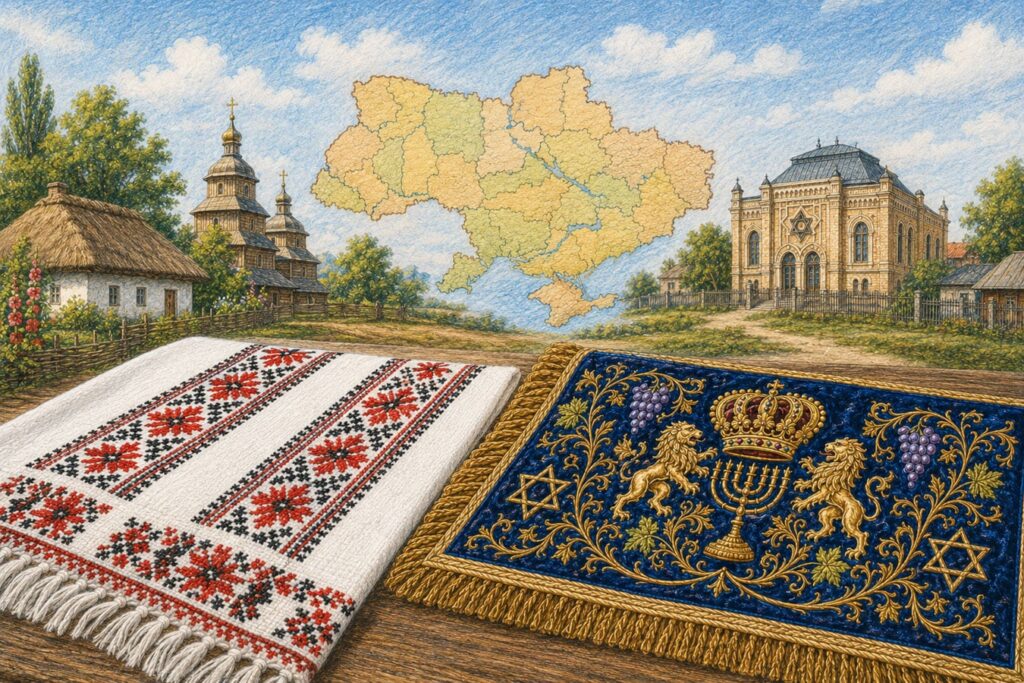
Every year, on the third Thursday of May, Ukraine and Ukrainian communities around the world mark World Vyshyvanka Day. In 2026, the date carried additional symbolism: the holiday turned twenty. It began in 2006 at Chernivtsi National University and has since grown far beyond Ukraine itself.
Today, embroidered Ukrainian shirts are worn by students, diplomats, volunteers, cultural activists, families, and diaspora communities across Europe, North America, Australia, Israel and many other places. Since 2014 — and especially after Russia’s full-scale invasion of Ukraine in 2022 — the vyshyvanka has become more than festive clothing. It has become a visible language of dignity, memory, identity and resistance.
But there is another question that is asked much less often.
If embroidery was such an important cultural language on the lands of today’s Ukraine, did it also exist in Jewish traditional art there?
The answer is yes. But precision matters.
Jewish embroidery on the territory of modern Ukraine was not an attempt to “invent a Jewish vyshyvanka.” Nor was it a myth. It was a real, complex layer of culture, expressed through synagogue textiles, ritual objects, women’s head coverings, kippot, breastpieces, belts, tallit ornaments, festive garments and domestic ceremonial items.
This is not a claim that Jews had a direct equivalent of the Ukrainian embroidered shirt. That would be too simple, and probably misleading.
The more accurate picture is different: alongside the Ukrainian embroidered shirt there existed a Jewish world of fabric, ornament, ritual, memory and community.
This topic matters deeply for Israel. So many Israeli families have roots in places that are now part of Ukraine: Lviv, Kyiv, Odesa, Chernivtsi, Berdychiv, Medzhybizh, Brody, Podolia, Volhynia, Galicia, Bukovina and dozens of smaller towns and shtetls. When we speak about Jewish embroidery in Ukraine, we are not speaking about museum exoticism. We are speaking about objects that may once have belonged to synagogues, homes, weddings, holidays and family memory.
At NAnews – Nikk.Agency Israel News, we approached this subject in a popular historical format, not as an academic monograph or a museum inventory. That distinction is important. The goal is not to create a romantic legend. The goal is to recover a cultural field that was real, visible and often overlooked.
Jewish ritual textile on Ukrainian lands could be remarkably rich. Velvet, silk, brocade, gold and silver thread, metallic embroidery, appliqué, braid, beads, pearls, sequins, fringe and decorative patches were all part of this visual world. In Kyiv and Galician collections, researchers describe brocade, velvet, gold and silver metal threads, sequins, backing materials and complex metal-thread work.
The motifs were not accidental. Jewish embroidered textiles often carried the Torah crown, the Tablets of the Covenant, the lions of Judah, deer, birds, the menorah, the Star of David, priestly hands, floral garlands, vases, pomegranates, rosettes, palm leaves, wreaths and Passover imagery. Inscriptions were no less important: Hebrew letters, donor names, dates according to the Jewish calendar, biblical phrases, liturgical formulas and dedications.
In Ukrainian embroidery, meaning was often carried by the shirt: the sleeves, the collar, the chest, the hem, the regional pattern. In Jewish tradition, meaning often moved through another space: the synagogue, the ark curtain, the Torah mantle, the tallit ornament, the kippah, the woman’s breastpiece, the festive head covering, the belt, the ritual bag.
That does not make it less “embroidery.” It makes it a different cultural system.
The strongest documented body of this material is connected with Galicia. Lviv, Sasiv/Sasov, Zolochiv and other towns are associated with parochets, Torah mantles, atarot, tefillin cases, kippot, women’s breastpieces known as brusttukh or brustikhl, Yom Kippur belts and other objects.
Sasiv, in the Lviv region, deserves special attention. It was linked to the technique known as shpanyer arbet or spanier arbeit — a type of metal-thread work using gold and silver threads, lace-like strips, decorative modules, floral and geometric motifs. This technique is important because it connects synagogue textile and clothing. It appeared on atarot, kippot, women’s breastpieces, festive caps, collars, cuffs, belts, waistcoats and the decoration of dresses and skirts.
In other words, Jewish embroidery was not locked inside the synagogue. It also entered visible festive culture — the kind of object a person could wear, preserve, inherit or remember.
Kyiv forms another important layer. Jewish textiles preserved in Kyiv museum collections include objects that entered museums in the 1920s and 1930s, when religious items were removed from synagogues and transformed into museum holdings. That history is painful, but it also explains why some objects survived at all. The Kyiv corpus includes references to parochets, Torah mantles, a chuppah, tallit, tefillin and kippot, as well as textiles made with brocade, velvet, gold and silver thread, sequins and complex embroidery structures.
Bukovina, Chernivtsi, Sadagora and southern Ukraine should not be excluded either. Their digital visibility is weaker than that of Lviv and Kyiv, but this does not mean the tradition was absent. It often means that materials were lost, poorly catalogued, not digitized or scattered across regional museums and archives. Odesa and the southern ports developed in another urban, commercial and Jewish cultural environment, and they deserve separate work.
The relationship between Ukrainian and Jewish embroidery should also be described carefully. These were not isolated worlds. Jewish communities lived alongside Ukrainians, Poles, Romanians, Armenians and others. People bought fabrics in the same markets, saw neighboring costumes, ordered work from local artisans and traded in materials. Influence was almost inevitable.
But influence is not the same as copying.
It would be crude to say that Jews simply “borrowed the vyshyvanka.” It is more accurate to say that Jewish communities lived inside a shared decorative and craft environment. They could absorb local techniques, visual rhythms, geometric patterns, color choices and textile practices. Yet the result remained Jewish in function and meaning: synagogue curtains, Judaica, atarot, kippot, breastpieces, belts, festive caps and ritual textiles.
The Ukrainian vyshyvanka became a symbol of regional and national identity. Jewish embroidery on Ukrainian lands spoke through Torah, prayer, family memory, communal donation, ritual beauty and the sanctification of objects.
The two traditions were not the same. But they existed on the same land.
There is also a modern reverse movement. In today’s Ukraine, designers and artists sometimes combine the silhouette of the Ukrainian vyshyvanka with Jewish symbols: the Star of David, the menorah, lions, grapevines, Hebrew letters, or motifs of Jerusalem. This can be powerful, especially after 2022, when Ukrainian and Jewish memory again intersected through war, destruction, resistance, exile and return.
But the past and the present must be separated.
A modern Jewish-Ukrainian vyshyvanka is not necessarily a reconstruction of an old Jewish costume. It is often a new cultural gesture — a way of saying that Jewish history was not external to Ukraine. It was part of Ukraine.
That distinction matters. Historical Jewish embroidery in Ukraine was primarily Judaica, ritual textile and specific elements of clothing. Modern hybrid embroidery is a new language of memory.
So what can we say with confidence?
Jewish embroidery existed on the territory of modern Ukraine. Its strongest evidence is found in synagogue and ritual textile: parochets, Torah mantles, atarot, matzah bags, tefillin cases, chuppot and festive fabrics. Its clothing line also existed: kippot, women’s caps, breastpieces, belts, collars, waistcoats and the decoration of dresses and skirts.
What we should not say too easily is that there was a fully established “Jewish vyshyvanka” equivalent to the Ukrainian national embroidered shirt.
The better formula is this: on Ukrainian lands there existed a developed Jewish culture of embroidered ritual textile and embroidered elements of clothing, connected with Judaica, domestic life, festive costume, craft, regional exchange and the multiethnic history of Ukraine.
This does not compete with the Ukrainian vyshyvanka.
It deepens the map of memory.
For Israelis with roots in Ukraine, it may also open a quieter question: what objects disappeared from our family stories? What fabrics were once in the synagogues of our ancestors? What did our grandmothers see, sew, preserve or lose? What did our communities once give to the ark, the Torah, the wedding canopy, the holiday table, the child, the bride, the mourner, the congregation?
Jewish embroidery in Ukraine is not a myth.
It is not an invented costume.
It is a thread that still connects the synagogue, the home, the body, the archive, the museum, the region, and the memory of a Jewish life that once formed an inseparable part of Ukraine.