
Palemonas military mobility terminal construction has begun in Lithuania. The site is designed to serve both civilian logistics and military mobility. LTG Infra, Lithuania’s railway infrastructure manager, is implementing the project. This is reported by the railway transport news portal Railway Supply.
 Palemonas Military Mobility Terminal Supports NATO Rail Moves
According to LTG Group, the terminal is intended to help Lithuania meet military mobility standards. Projects of this kind strengthen the country’s ability to receive and handle NATO military transports. Also, they reinforce Lithuania’s role in the Alliance’s logistics chain.
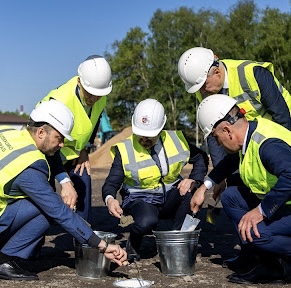
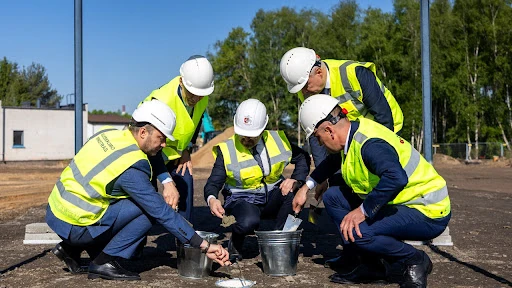
The start of construction was marked by a symbolic time capsule burial ceremony. Ministers of transport and national defense attended the event. Representatives of the LTG group and the contractors also took part. The ceremony marked the formal project launch. It also emphasized the project’s relevance for national security and NATO logistics.
Minister of Transport Juras Taminskas said:
“Railways are particularly important for both civilian evacuation and the rapid movement of military forces in Europe. By investing in the development of military mobility infrastructure in Palemonas, we are strengthening the security of Lithuania and the entire Baltic region,”
The works are being carried out by Gevalda, Kauno keliai, and Statybų techninė priežiūra. These companies won the relevant public tenders. The total project value is 37.4 EUR million. This includes design, expertise, construction, and technical supervision.
Palemonas military mobility terminal works and scope
The project consists of two main parts. They cover the loading area and rail infrastructure linked to the terminal’s dual civilian and military use. One part covers construction and modernization of a reinforced loading platform in Palemonas. Its area is about 36,000 m². The platform will support cargo weighing up to 100 tons. It will also support vehicles weighing up to 120 tons.
Overall, around 46,000 m² of hard surfaces will be built or modernized. The Palemonas intermodal terminal works will include two 1,435 mm gauge tracks. They will also include one 1,520 mm gauge track with terminal ramps. In addition, utility networks, security systems, and noise and vibration reduction measures will be installed.
The second part covers the expansion of 1,435 mm European gauge railway infrastructure. Three new tracks will be built with a minimum usable length of 750 m. Three existing tracks will be extended to the same length.
In total, about 5.5 km of track will be reconstructed. Also, 12 switches will be installed. The project includes the modernization and installation of utility networks. BIM methodology is being used to manage the design and construction processes more efficiently.
Arūnas Rumskas, acting CEO of the LTG Group, said:
“The expansion of the military mobility infrastructure in Palemonas is a strategic step that strengthens Lithuania’s readiness to receive large volumes of military transport and ensures that our railway network operates as reliably as the logistics hubs of the most advanced NATO countries. It is an investment that is equally important for both defense and civilian logistics,”
NATO military transports and gauge transfer
After completion, Palemonas is expected to become one of Lithuania’s most important military mobility hubs. The terminal will increase readiness in Lithuania and the wider region. It will support the receipt and management of NATO military transports.
The project will also expand loading and storage capacity at the intermodal terminal. This is needed to receive and transship NATO military transports. They arrive on the standard 1,435 mm gauge, in accordance with European standards. They will then be transferred to the 1,520 mm broad gauge. From there, onward movement can continue to Latvia, Estonia, or the port of Klaipėda. The upgraded terminal will also enable more efficient deployment and support for the German brigade in Lithuania.
Minister of National Defense Robertas Kaunas said:
“By investing in military mobility today, we are investing in Lithuania’s security, readiness, and closer cooperation with our allies. Modern infrastructure—roads, railways, and logistics hubs—is an essential part of a strong state. The loading area at the Palemonas terminal will ensure that Lithuania is prepared to rapidly receive allied forces, efficiently coordinate logistics, and strengthen the resilience of NATO’s eastern flank,”
News on railway transport, industry, and railway technologies from Railway Supply that you might have missed:
Find the latest news of the railway industry in Eastern Europe, the former Soviet Union and the rest of the world on our page on Facebook, Twitter, LinkedIn, read Railway Supply magazine online.
Place your ads on webportal and in Railway Supply magazine. Detailed information is in Railway Supply media kit