
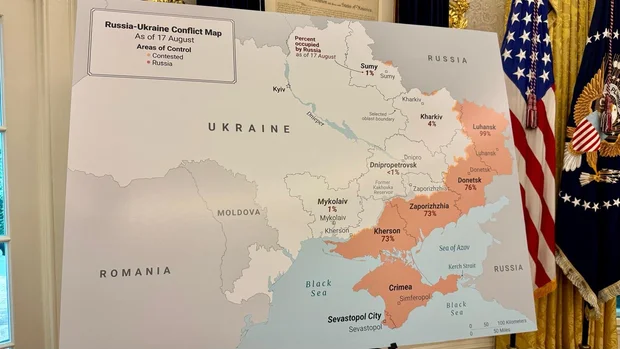
Source: BBC News; used by CBS News in “Maps Show Ukrainian Territories Claimed by Russia Amid Talks on Possible End to War,” Aug. 19, 2025.
Russia retains occupied territory for a century, then returns it to Ukraine
I once met Chris Patten, the last British governor of Hong Kong, at my workplace in London’s Covent Garden. After a brief and warm exchange, I asked if I might see him again. Patten smiled, wrote his home phone number on a scrap of paper, and handed it to me. I never followed up, and I have regretted it.
Patten presided over one of the strangest but most stabilizing geopolitical transitions of the modern era: the return of Hong Kong to China after a 99-year arrangement signed in 1898. That unusual precedent has resurfaced in my mind as Europe faces its most dangerous conflict since WWII.
In the wake of President Trump’s recent high-stakes meetings with Xi Jinping in Beijing to navigate global stability, Russia’s full-scale invasion of Ukraine has become catastrophic for both sides. Ukraine continues to suffer immense human loss and devastation, while Russia itself is absorbing staggering casualties that some estimates place near a million killed and wounded. The war exposes a darker truth: Europe, a continent that gave Aristotle, Leonardo, Kant, Taras Shevchenko and Dostoevsky, is again trapped in the habits of violence it once promised to transcend.
This crisis is compounded by Europe’s uneven record on the security guarantees it has made. The 1994 Budapest Memorandum, which persuaded Ukraine to surrender the nuclear arsenal it inherited from the Soviet Union, pledged that its territorial integrity would be respected. Today, one of the guarantors is the aggressor. After 1945, Europe embraced the rhetoric of human rights and international law, but the durability of its peace depended overwhelmingly on American power, at times contradictory, imperfect and costly, yet indispensable.
Russia’s invasion is not simply a strategic gamble; it resurrects older imperial instincts. Symbolism makes this clear. When Russia’s foreign minister wore a sweater marked “CCCP, (USSR)” he signaled a longing for Soviet stature, which itself was an extension of the czarist empire. It is difficult to imagine the Founding Fathers –wise architects of a republic– endorsing a war to redraw borders by force. And if ‘historical claims’ justify invading Ukraine, then why would any future claim not extend to demands such as the return of Alaska? The logic collapses.
Vladimir Putin’s historical legacy is already marred by repression, political killings and a tightening authoritarianism. But the urgent danger is strategic, if he senses that Russia is losing a war he initiated, the possibility of escalation –including nuclear weapons– cannot be dismissed. Meanwhile, Ukraine under Volodymyr Zelensky has fought with extraordinary courage, but nearly 20% of its territory remains under Russian control, and corruption scandals in Kyiv have complicated the political landscape.
This is why an unconventional idea deserves serious consideration, a 100-year territorial settlement modeled loosely on the 1898 Hong Kong arrangement. Under this framework, Russia would retain de facto control of Crimea and the territories seized after 2022 for a century, while Ukraine would retain full de jure sovereignty throughout. To stabilize the region, Ukraine would join the EU for economic rebuilding but forgo NATO membership, sanctions on Moscow would be lifted, and the international community, via the UN, would legally monitor the deal. After 100 years, these regions, including Crimea, would automatically and legally return to Ukraine.
Such an arrangement does not excuse aggression. Instead, it freezes the conflict before it expands into something unmanageable, preserves Ukraine’s long-term sovereignty, and prevents Russia from facing the humiliation that could trigger reckless behavior from a wounded nuclear power. It offers a political exit that stabilizes rather than sanctifies conquest. Would Putin accept such terms? Perhaps, if China applied real pressure and if the United States abandoned its recurrent tendency to handle Moscow with velvet gloves.
No analogy is perfect. This idea is morally and politically sensitive, because some may view it as “normalizing occupation” over an extended period. Ukraine today is not Hong Kong in 1898. Yet history shows that unconventional frameworks, however imperfect, can defuse conflicts otherwise locked in stalemate. In a war with no clear endpoint and dangerous prospects for escalation, a century-long settlement may represent one of the few pathways capable of bridging the gulf between the parties.
Europe has stood at the cliff’s edge before. It should not approach it again.
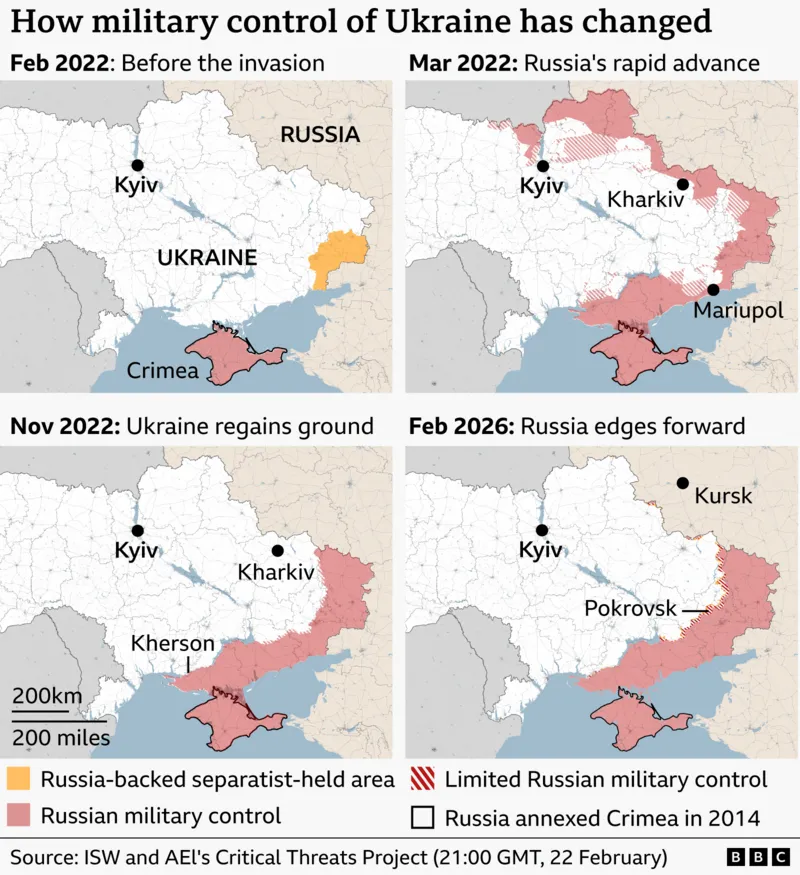
Source: BBC News Visual Journalism Team, “Ukraine in Maps: Tracking the War with Russia,” Feb. 24, 2026.
Dimitris Eleas is a New York City–based writer and independent researcher. His work explores philosophy, global politics, antisemitism, and modern history, with a particular focus on the Holocaust. He is currently developing his long-term project, the novel-‘essay’ The Black Birds of Warsaw.