
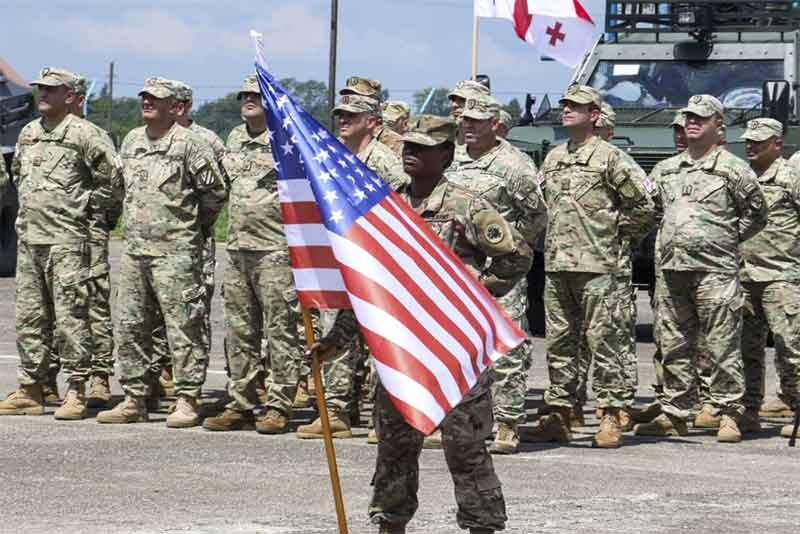
Are the moves or announcements regarding reduction and, later, re-deployment of U.S troops in Poland reflect an indecision of the Empire? Does it echo an indecisive state of a part of geopolitics of the Empire? Or, is it a part of geotactics, and a part of dealings with a number of allies in Europe? Is this a slow-moving image of withdrawal from a certain area by the Empire?
There may be a lack of coordination in planning, may be an absence of a long-term approach to a certain area of a theater of competition. Or the announcement – first, a reduction, then, a redeployment – may be part of a move to confuse enemy: Keep the enemy in an undecided state and with a semi-finalized plan.
These questions or issues are related to the Empire’s decisions related to U.S. troops in Poland.
An ABC News, one of the leading U.S. media outlets, report [In apparent reversal, Trump says he’s sending 5,000 troops to Poland, May 22, 2026] said:
U.S. President Donald Trump announced Thursday [May 21, 2026]: He is sending 5,000 U.S. troops to Poland – “appearing to reverse a move announced last week to halt a U.S. Army brigade headed to the U.S. ally in Europe.
“In a post on his social media platform on Thursday evening, Trump said the decision to send troops was, in part, because of the 2025 election of Poland’s President Karol Nawrocki.
“‘Based on the successful Election of the now President of Poland, Karol Nawrocki, who I was proud to Endorse, and our relationship with him, I am pleased to announce that the United States will be sending an additional 5,000 Troops to Poland,’ Trump said in the post.”
The report said:
“It is not entirely clear which troops the president is referring to, and it appears to be an about-face from a move announced last week.
“Last week, the Pentagon announced that a 4,200-man Army brigade headed to Poland would not be deploying after all, even though the unit’s equipment had already arrived and the unit underwent months of training for such a mission.
“The move would effectively cut American combat power in Poland by nearly half.
“During a press briefing on Tuesday, Vice President JD Vance defended the Pentagon’s plans to halt the brigade, saying it was a ‘standard delay’ rather than a ‘reduction.’
The ABC News report added:
“Later Tuesday, the Pentagon released a statement saying Defense Secretary Pete Hegseth had spoken with the Prime Minister of Poland and assured him that the U.S. ‘retains a strong military presence in Poland.’
“‘Poland has shown both the ability and resolve to defend itself. Other NATO allies should follow suit,’ the statement added.”
Citing a Polish official, ABC News said:
“The Polish government credits a ‘diplomatic offensive’ in Washington with helping to counter the planned troop cut.
“But it is not clear from the Trump’s announcement which troops will be deployed to Poland and when they will be deployed, the [Polish] official added.
“It is also not clear whether the delayed brigade will deploy from Ft. Hood, Texas, as originally planned, the Polish official said, or whether the 5,000 troops Trump announced will come from Germany or elsewhere.
“Alternatively, an American unit in Poland that is scheduled to rotate out of the country could simply be extended to keep U.S. troop levels at net-zero, the Polish official said.
“The Polish official said Polish officials applied pressure to their American counterparts and it worked. Broader shifts in U.S. force posture in Europe are likely to be understood better when NATO hold its annual summit in Ankara, Turkey, in July, the official said.”
It should be mentioned that in recent months, the U.S. President has repeatedly talked about his consideration regarding reduction of U.S. troops in NATO countries, specifically over those countries’ role, or no-role, on the Empire’s Iran war. To the U.S. President, the Empire’s European allies’ role on the question of the Iran War was not favorable to the Empire.
The U.S. Department of Defense last month said: The U.S. would pull 5,000 troops out of Germany over the next six to 12 months.
The U.S. DoD announcement followed German Chancellor Friedrich Merz’s remarks about the U.S. war with Iran.
The ABC News report said:
Earlier this week, Gen. Alexus Grynkewich, the top U.S. military commander in Europe and NATO commander, told reporters: The 5,000 troops reduction would be ‘coming out of Europe,’ but did not specify Germany.
Only days ago, citing five U.S. officials, ABC News said in a report [Pentagon abruptly cuts US combat forces in Poland, officials say, May 15, 2026]: The U.S. DoD “has abruptly scrapped plans to deploy a brigade of 4,200 U.S. troops, which make up one of the Army’s frontline tank formations”
According to the report, the “move would cut the American combat power in Poland by nearly half.”
The report said:
“The Army’s 1st Cavalry Division, 2nd Armored Brigade Combat Team, based at Fort Hood, Texas had been slated to replace another armored unit from the same division that deployed to Poland last year.
“The move came as a surprise both inside the unit and among defense officials and lawmakers. Preparations for the deployment were already well underway with the brigade having shipped much of its equipment and advance personnel into Europe, a routine step in large-scale military movements that sends troops and gear ahead of the main force.”
The report cited Senator Jeanne Shaheen, D-N.H., a ranking member of the Senate Foreign Relations Committee, who told reporters: “She was concerned. ‘It is not at all clear’ why the decision was made, Shaheen said, adding she does not believe Congress was briefed.
“‘One of the advantages of having those operating bases in Poland is that, if we have to deploy, we’ve got a base from which to do that,’ Shaheen said. ‘And that’s not only faster, but it’s cheaper.’”
So, it appears there is at least a spot of darkness at least for a certain period of time in the entire system – a ranking member of the Senate Foreign Relations Committee [1] was concerned, and [2] unaware about the reason related to the troops deployment pattern.
The issue related here is not simple or small. Rather, the issue is part of geopolitics related to a continent, which [1] is yet economically important, [2] faces a strong, resource-rich and powerfully emerging competitor within the continent, [3] is near-to areas of new competition including new trade routes.
So, plans and decisions related to either the continent or its any part does require serious and sound attention instead of decision that appears growing out of impatience or short-term step or sudden changes with reasons unknown to all concerned.
It is not that the concerned power does not understand these. So, the question comes: Why such moves happen while stakes and related issues are well-known to the decision-makers? Is this a symptom of a certain state of the related powerful state, here, the Empire? Coming years will provide the answer, or the answer – a decisively decline – is already known to many.
Earlier, there was the U.S. DoD’s announcement of withdrawal of about 5,000 U.S. troops over the next 6 to 12 months from Germany.
The U.S. President, at that time, told: Those troops cuts will go “a lot further.”
At the time, a senior defense official said: U.S. force reduction would bring U.S. combat troop levels in Europe to what they were prior to the Ukraine War initiated in 2022.
The report said:
“It’s unclear whether canceling the brigade’s rotation is tied to that drawdown in Germany or reflects a separate effort to further reduce the U.S. military footprint in Europe. During rotations to Poland, units may also have personnel across Europe, including Germany and Lithuania.”
The twist of incidents related to the troops-deployment takes a seemingly strange look if the Poland side is observed.
The report said:
“Polish defense minister Wladyslaw Kosiniak-Kamysz, said on social media that the deployment cancellation ‘does not concern Poland’ and that it ‘relates to the previously announced change’ to the U.S. troops presence in Europe.”
But another version appears from Poland, as the report cites another Polish official, who said: The move came as ‘a surprise.’
What is the condition of the Empire’s ally, or to be specifically said, the ally’s state machine, as two contradictory versions on an important issue appear at the same time?
According to the report, the U.S. DoD “declined to comment.”
The emerging reality takes more serious turn, as it is found, according to the report, “The reduction of forces in Poland comes as the Army is facing a shortfall of $4-$6 billion. ABC News was the first to report that commanders were making significant cuts to training.”
Shortfall in funding? Cuts in training? What do these convey? What implication do these carries? Answers to the questions are known to all.
The report said:
“The brigade had been expected to depart soon before soldiers were abruptly told to halt preparations. Just two weeks earlier, the unit had held a deployment send-off ceremony.”
Abruptly? Is the abrupt change of decision or plan part of a training – test readiness of a certain unit? Or, is this abruptness shows indecision or absence of a plan? Based on current news report, it will not be proper to definitely tell or find a definite answer to the questions.
The report tells importance of the unit: “The brigade is among the Army’s premier heavy combat formations, with its arsenal including 87 M1 Abrams tanks, 152 Bradley Fighting Vehicles, 18 Howitzer artillery systems, and dozens of other armored vehicles – equipment which has historically been seen as key to defending Europe.”
The importance stands much clearly, as the report cites Major-General Tom Feltey, 1st Cavalry Division commander. The commander, according to the report, said at the deployment ceremony: “Make no mistake – our adversaries are paying attention. When an armored brigade combat team deploys forward, it sends a clear and unmistakable signal. The [brigade] is the embodiment of American ground combat power.”
With such importance, and attempt to “send unmistakable signal” to an “adversary”, such indecision raises questions, and the question is related more to political level than at military level.
The report presents a context, which helps understand importance related to the troops-deployment, and in real term, the importance is more than the bygone Cold War phase in Europe, as during the Cold War, Soviet Tanks rolled in Czechoslovakia, and that was only for a very short period while the continent – Europe – is now painfully experiencing a larger war due to its folly and not honoring its commitment: It renounced its commitment not to expand its military alliance – NATO – eastward after the fall of the Berlin Wall.
Moreover, there was understanding that NATO shall not attempt to tear into pieces the Russian Federation.
Instead of the commitment and understanding, NATO made Ukraine its frontline of war against Russia. It disregarded Russia’s repeated call, over years, to avoid animosity to Russia and to allow Russia to integrate into a greater arrangement or alliance of cooperation. Moreover, Nazi political forces were organized in Ukraine, and a part of that force was militarized, and then, that Nazi military outfits were integrated within the Ukraine armed forces. In addition to these steps of fueling Nazism in Ukraine, a part of the population – the Russian-speaking people – were persecuted and their rights were denied.
Now, Ukraine is an almost-completely devasted, scorched land, which has ensured, through the war it continues with, loss of a significant part of population and landmass. So, the context, as the report said, is to be kept in mind:
“The Pentagon bolstered NATO’s frontline presence in Poland after Russia’s 2022 invasion of Ukraine included deploying units on up to year-long rotational tours, with armored brigade combat teams serving as the core of those rotations and much of their time devoted to training alongside allied forces in the region. Some 10,000 U.S. troops are currently in Poland.”
The U.S. move – withdraw and redeploy – prompted confusion among Polish officials.
A Council on Foreign Relations, one of the leading U.S. thinktanks, assessment said: The Empire’s current deployed number of troops in Europe is around 80,000.
Earlier official announcements said: A decoupling – winding-up the post-1945 arrangement of combined territorial defense and deterrence – of the U.S. and European armies within NATO is under process.
Not only the current U.S. President, his forerunner, Biden also signaled that the U.S.’ commitment to European defense is on the ebb.
The U.S.’ National Security Strategy considers the EU as planned to put burden of Europe’s security on the U.S. Now, the U.S. President publicly questions the value of NATO.
Position of a number of NATO’s European members have also changed. The NATO’s Ukraine War has played a role in this development.
A number of NATO’s European members had to pay, and are continuing with payment a high price for the war, which includes hurting of domestic economy, loss of market and competitiveness, paying high price for fuel, which has already made impact on and is impacting voters in respective countries.
This, the Empire’s understanding about burden of Europe on the Empire’s shoulder, and the Empire’s plan to shed off the burden, signifies something in the deep – in related economies and politics, and changes in global military strategy. So, Mario Draghi, former ECB chief, said: “For the first time in human memory, we are alone.”
The former ECB leader is slightly wrong, as human memory is not very short, or not decades-long. The coupling happened since the WWII. After the shameful fall of Third Reich, the Empire coupled with its European allies, fearing Soviet Union. So, it should be “for the first time since beginning of encircling Soviet Union after the Third Reich’s disgraceful fall.”
The reality is bitter and hard, very difficult to digest at times. The Empire is over-stretched, and may be, under-armed in some areas.
Citing U.S. officials, media reports already said: A number of NATO member-countries have already been informed by the Empire that vital arms deliveries through the Foreign Military Sales program will be delayed. The reason acting behind this delay lies far away: The Empire’s Iran War. Already a media report said: The U.S. Army cuts dozens of medical training courses amid funding woes.
Moreover, the Empire is struggling with its economy within its home.
In addition to this, the Empire’s focus has shifted: From Europe to the Indo-Pacific, as there is China, the power rising steadily, confidently and successfully.
What the world is witnessing through quick reversal of military decision and other pronouncements are a process of decline of an over-stretched decadent system, although the system still plans to stretch its power further – in addition to the Asia-Pacific, in Latin America, in Africa.
The development cited above is a single example, but not the only example. Since years, developments of this kind and of other kinds are appearing, which illustrate the declining process. These remind Edward Gibbon’s famous book The History of the Decline and Fall of the Roman Empire, although the two Empires are not the same – neither in term of economy or mode of production, nor in terms of ideology, society, classes, conflicts, interests, institutions, arrangements, practices, politics, and type, tools and instruments of dominance, and wars and conquests. However, there are similarities to some extent and in some areas, but not as a whole. Despite the differences, the following parts, only a few from many in the book, from Gibbon’s book may be cited to understand the current Empire’s condition and symptoms:
“The memorable series of revolutions, which, in the course of about thirteen centuries, gradually undermined, and at length destroyed, the solid fabric of Roman greatness …” [“Preface”, February 1, 1776]
A solid fabric or a stone, a boulder or a pebble, requires time and process to get lost or to change size and shape.
Gibbon says further:
“The loss or desolation of the provinces, from the ocean to the Alps, impaired the glory and greatness of Rome; her internal prosperity was irretrievably destroyed by the separation of Africa. The rapacious Vandals confiscated the patrimonial estates of the senators, and intercepted the regular subsidies which relieved the poverty, and encouraged the idleness, of the plebeians.” [vol. IV., Chapter XXXVI, edited in seven volumes, with introduction, notes, appendices, and index by J. B. Bury, M.A., Methuen & Co. Ltd., 86 Essex Street W.C. London, fourth edition, October 1911]
What is happening in Ukraine and in Europe in relation to the Empire is its retreat with a slower pace. The speed the Empire had at the beginning of the Ukraine War, the forceful military and diplomatic moves it took at the start of that war, the gigantic size of the bucket that it filled with money and weapons, and poured those into pockets of the Ukraine-proxies at the first phase of the war is now only waning memory. Those – the money, the weapons – are, one the one hand, undeliverable today, and on the other hand, the actor – the Empire – is unwilling to deliver those, with reasons well-known to the Empire. Those “glories and greatness” seem fading, impaired.
The historian, who was disliked by the non-seculars, writes:
“The review of the nations from the Danube to the Nile has exposed on every side the weakness of the Romans; and our wonder is reasonably excited that they should presume to enlarge an empire whose ancient limits they were incapable of defending. But the wars, the conquests, and the triumphs of Justinian are the feeble and pernicious efforts of old age, which exhaust the remains of strength, and accelerate the decay of the powers of life. He exulted in the glorious act of restoring Africa and Italy to the republic; but the calamities which followed the departure of Belisarius betrayed the impotence of the conqueror and accomplished the ruin of those unfortunate countries.
“From his new acquisitions, Justinian expected that his avarice as well as pride should be richly gratified. A rapacious minister of the finances closely pursued the footsteps of Belisarius; and, as the old registers of tribute had been burnt by the Vandals, he indulged his fancy in a liberal calculation and arbitrary assessment of the wealth of Africa. The increase of taxes which were drawn away by a distant sovereign, and a general resumption of the patrimony or crown lands, soon dispelled the intoxication of the public joy; but the emperor was insensible to the modest complaints of the people, till he was awakened and alarmed by the clamours of military discontent.” [Chapter XLIII]
While discussing the “causes of destruction of the ruin of Rome”, Gibbon mentions the following [here, in short, parts of sentences]:
“I have reserved for the last, the most potent and forcible cause of destruction, the domestic hostilities of the Romans themselves. … the peace of the city was disturbed by accidental, though frequent, seditions: … the licentiousness of private war, … In a dark period of five hundred years, Rome was perpetually afflicted by the sanguinary quarrels of the nobles and the people, the Guelphs and Ghibelines, the Colonna and Ursini; … At such a time, when every quarrel was decided by the sword, and none could trust their lives or properties to the impotence of law, the powerful citizens were armed for safety, or offence, against the domestic enemies whom they feared or hated. … the nobles usurped the prerogative of fortifying their houses, and erecting strong towers, that were capable of resisting a sudden attack. The cities were filled with these hostile edifices; …. With some slight alterations, a theatre, an amphitheatre, a mausoleum, was transformed into a strong and spacious citadel. …. Even the churches were encompassed with arms and bulwarks, and the military engines on the roof of St. Peter’s were the terror of the Vatican and the scandal of the Christian world. Whatever is fortified will be attacked; and whatever is attacked may be destroyed. Could the Romans have wrested from the popes the castle of St. Angelo, they had resolved by a public decree to annihilate that monument of servitude. Every building of defence was exposed to a siege; and in every siege the arts and engines of destruction were laboriously employed. After the death of Nicholas the Fourth, Rome, without a sovereign or a senate, was abandoned six months to the fury of civil war. …. The work was consummated by the tyranny of the laws; and the factions of Italy alternately exercised a blind and thoughtless vengeance on their adversaries, whose houses and castles they razed to the ground. …. ‘Behold,’ says the laureate [Petrarch], ‘the relics of Rome, the image of her pristine greatness! Neither time nor the Barbarian can boast the merit of this stupendous destruction: it was perpetrated by her own citizens, by the most illustrious of her sons; and your ancestors … have done with the battering-ram what the Punic hero could not accomplish with the sword.’” [IV. The Domestic Quarrels of the Romans, Four Causes of Destruction of The Ruin of Rome, Chapter 71—Fall In The East]
Does something told above sound or appear familiar in the case of the current Empire? A deep look into the Empire will find many similarities told above. Indecisiveness or indecision regarding deployment of troops in Poland is a single example only. Who can ensure that the decision will not be changed? It is uncertainty of a power with many pulls and pushes from outside and from within. Even, if it is a tact, it can backfire. Allies turn confused. Credibility goes away. Such uncertainty grows out of incoherence within a declining power, and such incoherence has its roots and consequences negative in character. Historians in future will study these developments.
Get the latest CounterCurrents updates delivered straight to your inbox.