

The European Union’s High Representative for Foreign Affairs and Security Policy, Kaja Kallas, issued a sharp diplomatic condemnation following Russia’s overnight deployment of an RS-26 Rubezh “Oreshnik“ medium-range ballistic missile against the city of Bila Tserkva, labeling the strike a dangerous act of nuclear brinkmanship.
In a public statement broadcast on her official X (formerly Twitter) account on Sunday, May 24, the EU’s top diplomat argued that Moscow is leaning heavily on psychological terror tactics to compensate for its operational stagnation along the active frontlines.
Follow our coverage of the war on the @Kyivpost_official.
“Moscow reportedly using Oreshnik intermediate-range ballistic missiles – systems designed to carry nuclear warheads – is a political scare-tactic and reckless nuclear-brinkmanship,” Kallas emphasized.
Kallas directly linked the use of the strategic ballistic system to a wider, systemic campaign aimed at urban infrastructure, characterizing the morning’s actions as heinous acts of terrorism specifically engineered to claim as many civilian lives as possible.
To counter this latest vertical escalation, she confirmed that EU foreign ministers are shifting their institutional focus toward a coordinated response, scheduling an emergency review session for next week to hammer out concrete frameworks to heavily tighten international sanctions and amplify diplomatic leverage against the Russian Federation.
Other Topics of Interest
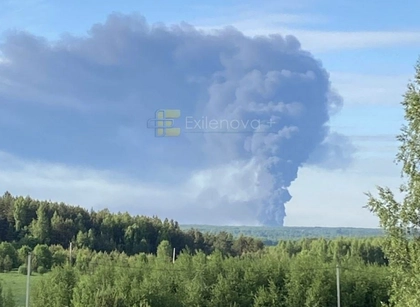
SBU Drones Strike Critical Russian Fuel Hub in Vladimir Region
The Security Service of Ukraine (SBU) executed a precise long-range drone operation against the Vtorovo linear production and dispatch station in Russia’s Vladimir region overnight into Sunday, May 24. Conducted by special operations units from the Center for Special Operations “Alpha,” the precision strike ignited a massive 800-square-meter fire at the facility.
The centerpiece of a subliminal nuclear threat
The statement from Brussels arrives as Ukrainian forensic teams and regional prosecutors sift through the debris field inside the Bila Tserkva district to analyze the wreckage of the hypersonic platform.
Fired from the Kapustin Yar military test range in Russia’s southwestern Astrakhan region, the Oreshnik reentered the atmosphere at hypersonic velocities, deploying multiple independently targetable reentry vehicles (MIRVs) to generate a dense sequence of kinetic ground strikes.
The early morning strike marks Russia’s third operational deployment of the strategic Rubezh platform since the full-scale invasion began, closely matching identical deep-penetration launches executed against Dnipro in November 2024 and the Lviv region in January 2026.
Military analysts note that because the system is structurally integrated into Russia’s strategic rocket forces as a nuclear delivery vector, its conventional employment inside Ukraine functions primarily as a high-stakes geopolitical signal intended to unnerve Western security partners.
Russia hit a dead-end on the battlefield, so it terrorizes Ukraine with deliberate strikes on city centres.
These are abhorrent acts of terror meant to kill as many civilians as possible.
Moscow reportedly using Oreshnik intermediate-range ballistic missiles – systems designed…
— Kaja Kallas (@kajakallas) May 24, 2026
A massive attack on Ukraine on May 24
The Oreshnik launch served as the technical anchor for an exceptionally high-volume saturation campaign that tested the limits of Ukraine’s integrated air defense umbrella. According to consolidated operational metrics released by the Air Force Command, radio-technical troops tracked a total of 690 concurrent aerial threats slicing through domestic flight paths, counting 90 diverse missiles and a fleet of 600 strike and radar-saturating decoy drones.
The complex strike package required the Kremlin to coordinate multiple remote launch vectors simultaneously. Alongside the Oreshnik, Russian tactical forces fired two MiG-31K-launched Kh-47M2 Kinzhal aeroballistic missiles, three 3M22 Zircon hypersonic anti-ship missiles from occupied Crimea, 30 ground-launched Iskander-M systems, and 54 air- and sea-launched cruise missiles.
While mobile fire groups, electronic warfare (EW) units, and anti-aircraft missile batteries successfully shot down or suppressed 604 individual targets nationwide, the unintercepted munitions caused heavy damage in urban areas.
Breakdown sectors inside the city of Kyiv saw residential high-rise blocks in the Shevchenkivskyi and Solomyanskyi districts suffer structural collapses and severe fires, leaving two civilians dead and dozens wounded. Parallel drone and artillery strikes further expanded the casualty log throughout the morning, wounding 11 residents at a high-rise in Cherkasy, 12 in Bohodukhiv, and seven in Nikopol – including a three-month-old infant.