
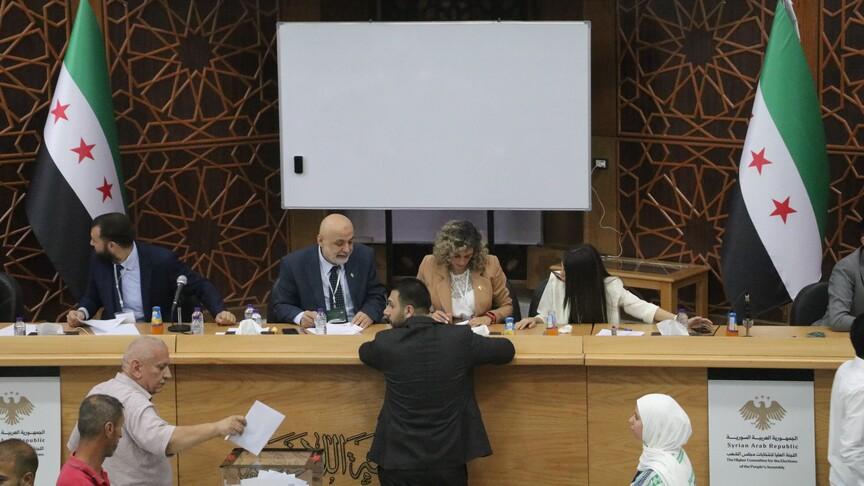
DAMASCUS, Syria (MNTV) — Syria completed a significant phase of its transitional parliamentary elections on Sunday after voting concluded in predominantly Kurdish regions in the country’s northeast, paving the way for the first session of the new legislature.
The ballot took place in parts of Hasakah province and the Kurdish-majority district of Ain Al-Arab, also known as Kobane, following an agreement reached earlier this year between Damascus and Kurdish authorities on integrating civilian and military institutions under the Syrian state.
The transitional parliament will consist of 210 members serving a renewable 30-month term. Syrian President Ahmad Al-Sharaa is expected to appoint 70 members, while the remaining seats are being filled through a voting process involving local committees.
State media reported that voters selected representatives for seven seats in Hasakah province, while two additional seats were filled uncontested after only two candidates registered.
Authorities also held elections for two parliamentary seats in Ain Al-Arab in Aleppo province.
The electoral process, which began last year, has faced criticism from several Kurdish political groups that described it as an appointment-based mechanism rather than a democratic election.
In a joint statement, Kurdish parties argued that Kurdish representation in the assembly remains inadequate, noting that only four seats out of 210 were allocated to Kurds despite their large population in northeastern Syria.
Syria’s electoral commission had previously announced 119 elected members of parliament, while voting in some Kurdish-controlled regions and the Druze-majority Sweida province had been postponed because of security concerns.
Following Sunday’s vote, Sweida remains the only province yet to complete the parliamentary selection process.
Nawar Najmeh, spokesperson for the Higher Committee for People’s Assembly Elections, said the completion of voting in Hasakah, Qamishli, Al-Malikiyah and Ain Al-Arab cleared the way for parliament to convene once presidential appointments are finalized.
Najmeh described the elections as an important moment in Syria’s political transition and said they reflected efforts to integrate different communities into a unified national framework.
He added that turnout exceeded 95 percent across all voting districts and characterized the atmosphere as positive during what officials called the country’s first major electoral process since the overthrow of the previous government.
Election authorities later released the names of the winners and granted candidates 48 hours to submit appeals.