
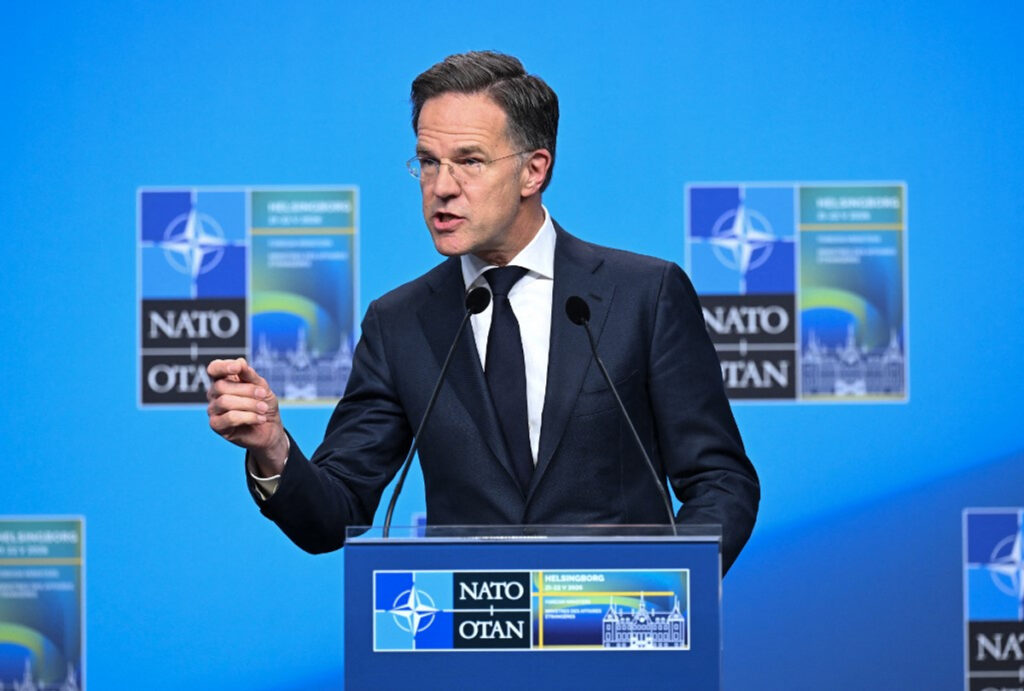
NATO Secretary General Mark Rutte said Friday that continued support for Ukraine remains central to the alliance’s own security, as foreign ministers discussed Kyiv’s battlefield requirements, Russia’s ongoing attacks on civilians, and preparations for the NATO summit in Ankara.
“Ukraine must have what it needs to defend itself today and deter future aggression tomorrow,” Rutte said after a meeting of NATO foreign ministers in Helsingborg, Sweden.
Follow our coverage of the war on the @Kyivpost_official.
Support for Ukraine “an important part” of NATO security
Rutte framed continued assistance to Kyiv as an essential part of NATO’s own security.
“An important part of ensuring our own security is continuing our support for Ukraine,” Rutte said.
Ukraine’s Foreign Minister Andrii Sybiha joined NATO foreign ministers on Thursday evening, as allies reviewed Russia’s ongoing war and Kyiv’s defense requirements.
“Russia continues to wage its horrific war and target civilians and civilian infrastructure,” Rutte said. “Ukraine continues to defend its sovereignty and independence with bravery and ingenuity.”
According to the NATO chief, the alliance is working to ensure that support for Ukraine remains “substantial,” “predictable” and “sustainable,” and is based on Ukraine’s critical requirements.
He pointed to the Prioritised Ukraine Requirements List, known as PURL, as a key mechanism for delivering urgent military support to Kyiv.
Other Topics of Interest
European Leaders Debate NATO Future and Weapons Reliance
At the GLOBSEC Forum in Prague, European politicians engaged in sharp debates over the future of NATO and the continent’s heavy reliance on US military hardware following Donald Trump’s return to power. The discussions were catalyzed by Washington’s uncoordinated reversals regarding US troop levels in Poland, prompting Czech President Petr Pavel to warn against a lack of allied consultation.
The mechanism provides “crucial equipment that makes a real difference on the front lines and helps protect Ukraine’s cities and civilians,” Rutte said, adding that allies continue to contribute through PURL and other channels.
Ukraine’s front line is stabilizing
Asked whether Ukraine’s growing defensive capability had weakened Russian President Vladimir Putin’s position, Rutte said Ukrainian forces were holding firm and that the front line was stabilizing.
“Clearly, Ukraine is putting up a strong defense,” Rutte said. “You look at the front line at the moment, it is stabilizing.”
He said there were reports that Ukraine was “in net terms” regaining territory, though not on a massive scale.
“At least it’s stabilizing and potentially even moving now in the right direction and not any longer in the wrong direction,” Rutte said.
Rutte praised Ukraine’s wartime innovation, saying the alliance was learning from Kyiv’s battlefield experience, particularly in drone warfare and anti-drone technologies.
“The Ukrainians have been incredibly ingenious in terms of their ability to innovate,” he said.
He also cited the Joint Analysis, Training and Education Centre, or JATEC, in Poland, as one way NATO is capturing lessons from Russia’s war against Ukraine and incorporating them into alliance planning.
“I would not be too happy if I was Putin today,” Rutte said, adding that events in recent weeks were “not going in the right direction” for Russia.
NATO allies urged to share Ukraine burden more evenly
Rutte was also asked whether allies had agreed to share the burden of supporting Ukraine more evenly.
He said he had received “a lot of encouraging comments” from foreign ministers, but added that NATO would now need to see whether those commitments are delivered.
“And I will do everything to make them deliver.”
He said the need for more balanced burden-sharing on Ukraine support was “absolutely understood in the room,” and described ministers’ comments as “very encouraging.”
Zelensky invited to Ankara Summit
Rutte also confirmed that President Volodymyr Zelensky had been invited to the NATO summit in Ankara.
Asked whether an invitation had been sent, Rutte said he had already invited the Ukrainian president.
“Yes, I did,” Rutte said. “He will be there.”
The Ankara summit is expected to focus heavily on defense spending, industrial production and NATO’s long-term ability to deter Russia, while maintaining support for Ukraine.
The NATO chief said allies were focused on turning commitments into concrete results, including increased defense spending, greater production of weapons and military equipment, and sustained assistance to Ukraine.