
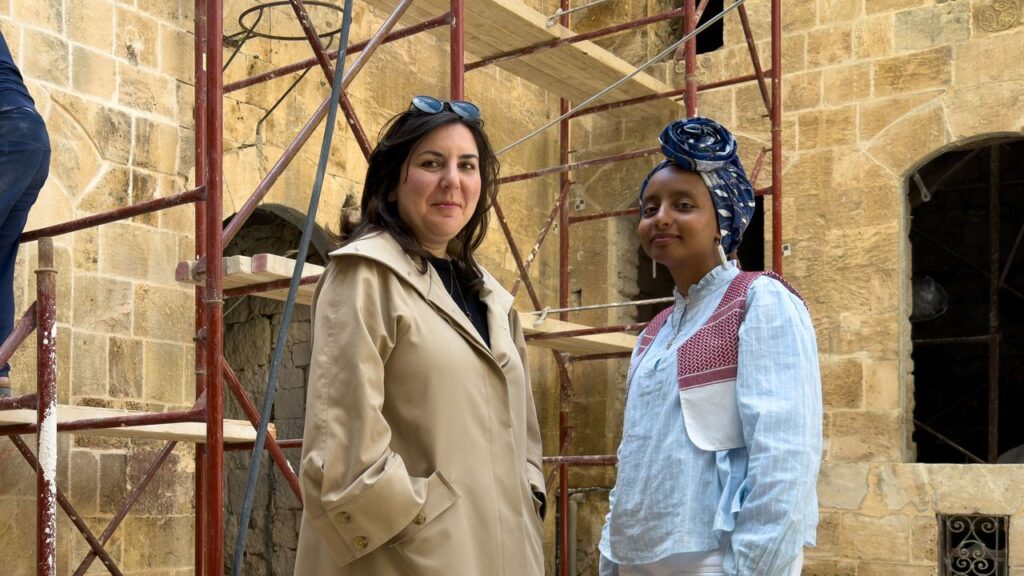
I walked out of a demolished section of the old souk, up a narrow alleyway and into a traditional Syrian courtyard house undergoing reconstruction. I was there to meet two women architects on the frontlines of the effort to rebuild Aleppo’s old city, ravaged by 15 years of war and neglect.
Dima Dayoub, who started working in Syria with the Aga Khan Development Network and is now the Aleppo lead of Turquoise Mountain – a charity founded by Kind Charles III – is already waiting for me.
Though she seems reserved at first, keeping her hands tucked away in the pockets of a beige raincoat, it becomes clear that her restraint is intentional, a careful search for precision rather than reticence. Perhaps it reflects the way she approaches architecture itself: tackling massive challenges layer by layer, with patience, and a view toward bringing life back to the old medina. “This is about what’s around the iconic sites. It’s about the urban fabric of the city,” she says of her work.
A woman in a field largely dominated by men, she reflects on how even the worst tragedies can lead to unexpected places. “If there is a silver lining to war, it’s that woman become more visible in the labor market and become more independent. Because they had to,” she tells me, an all-man construction crew working behind them.
We are soon joined by Rama Omar, another female architect, whom I also met through the Aga Khan Foundation, an organization that has been present in Syria for over 25 years. And as I gathered contacts and carried out research for a longer report on the rebuilding of old Aleppo, I kept encountering more and more women on the front lines of the daunting task of bringing an entire city back from the ashes.
To be clear, I was hardly a neutral observer: my family is originally from Aleppo. The souk, the medieval citadel, the Mamlouk-era hammam, the winding cobblestone alleyways of the old city are as dear to me as any physical place can be. Seeing them destroyed and damaged felt like a part of my own identity had been shattered, in the same way the stones had been by the fighting that cut through the city. Seventy percent of the old souk was either damaged or destroyed first during the war and later as a result of an earthquake in 2023.
Talking to Dayoub and Omar, who never stopped traveling to Syria even during the worst of the war, I was struck by how they balanced hope with realism. Syria is still economically demolished. There are also real challenges that go beyond the will to rebuild, like raising funds and training skilled workers. And getting traditionally male dominated industries to accept that women could lead projects on a construction site wasn’t always easy.
“At the beginning it was hard,” Omar tells me. A petite thirty-something with a colorful headscarf and who looks even younger than her years, she recounts times when rebuilding Aleppo meant working not only alongside building tools, but firearms.